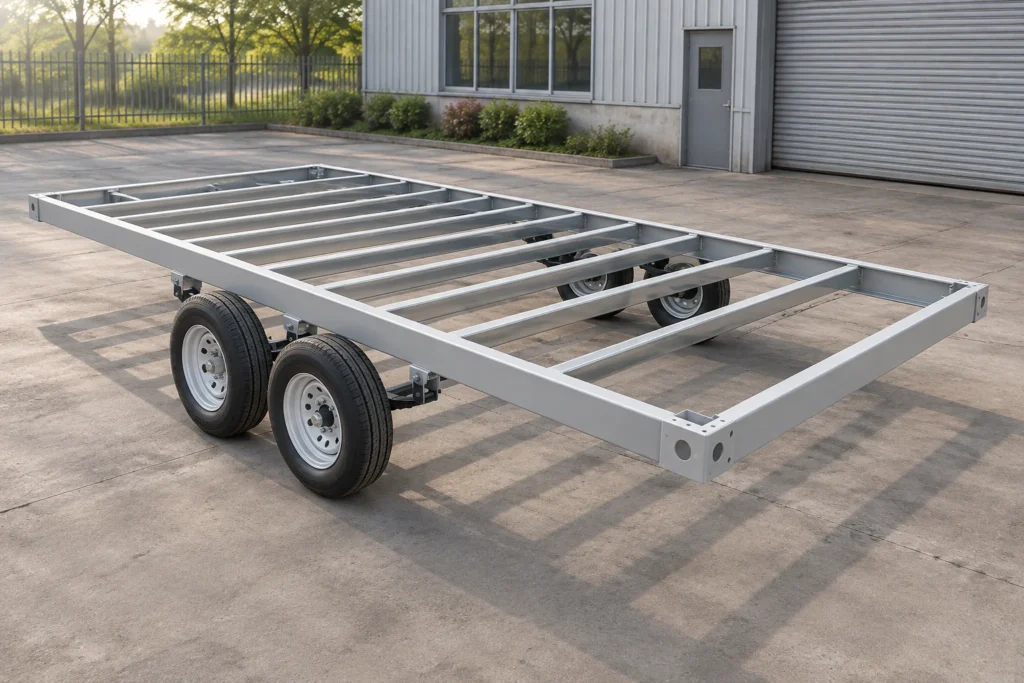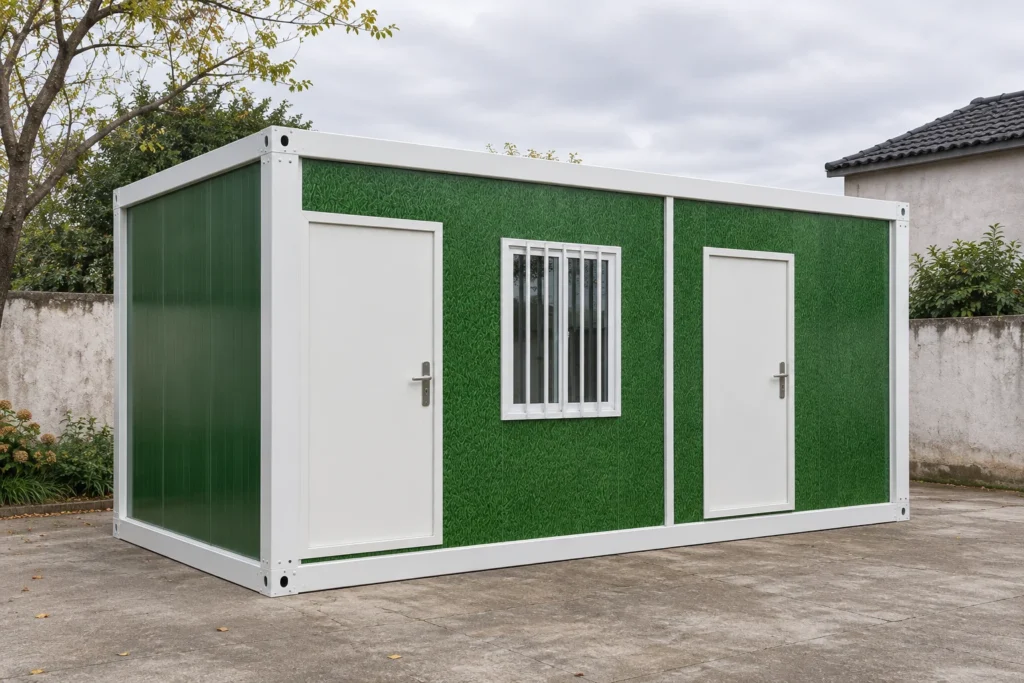
A tiny house sewer connection needs an agreed receiving point and a suitable route from the building's waste outlet to that point. Start at the receiving line, not with a length of hose: confirm that the site can accept the proposed wastewater, then establish whether gravity drainage is feasible or a designed pumping arrangement is needed.
For a container house on wheels parked for extended use, settle the site connection alongside the room package. A fitted toilet, shower and basin do not establish that the building is connected or ready for occupancy.
Find out what the receiving line actually is
Ask the property owner and local sewer authority or responsible installer to identify the sanitary connection, its location and the conditions for adding the accommodation. Do not assume an unidentified pipe, nearby access cover or existing house connection is available for another unit.
Portland, Oregon's ADU connection guidance illustrates why this matters: its connection decisions depend on fixtures, dwelling units, slope and existing conditions. Those are city-specific ADU rules, not permission to connect a wheeled cabin in another location. Keep rainwater arrangements separate from the sanitary-waste discussion.
Check the route and levels before choosing parts
Have the installer establish the building outlet elevation, receiving-line elevation and actual route. Distance alone does not decide whether gravity drainage will work. The route also has to accommodate the necessary fall, the site conditions and the applicable design requirements.
| Receiving arrangement | What the connection needs to resolve | Additional work to allow for |
|---|---|---|
| Sanitary sewer with a feasible gravity route | Outlet and receiving levels, route, materials and access | Site installation, required permissions and completion checks |
| Sanitary sewer without a feasible gravity route | A suitable wastewater lifting arrangement for the actual fixtures and discharge route | Equipment, power, controls and service access |
| Existing septic system | Whether the complete system can accept the proposed additional use | Local assessment of the system and any necessary changes |
Grundfos's lifting-station introduction explains the situation where wastewater cannot follow a natural downward slope. Its range also distinguishes equipment for toilet discharge from greywater-only applications. That distinction is useful; it does not select a pump for your site. Have the designer confirm the whole arrangement rather than choosing a unit from a maximum-distance claim.
Match the factory outlet to the site work
Put the agreed outlet position and connection details on the selected cabin drawings. Keep the actual fixture list and room layout together: a toilet, kitchen sink or washing machine added later changes what the drainage proposal must serve.
Use the modular utility planning guide to divide the factory work from local design, installation and final checks. Confirm what the quotation includes. A photograph of another manufacturer's drain fitting is not a specification for your unit.
Agree service access before enclosing the underside with wheeled-cabin skirting. Do not improvise cuts through a floor frame to reach a convenient pipe position.
Complete and check the connection before use
Have the responsible installer arrange the applicable inspections and demonstrate the completed drainage arrangement. Obtain the equipment instructions and identify who handles a blockage, pump alarm or connection fault. Keep required access points reachable when landscaping or finishing the parking area.
Ask for the site work to be priced separately where it is outside the building supply. Portland's private sewer installation guide identifies connection depth, existing services and physical obstacles among the reasons projects differ. A neighbor's bill or a building-only price is not a reliable connection quote.
คำถามที่พบบ่อย
Can I connect to the main house's sewer?
Possibly, but the existing connection needs to be assessed for the proposed use, condition, capacity and route. Get the local connection decision before treating a shared pipe as the plan.
Does every tiny house need a septic tank?
No. Sewer and septic are different receiving arrangements. EPA explains that a conventional septic system includes both a tank and a drainfield. A holding tank that needs emptying is not the same treatment system.
Do I still need water tanks?
The sewer connection answers where wastewater goes. Fresh-water supply is a separate decision; the water-hookups-or-tanks guide helps distinguish those functions.
Bring the site information into the enquiry
Send PQSE the destination, proposed fixture layout and the receiving connection information available from your site installer. Include any known route or elevation constraint. Ask for the building outlet and factory supply scope to be defined alongside the local connection work.