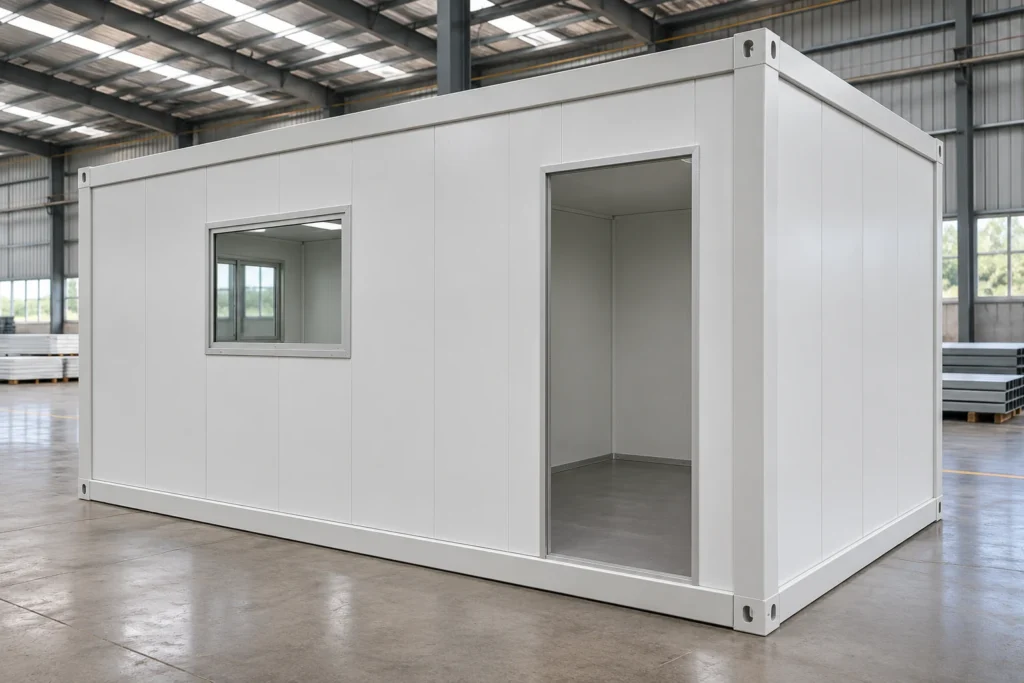
A tiny house water pump should match the water source, the flow needed at the fixtures and the available power. A large flow number on the box is not enough. Check what the pump can deliver at the required operating pressure, then coordinate the tank, heater, pipe routes and maintenance space as one system.
Für ein container house on wheels, make that decision while the room and fitted equipment are being specified. A bathroom in the drawing does not mean a tank, pump or independent power supply is included.
Do you need a pump for this water source?
A suitable pressurized site supply may serve the cabin directly. Water stored in a tank normally needs a delivery arrangement to reach the taps with usable pressure. A pump intended to transfer water into storage is not automatically the right unit to supply a shower on demand.
First settle the choice between a water hookup and stored fresh water. Then describe where the source sits relative to the cabin, the route to the fixtures and which outlets may run together. Those details change the pump duty; “one tiny house” does not define it.
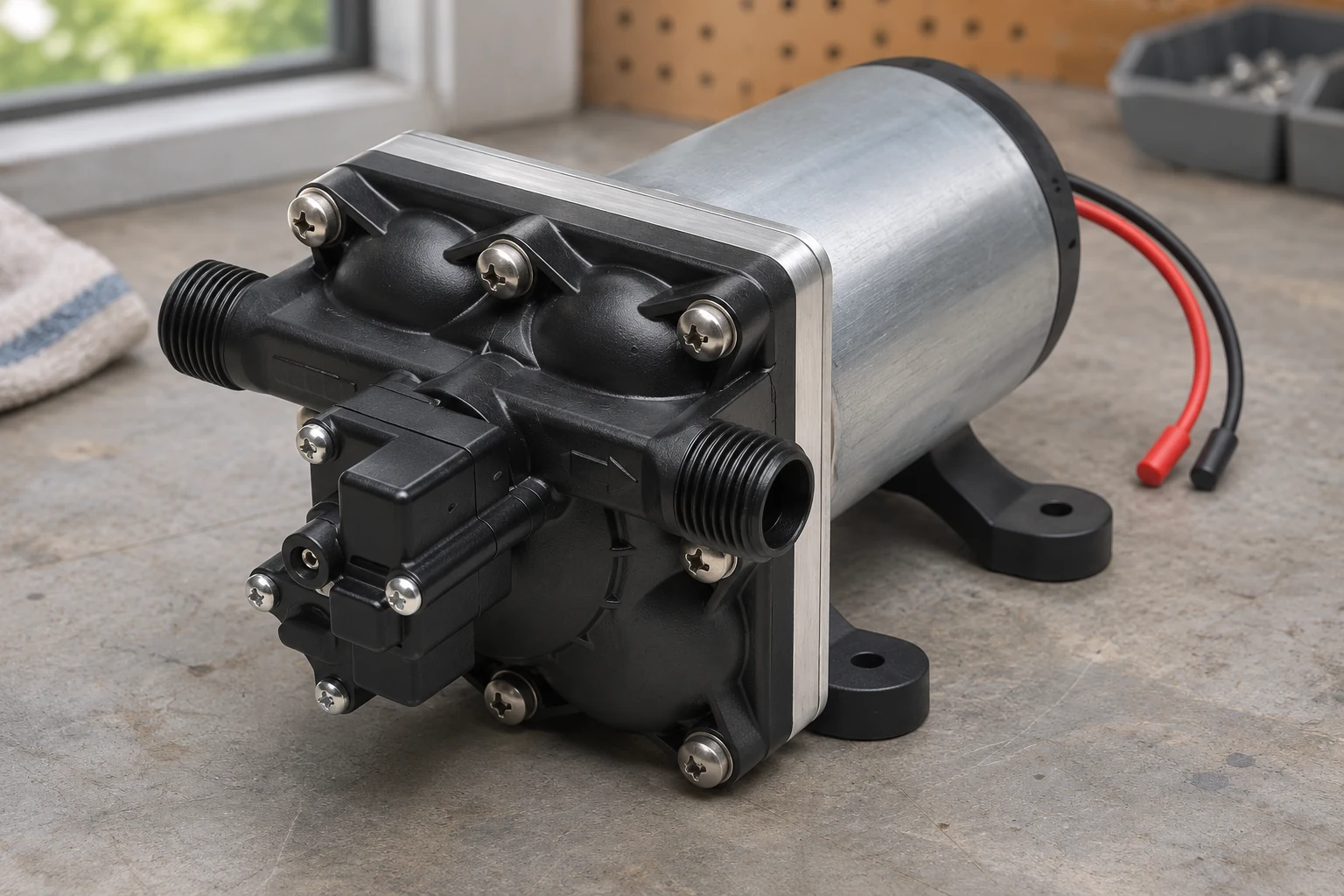
An automatic demand pump starts in response to water use. Pentair identifies that feature on its Shurflo Revolution 4008 series. This is an example of a pump category, not a statement that PQSE supplies that brand or model.
Compare flow at pressure, not two separate maximums
Pump flow changes with pressure. The highest advertised flow and the shut-off pressure should not be read as an output the pump delivers simultaneously at the shower.
For example, Pentair’s 4008-131-A65 technical sheet lists typical performance at 24 V: 3.2 GPM at zero pressure, compared with 1.50 GPM at 40 PSI. These are points for that named RV pump, not a recommended operating target for every tiny house.
The useful comparison is the flow available under the proposed conditions. Ask the system designer to account for the source, elevation, route, restrictions and simultaneous demand. Include the selected heater’s inlet and operating requirements. A pump and heater can each work individually yet be poorly matched in the same small system.
Make space for power, access and low-flow operation
Choose the electrical arrangement alongside the pump. A DC model needs its specified DC supply; plugging into shore power does not by itself provide that. The electrical installer must coordinate the selected pump, controls and protection with the cabin supply. Use the modular-building utility guide to separate factory equipment from the final site work.
Keep the pump accessible after the furniture and bathroom are fitted. Pentair’s 4008 installation manual calls for accessible mounting and strainer maintenance, and explains how connections and mounting can transmit vibration. That makes a sealed void behind a finished lining a poor starting point for equipment that needs servicing. Follow the instructions for the actual selected model.
| System condition | Was zu vergleichen ist | Effect on the room package |
|---|---|---|
| Stored water away from the cabin | Pump duty for the source position and complete route | Resolve the pump location and service route before fixing cabinets |
| Limited battery or electrical capacity | Voltage, operating load and control requirements | Coordinate the power package rather than treating the pump as a loose accessory |
| Shower and another outlet used together | Delivered flow and heater compatibility under that demand | Specify the intended use, not just a maximum pump rating |
| Frequent small draws or pulsing | Selected pump’s low-flow control and accessory instructions | Allow room for the equipment actually required; an accumulator is not universal |
| Seasonal absence or freezing weather | Model-specific protection and shutdown requirements | Preserve access to the components that need attention |
Das container home plumbing guide explains the separate supply, drainage and venting functions. Changing the freshwater pump does not solve the wastewater outlet. If water storage travels with the unit, include its stated condition in the loaded-weight review.
Häufig gestellte Fragen
Does every tiny house pump need an accumulator?
No. Some systems use one to manage pressure fluctuations, while particular bypass pumps are designed to operate without one. The 4008 manual explicitly says an accumulator is not needed for its bypass design. Decide from the selected pump and system requirements, not a universal accessory list.
Will a higher-pressure pump fix a weak shower?
Not necessarily. A restricted inlet, unsuitable plumbing, inadequate supply or a heater mismatch can affect delivery. Have the actual system checked before replacing the pump or altering pressure settings. The manufacturer reserves bypass adjustment for a properly equipped professional technician.
Can I switch between a hookup and an onboard tank?
Only if the proposed plumbing is designed for those operating modes. Ask how the supply is selected and protected, which pump and controls are included, and what the operator must do. Adding a tank alone does not establish a dual-mode system.
Send a water-service brief with the cabin enquiry
Tell PQSE the destination, cabin quantity, fixture layout, available water source and power arrangement. Identify whether the tank and pump should be part of the supply discussion or provided locally. Add likely simultaneous use and seasonal shutdowns so the equipment space and building interfaces can be reviewed together.