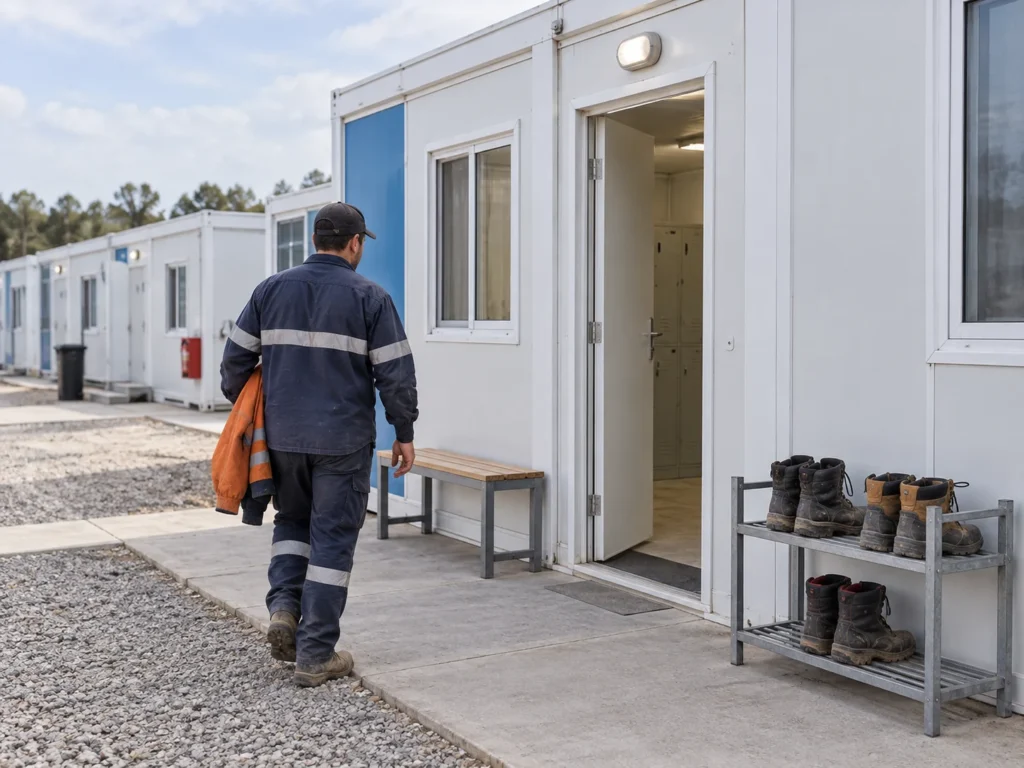
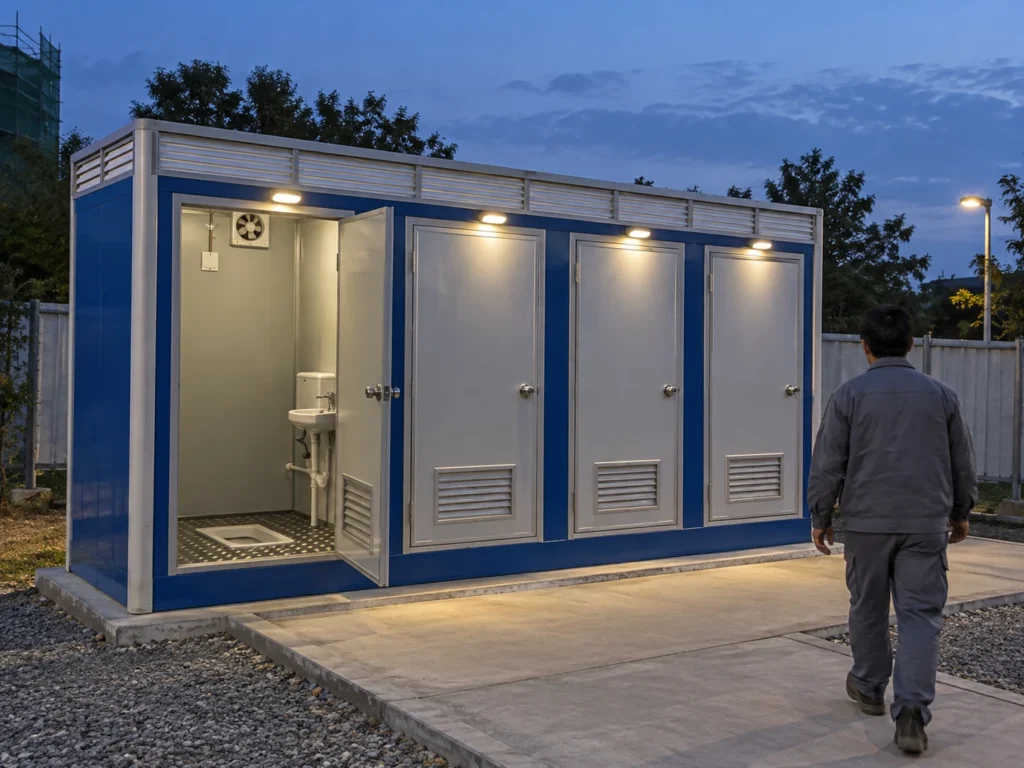
Plan emergency housing waste collection as a service residents can actually use: a known place to deposit ordinary household refuse, a workable approach, suitable containment and an agreed arrangement for removing the material. Supply of containers answers only one part of that requirement. Before households arrive, connect each occupied cluster to its intended point and identify who keeps that point functioning as the site changes.
For a buyer specifying homes and shared facilities for emergency housing, the useful question is what a household does with today's discarded packaging or food-related refuse. The answer should remain clear after the delivery crew leaves. This guide develops that residential operating brief, using scoped humanitarian and government references. It concerns ordinary household solid refuse, rather than liquid tank contents, clinical waste, hazardous material or disaster-debris treatment. Local authorities and the appointed service parties must resolve the actual waste route and requirements.
Map occupied homes to the point residents will use
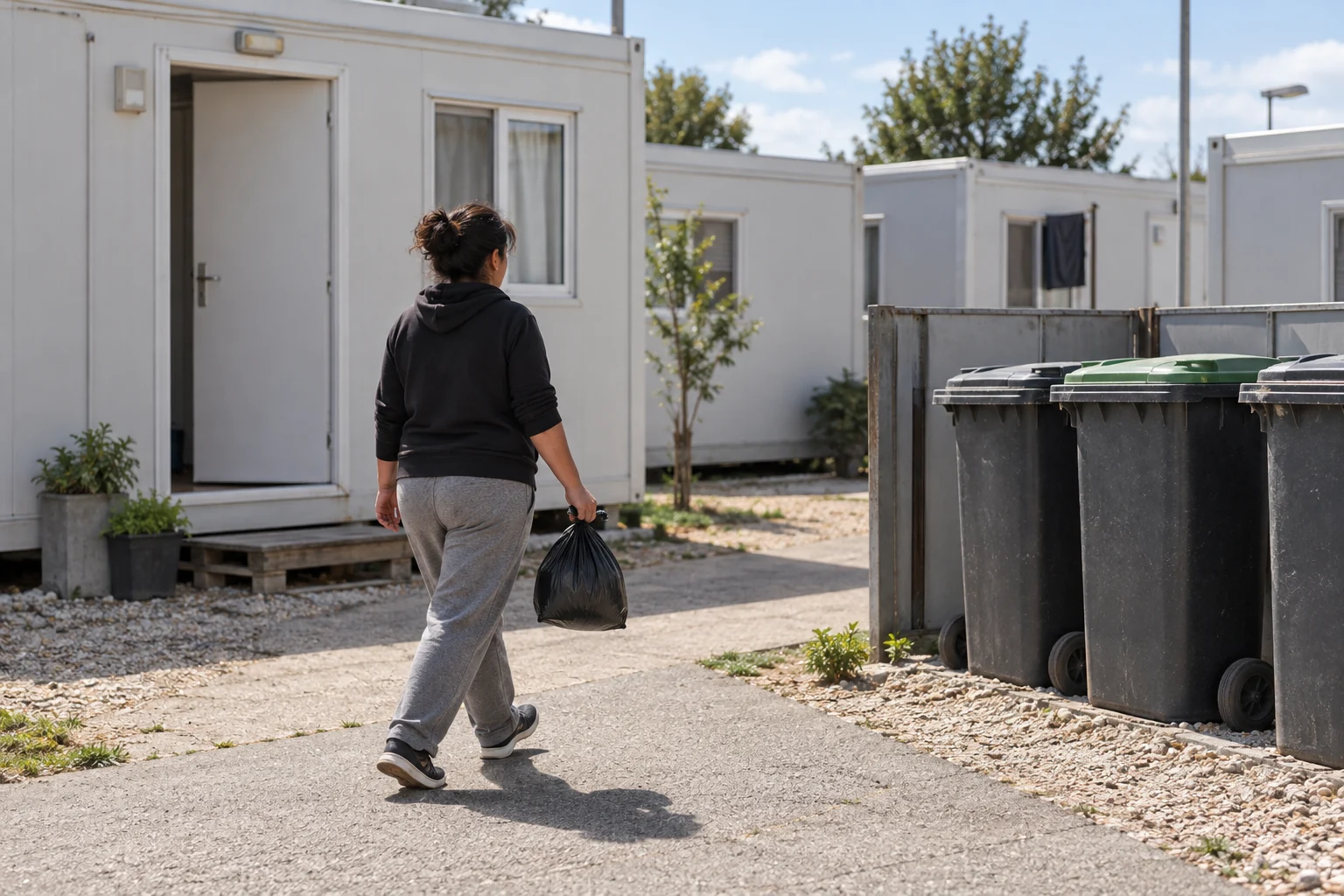
Identify the households using a point now, rather than assigning containers to every rectangle in the eventual site plan. A first occupied cluster may sit beside units still being installed. Its residents need a present arrangement, with an identifiable destination and someone responsible for it. Mark that relationship on the current plan and explain whether another cluster shares the same point, instead of relying on people to choose whichever bin appears closest.
Ask the housing operator how that allocation reaches residents. It may be part of arrival information, a conversation or another method suited to the people involved. A location code useful to staff is not necessarily a recognizable destination for a household. Keep the resident description and the operator's point identifier connected, so a report about an unavailable place can be directed correctly.
Relate this to the broader household mix and site-readiness brief. The new decision here is the refuse point serving that mix, not a repeat of the accommodation allocation exercise. Confirm whether households depend on a shared point or another agreed arrangement. Do not assume a building's private kitchen determines who collects its refuse.
Distinguish the proposed arrangement from what exists. If the first phase relies on a point that will eventually move, name the present location and the decision that changes it. A future waste area drawn beyond unfinished ground does not explain where people should go today. The operator should retain an open item until the actual destination, access and removal responsibility are agreed.
Read container figures with the stage attached

A published container ratio can help frame a question without settling the installed service. Keep its original household basis, container unit and response stage together. The same quoted volume can mean very different provision if the household count is dropped. Ask the operator which occupied households the proposed point serves and what current information supports the arrangement, before turning a reference figure into a purchase quantity.
Provision is different from accumulation between visits
Le Sphere Handbook's 2018 guidance on printed page 128 distinguishes initial from longer-term community provision. These planning references do not establish PQSE specifications, daily household allowances or collection intervals.
A container's nominal volume does not explain how much space remains before the next removal. That depends on the actual discarded material, collection arrangement and other conditions the operator must establish. Do not divide a published ratio into an invented number of safe storage days. The available sources do not provide measured waste generation for the residents of this proposed PQSE housing site.
Use the reference in a documented discussion, then retain the answer that applies to this location. Ask what household count was used, which containers are actually proposed and how the initial arrangement will be reviewed. If the site is intended to continue through a different phase, the operator needs a decision about that transition rather than a claim that the opening-day purchase remains sufficient indefinitely.
| Source stage | Published provision | Basis | What it does not determine |
|---|---|---|---|
| Initial | One 100-litre container | 40 households | Pickup interval or daily household allowance |
| Longer term | One container, following the 100-litre reference | 10 households | A defined transition date or verified local capacity |
Check the deposit action at the installed point

Consider a hypothetical resident arriving with a closed bag. Finding the point is only the first step: the person still needs to approach the intended container and use its opening. Ask the operator to review that complete ordinary action with appropriate resident input. The exercise can reveal a practical question about position or equipment, but it is not a validated accessibility test and should not require anyone to attempt an uncertain movement.
Discuss the actual selected container rather than an attractive generic symbol. An opening mechanism, placement or surrounding enclosure may change how the point is used. Request the relevant equipment information and the responsible team's review. Do not infer usable reach, opening force or clearance from an illustration, and do not ask the building supplier to certify external equipment it has not specified.
Connect this question to the resident journey between homes and shared facilities. That guide addresses the wider route and its scoped design review. Here, identify the final deposit action and what happens when that point is unavailable. A resolved path does not automatically resolve the chosen container; a convenient container does not approve the path.
Invite specific feedback without turning residents into inspectors. Someone may report that they cannot identify the intended opening, that another object occupies the approach or that assistance is needed. Record the actual account and refer the relevant question to its owner. Avoid converting one person's successful use into a promise that the same arrangement suits every household.
Keep collection space outside ordinary resident movement

A resident deposit point and a vehicle collection position may be connected without occupying the same space. Ask the collection provider and site team to explain their proposed relationship. Show where residents approach, where the relevant activity occurs and what changes during a visit. The building plan should not quietly make a household walk through a vehicle working area simply because the containers were placed beside the easiest road access.
In its Great Britain context, HSE's waste-transport guidance addresses route assessment, sensitive high-footfall periods and separation between pedestrians and moving transport. These principles sharpen the planning discussion; they supply no universal turning radius or safe collection time for this site.
Give the appointed parties current information about the places used by residents and the actual collection equipment. A collection arrangement assessed on an empty site may encounter different movements after households arrive. The responsible planners must resolve the method and controls. This article does not prescribe vehicle manoeuvres or ask residents and unassigned employees to direct a reversing vehicle.
Compare the proposed point with later deliveries and occupied-phase staging. A space reserved for incoming building components should not also be treated as an unrestricted waste collection area. Name who reviews the conflict if the delivery programme changes. Keep the current decision available to both teams, rather than leaving a driver or resident to infer it from a plan prepared before occupation.
Observe what changes between removals

The opening-day arrangement needs an operating basis that can be reviewed. Ask what the operator will record about the point before and after the agreed collection, using observations that its staff can make within their assigned role. The purpose is to identify a recurring service question, not to invent a waste experiment. Untrained residents or staff should not open, sort or weigh collected material merely to produce a useful-looking number.
A report can distinguish a point that could not be reached, a container that could not be used and material left outside the intended arrangement. Those observations may require different decisions. Retain the time, point identifier and relevant circumstances without assuming the cause. The collection provider and operator can then review whether the issue concerns availability, communication, equipment or the actual removal arrangement.
Use the table to organize that first account. It contains original qualitative prompts, not a survey of residents or a complete health inspection. Ask the responsible people what further evidence is needed and how it can be obtained appropriately. Do not label a point adequate solely because no complaint arrived; some residents may use an unsuitable alternative instead of reporting the difficulty.
Keep the observation distinct from the response. Adding another container may change provision while leaving an approach or collection problem unresolved. A revised appointment may improve removal without making an opening easier to use. State what decision was made and which part of the original concern still needs confirmation, so the next review tests the affected function rather than a general appearance of tidiness.
| Reported situation | Useful first record | Question to assign | Avoid assuming |
|---|---|---|---|
| The usual point is unavailable | Location and when the resident tried to use it | What confirmed alternative serves these households? | Every nearby bin accepts the same material |
| A container cannot be used | Selected container and reported ordinary action | Who reviews equipment and its placement? | The resident needs a different technique |
| Material is outside the arrangement | Point, time and visible condition without handling | Who controls the immediate response and cause review? | Nominal volume alone explains the problem |
| The point changes after a visit | Before/after observations and the agreed service scope | Which function remains unresolved? | A vehicle visit completed every responsibility |
Give distribution packaging its own question

A household's usual discarded material can change when supplies are distributed or another housing phase opens. In an illustrative situation, several households receive bulky packaging at once. That is different from assuming an unchanged daily pattern. Tell the operator and collection provider what activity is actually planned, and ask where the resulting material belongs. Do not direct residents to leave it beside a container without a confirmed arrangement for that material and location.
Sphere's 2018 discussion on printed page 127 identifies distributions and unsuitable household items as possible additional waste burdens. It does not quantify PQSE packaging or the receiving point's capacity.
Keep reusable belongings distinct from discarded packaging. A resident may choose to retain a box or bag, and the operator should not infer that every item outside a cupboard is waste. State the intended refuse arrangement clearly while respecting ownership. An invitation to dispose of packaging should explain the designated location and any accepted separation, instead of requiring people to guess from colours or an unfamiliar symbol.
Ask who coordinates the activity with the waste service. The distribution team may know when packages arrive while a different team controls point access and removal. Give them the same current information. If additional equipment or a separate service is needed, establish who arranges it before describing it as available. No waste-reduction percentage, recycling outcome or avoided cost is claimed here.
Confirm a receiving arrangement beyond the point

Moving material away from the residential point does not explain where it is accepted next. Ask the responsible waste-service parties to confirm the actual onward arrangement and its permitted material, rather than naming an apparently convenient piece of land. The buyer needs an identified answer for this site's ordinary refuse. That enquiry is different from designing a disposal facility or asking housing staff to improvise treatment when an expected service is unavailable.
Australia's enHealth disaster-management guide, copyright 2020, discusses service disruption, transfer-site restrictions and actual contract performance on printed pages 33–37. It is general Australian advice, explicitly not legally enforceable. Its site considerations do not authorize a housing programme to open a transfer station or disposal area.
For procurement, obtain the waste operator's answer about the service it will actually provide here. Confirm any limitation that changes what residents may place at the point, and who communicates that limitation. A general service available in the surrounding municipality may have conditions for this temporary residential arrangement. Do not assume eligibility, accepted materials or extra visits without confirmation from the relevant provider.
Keep an uncertain waste stream out of this guide's ordinary-refuse assumptions. Clinical material, sharps, hazardous substances and liquid tank contents require their own responsible assessment and service. Staff should have a reporting route for unexpected material instead of attempting to classify or move it from a photograph. The everyday point plan can state that boundary without pretending to supply a complete hazardous-waste procedure.
Make the current arrangement understandable after arrival
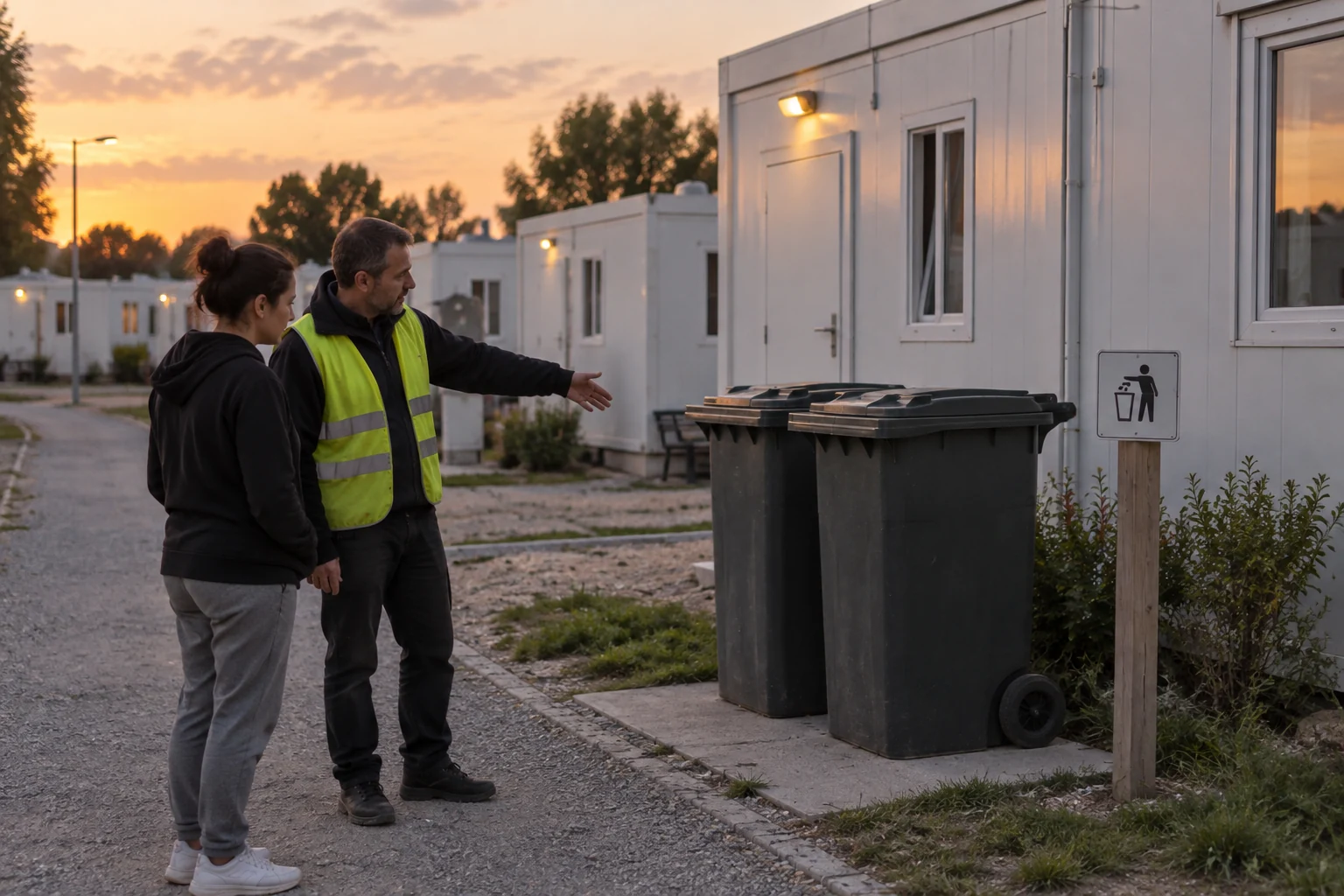
Residents need information about the current point, not only instructions written for the opening event. Explain where it is, what ordinary material it receives and whom to contact when it is unavailable. The operator should choose a method suited to the households and circumstances. A sign may support that explanation, but its presence does not show that a person can understand the message, find the destination or obtain help after the usual office closes.
Discuss language and communication needs with the housing team without collecting unnecessary personal information for supplier documents. A simple location description may need a conversation or other support. The article's examples are hypothetical; no resident consultation or literacy assessment has been conducted for this guide. Ask the actual operator how it learns whether the intended information reached households.
Incorporate the point into the resident-support information at move-in. Keep the specific refuse instructions concise and available when a household arrives later. The broader handover file can retain the service contacts and unresolved responsibilities. Avoid handing residents the internal contract when they need a usable destination and a reporting channel.
When the arrangement changes, communicate the new location and its actual availability together. An old direction can remain persuasive after containers have moved. Name who removes or updates superseded information and tells the affected households. A temporary alternative should be confirmed by the responsible parties before it appears in a notice; a printed arrow cannot make an unreviewed place suitable.
Review the point when the occupied phase changes
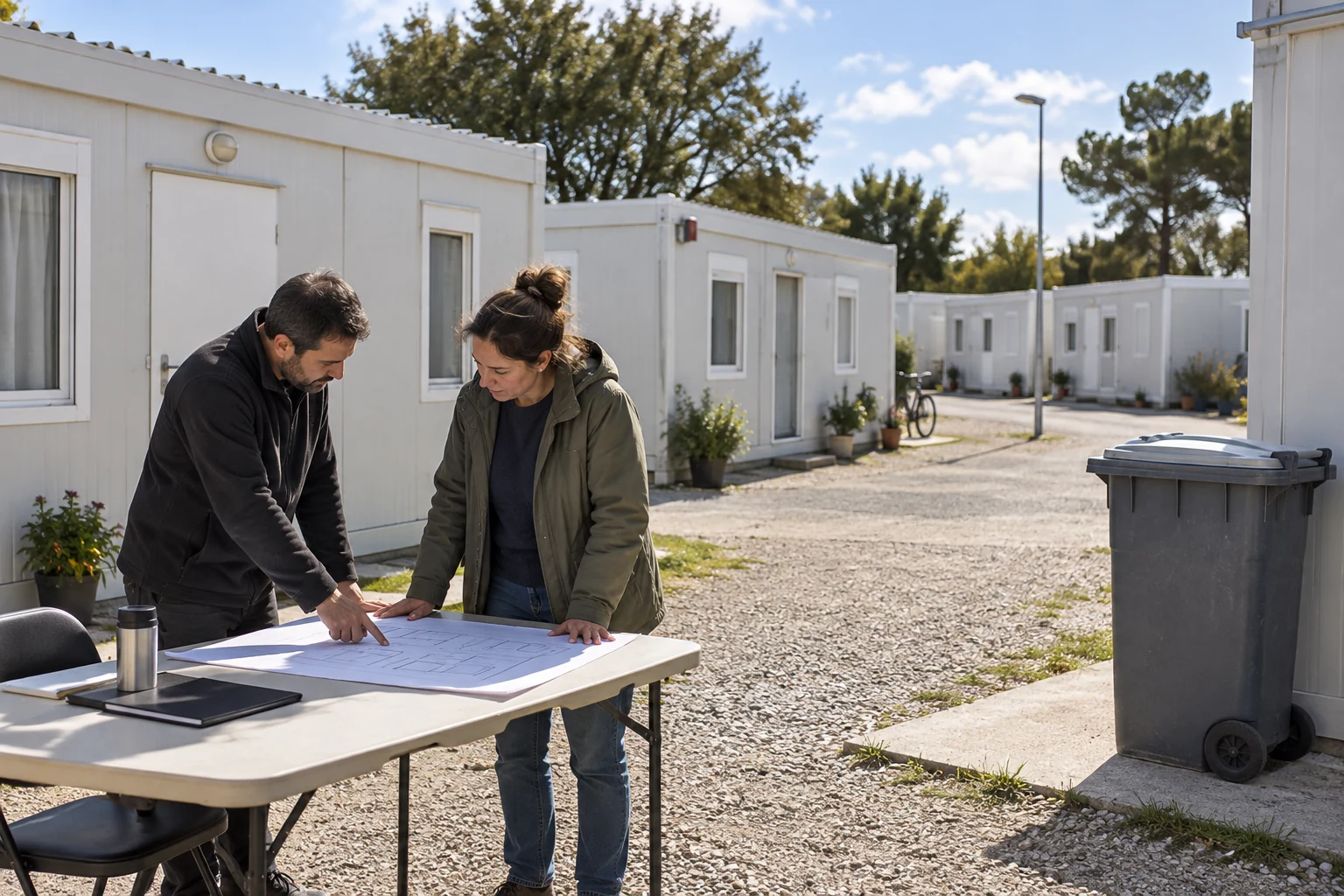
New homes can change which households use a point, the surrounding movement and the coordination needed for removal. Review those changes as part of the actual occupancy decision. Do not transfer the first cluster's arrangement to later units solely because the buildings look alike. The table gives an original way to identify the function affected by a change, without assigning an invented household growth rate or predicting when a container will overflow.
Keep the relevant household allocation and point plan current. If a group is reassigned, the service relationship can change even when no new building arrives. Ask whether the selected destination remains the agreed one and whether the operator's information has changed with it. Retain the answer with the operating plan, so a staff replacement does not have to reconstruct it from memory.
Distinguish the building order from the residential service. Where a detachable house building package is proposed, its agreed supply and assembly scope does not establish a municipal waste contract, bins or an external collection area. Put those tasks with their actual parties rather than inferring an inclusion from a furnished-building picture.
A review should produce a specific next decision. The point may remain unchanged under an agreed arrangement, require new information for residents or need further consideration by the appropriate service and design parties. Record which result applies. An additional purchased container is not a complete closeout if responsibility for its position, ordinary use or removal remains unassigned.
| Actual change to identify | Function to reconsider | Party to name | Answer to retain |
|---|---|---|---|
| Another residential cluster becomes occupied | Which households share each designated point | Housing allocation and waste-service coordinators | Current household-to-point arrangement |
| A distribution activity is planned | Accepted discarded material and any separate provision | Distribution team and waste-service operator | Confirmed location and service scope |
| Nearby receiving or installation work changes | Resident approach and collection activity | Site coordinator and competent collection planners | Current reviewed arrangement and affected information |
| A point moves or becomes unavailable | Confirmed alternative and resident understanding | Operator and responsible service parties | New location, availability and communication owner |
Send a service brief that names the unanswered decisions

Give the housing and waste-service parties a brief that identifies occupied clusters, intended points and the tasks each party has actually offered. Include the current plan and planned phase changes, while marking missing information plainly. Explain whether the request concerns building supply, point equipment or continuing collection. These are different scopes, and one quotation should not be treated as an answer to all three merely because it mentions site services.
Include the provision for staff hygiene where it belongs in the operator's agreed arrangements. If portable bathroom handwashing facilities are selected, confirm their own usable access and site connections separately. A waste-point photograph cannot prove that a basin works, and a bathroom order should not silently become a promise to supply waste equipment or collection.
Ask for the actual operating owner and the route for an unresolved service question. Retain declared exclusions beside the offered scope instead of filling them with assumed costs, visit frequencies or response times. Where a provider cannot yet confirm the receiving arrangement or a point's use, state the missing decision and its owner. The buyer can then compare answers to the same residential brief.
Before households rely on the arrangement, connect the selected point, resident information and confirmed service responsibilities. The cited guidance helps interpret questions and provision; it does not certify the proposed site. Keep the remaining design, public-health and local acceptance decisions with the appointed parties, and review an actual change rather than claiming that supplying containers completed the entire service.
Questions des acheteurs
Does Sphere's container figure determine the collection interval?
No. The 2018 guidance describes initial and longer-term communal provision on a household basis. It does not set a pickup schedule or predict storage time for the site's actual refuse. Retain the stage and unit, then obtain the operator's current provision and removal arrangement.
Can a planned future waste area serve the first occupied homes?
Only a confirmed present arrangement answers their daily need. Identify the point available to those households now, its usable approach and the party responsible for continuing removal. If the location will change later, record the current destination and who updates the arrangement and resident information. Do not use an unfinished future area as the opening-day answer.
Should every discarded item go to the ordinary household point?
No automatic assumption should be made. Confirm the materials the actual service accepts and a reporting route for unexpected items. Clinical material, sharps, hazardous substances, liquid tank contents and construction debris sit outside this guide's ordinary-refuse scope. The responsible local and specialist service parties must assess their arrangements; residents should not be asked to classify them themselves.
What evidence shows that supplying another container solved a concern?
Identify the original concern and the decision addressing it. More nominal volume does not by itself resolve an unavailable point, an awkward opening or an unconfirmed removal arrangement. Retain the affected location, response and remaining question. Review the relevant ordinary function through the operator's appropriate process without inventing a technical test or claiming a measured outcome that was never recorded.
Sources et étendue
- Sphere Association — The Sphere Handbook, fourth edition (2018). Printed pages 127–128: distribution waste and stage-specific community-container guidance. Planning references, not PQSE measurements or pickup intervals.
- HSE — Transport safety in waste and recycling (updated 12 January 2026). Great Britain transport and pedestrian planning context; no universal geometry or approved site collection method.
- Australian Government / enHealth — Disaster and Emergency Management for Environmental Health Practitioners (2020). Printed pages 33–37: disrupted services, receiving-site constraints and contract monitoring. Australian general advice, not legal authorization.
PQSE House publishes this research-based purchasing guide using the cited primary material and AI-assisted drafting and editorial checks. The tables are original planning aids; examples and newly created photographic scenes are illustrative. No PQSE emergency waste project, resident trial, measured container performance, human specialist approval or independent brand endorsement is reported. Actual site design, waste acceptance and operating responsibilities need confirmation by the appointed parties. Bin geometry references Bin.JPG by Joolz, licensed CC BY-SA 2.0; the new scenes change the setting and add people.