Choose the supply around the available site service and the actual equipment, not the number of office modules. A single-phase proposal may suit the agreed loads; a three-phase proposal may be needed for selected equipment or the planned distribution. In either case, the available capacity and the equipment’s voltage, frequency and phase requirements must match the approved design.
Three-phase incoming power does not mean every light, socket or air conditioner is a three-phase load. That distinction is worth settling before the building’s electrical package is manufactured.
Separate the site service from the equipment
There are two questions: what supply reaches the building, and what supply each appliance needs. A three-phase incoming service can, with the appropriate distribution arrangement, serve single-phase loads. It does not convert those appliances into three-phase equipment.
Pour un container office building configuration, list the selected air conditioning, heating, water heating, kitchen appliances and other substantial loads alongside ordinary lighting and desk power. A socket count alone does not describe what will be connected or when it will operate.
The same distinction applies to a group of construction site offices. Several rooms can create a different demand pattern from one room, but room quantity by itself does not establish the required supply.
Match the electrical version of the equipment
Air conditioners illustrate the issue. Daikin Australia’s phase explanation states that its three-phase air conditioners require a three-phase supply, while also stressing selection around the space’s needs. “Air conditioning included” is therefore less useful than an identified model and its electrical requirements.
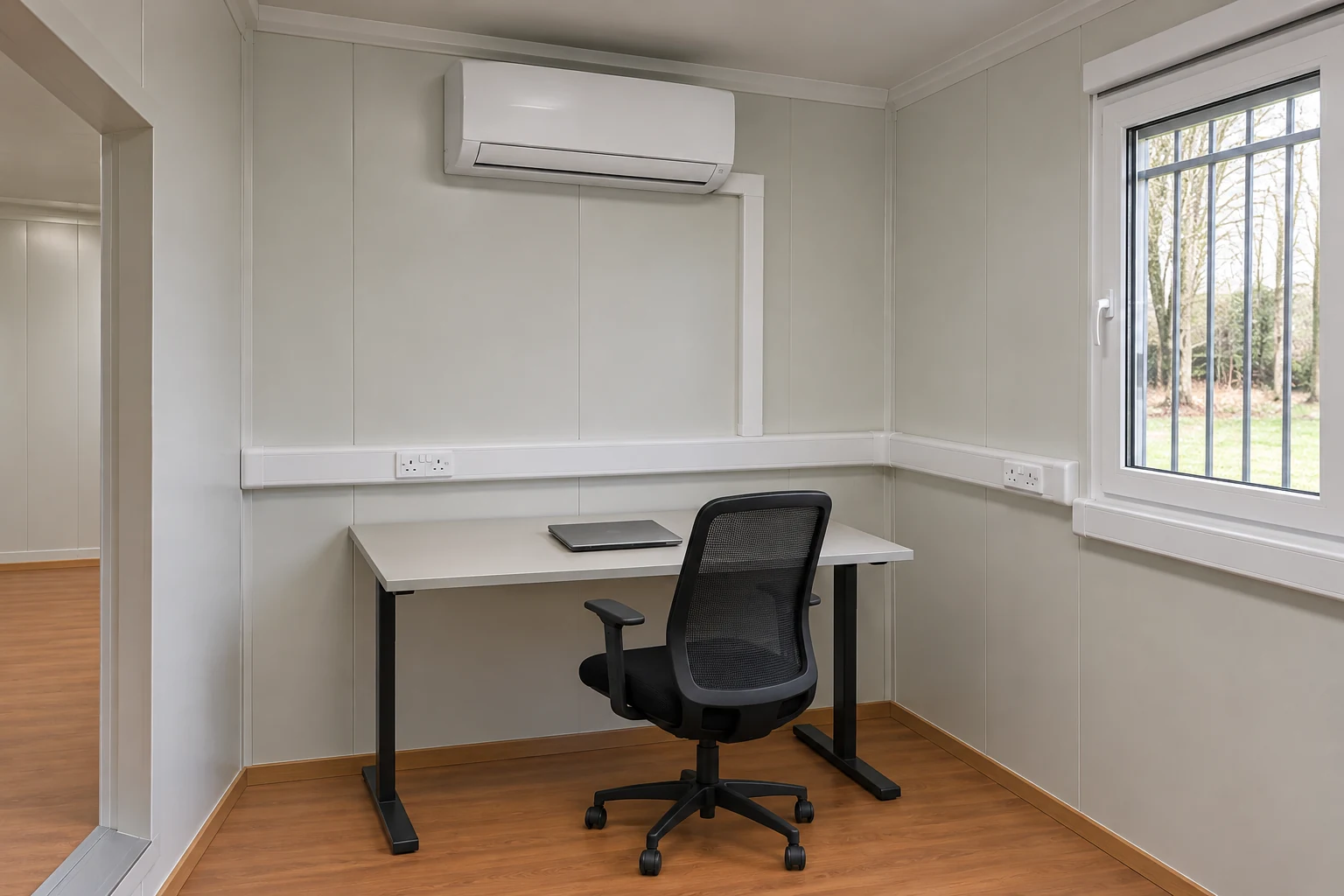
A wall-mounted indoor unit does not establish the electrical requirements of its complete system. For a split system, obtain the relevant outdoor-unit or system data as well. Compare the proposed equipment version before changing the building supply simply to accommodate an unspecified appliance. Our ductless versus ducted office air-conditioning guide addresses the room-distribution choice; phase compatibility is a separate question.
Compare these points in the proposal
| Question | Single-phase proposal | Three-phase proposal |
|---|---|---|
| Qu'est-ce qui est livré sur le site ? | Establish the actual available service and capacity | Establish phase availability as well as allocated capacity |
| Which equipment is selected? | Check that the offered electrical versions match | Identify three-phase equipment and any single-phase loads separately |
| How is demand assessed? | Review the actual connected loads and operating pattern | Review total demand and the distribution of loads across phases |
| What changes at the connection? | Identify building-side and site-side work | Identify any network change and its separate scope before assuming availability |
| What affects the bill? | Actual use, equipment and the applicable tariff | The same comparison is needed; phase count alone establishes no saving |
Le guide de planification des réseaux techniques des bâtiments modulaires helps coordinate the overall interfaces. For this decision, ask for the electrical proposal behind the supply label, rather than treating “single-phase” or “three-phase” as a complete specification.
Single-phase loads still need allocation
Where single-phase loads are distributed across a three-phase system, their allocation matters. Hammond Power Solutions’ transformer guidance explains the need to consider loading across the phases. A total building-load figure is not a substitute for that distribution review.
For example, a proposal with several single-phase air conditioners still needs an appropriate allocation. Buying a three-phase incoming board does not, on its own, establish that the connected loads have been balanced. Leave the actual circuit arrangement and protective design to the responsible electrical designer; this is a procurement question, not a wiring procedure.
Check availability before freezing the order
The local network may not offer the requested connection at the site without further work. Western Power’s phase-conversion service is one regional example that explicitly makes availability a condition. Its process and charges are specific to that network, not a worldwide installation allowance.
Separate the building package from the network connection, local installation and commissioning. The kit supply-scope checklist is useful when one quotation includes more electrical equipment or site work than another.
FAQ en bref
Does three-phase automatically reduce the electricity bill?
No saving can be inferred from phase count alone. Compare the selected equipment’s energy use, operating hours and the actual tariff, including any applicable fixed or demand charges. A connection upgrade and a running-cost comparison are different items.
Can a transformer turn single-phase supply into three-phase?
A transformer alone does not create the additional phase angles. Schneider Electric’s transformer FAQ makes that distinction. Do not assume a voltage transformer resolves a phase mismatch; any alternative arrangement needs assessment for the actual equipment and site.
Prepare an equipment-based enquiry
Send the destination, site service information, room layout and equipment schedule. Include the selected models or their electrical data, quantities and expected operating pattern, and identify future additions separately. Ask which electrical configuration the building offer includes and which connection work remains local. That gives both sides a clearer basis for comparison than “three-phase office” alone.