A container office needs paper storage that fits the actual files, can be used without blocking everyday movement, and leaves somebody responsible for the records when work stops. Start with a small inventory of the folders, drawing sleeves and loose paperwork people genuinely use. Then check the proposed furniture with those objects in place, including the space needed to open it. A cabinet that fits against a wall may still be awkward beside a working chair or unsuitable for an oversized document.
The procurement decision is therefore larger than choosing a cabinet width. It combines usable internal space, the way paperwork moves between people, access arrangements and the office's future moves. This guide concentrates on those decisions for a purpose-built container office. It does not prescribe legal retention periods, a certified security level or a structural loading allowance. Those questions require the actual records policy, furniture documentation and project requirements.
List the paperwork that must stay near the work
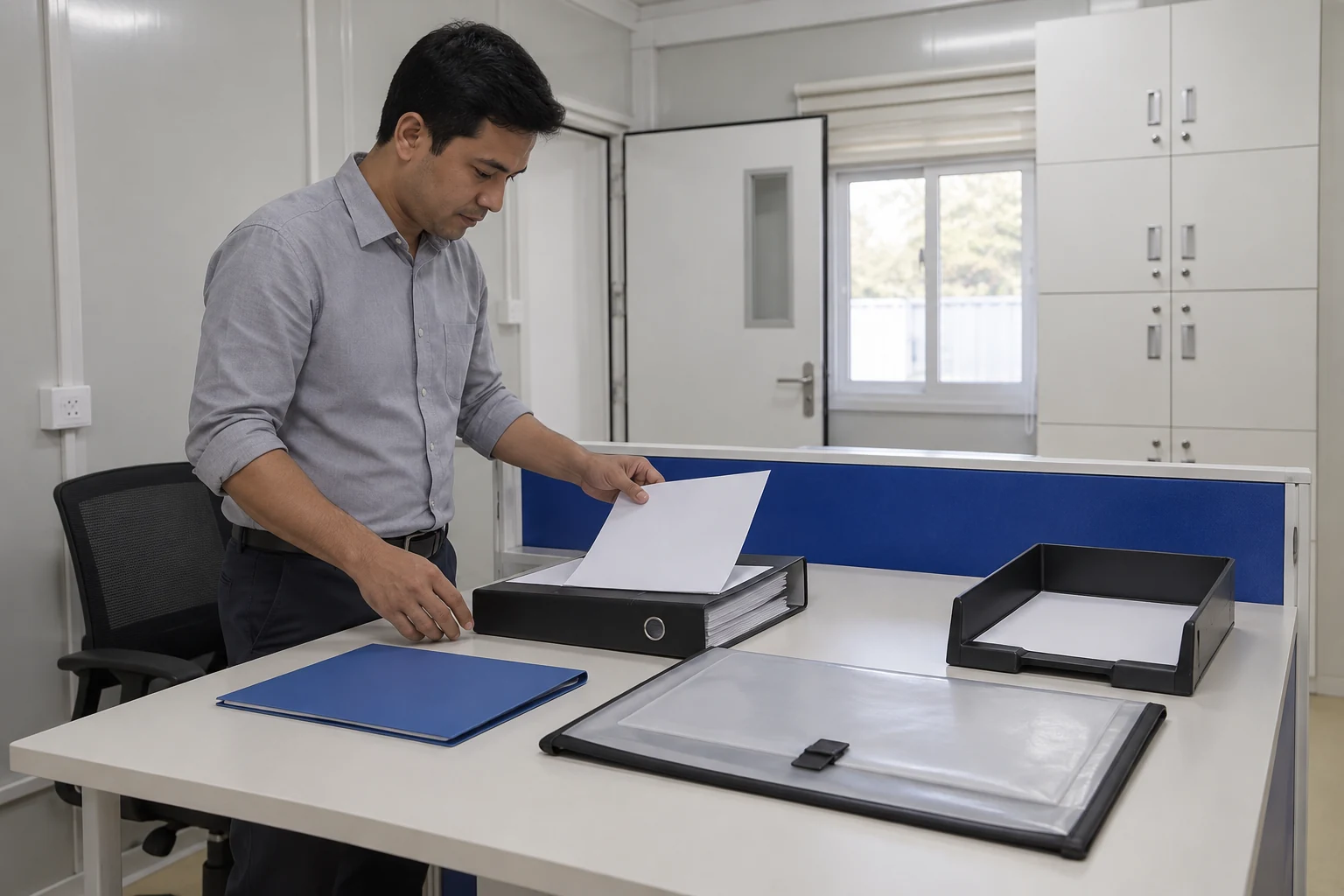
Place representative working items on a table before ordering storage. Include a partly filled binder, a drawing sleeve, the folder somebody carries to a meeting and the loose sheets that arrive during a busy day. Their different shapes reveal more than a photograph of an empty cabinet.
Separate the inventory by task rather than immediately assigning everything to departments. Some documents are consulted repeatedly while a job is underway. Others await a signature, belong to a completed package or need to be held by a designated person. These distinctions let the buyer explain why a particular item needs a desk tray, an accessible shelf or a controlled storage location. They also expose a common space problem: a permanent cabinet being used as a temporary dumping point because no receiving place was planned.
Record the container as well as the paper. A flexible sleeve behaves differently from a thick ring binder. A working file may grow after procurement, and a folder that closes easily when empty may need more room when filled. Ask users to bring normal samples, without disclosing confidential material. Where originals cannot be handled during a quotation review, use an empty folder of the same format and a clearly identified representative thickness.
Keep the inventory proportionate. A short list of recurring tasks is more useful than counting every sheet. Identify what remains in the room overnight, what leaves with an employee and what is transferred elsewhere. In a construction site office, those movements may change as the project progresses. The storage brief should say which activities the initial arrangement supports and what change would trigger another review.
Use paper dimensions as a starting point, then measure the folder
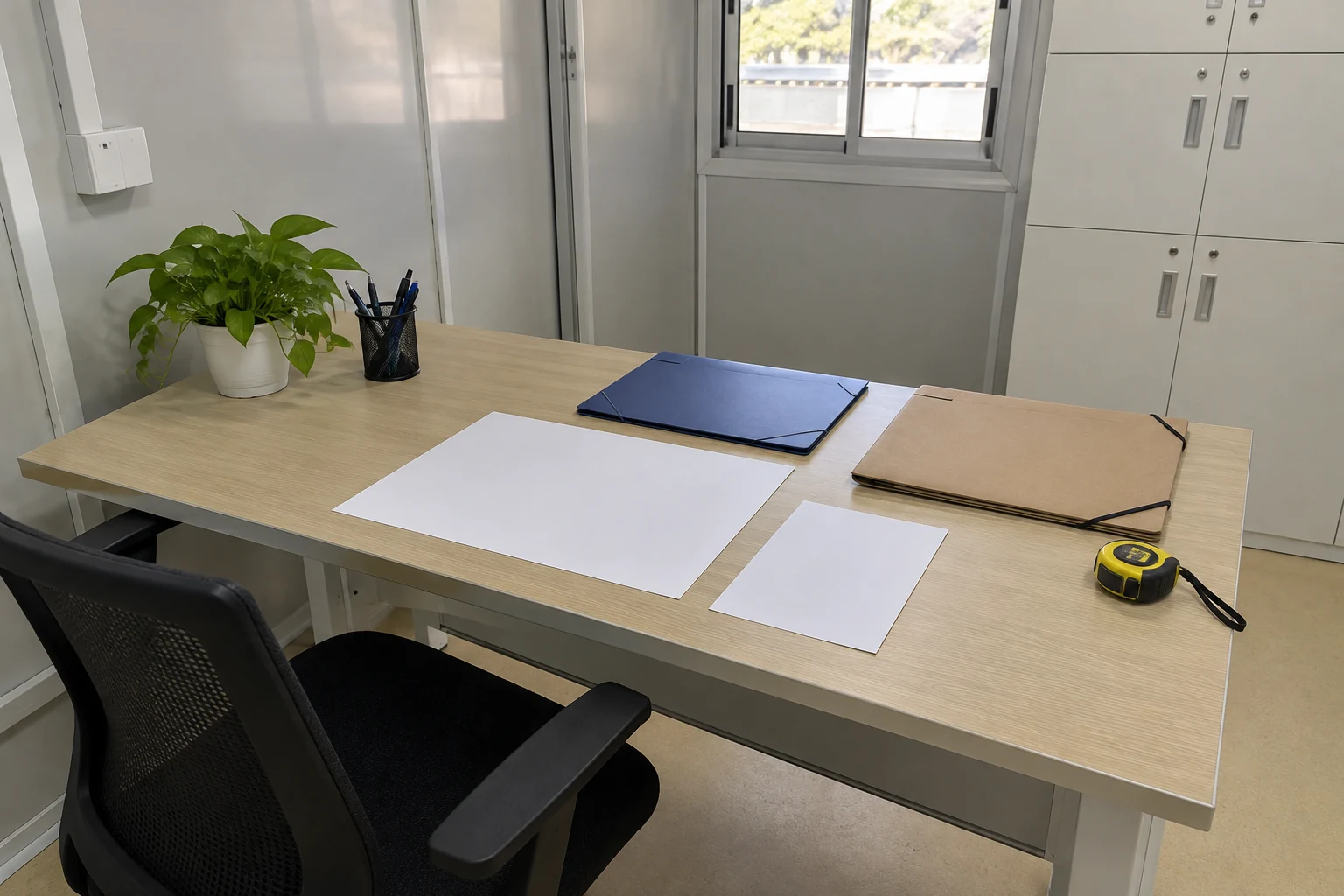
Paper dimensions describe the sheet, not the outside of its folder or the usable opening of a drawer. Compare the actual loaded folder with the cabinet's internal space and access opening. A nominally compatible label on a furniture listing is a question to verify, rather than a completed fit check.
Canon's PRO-2100 paper-size table lists A4 as 210 × 297 mm, A3 as 297 × 420 mm and Letter as 215.9 × 279.4 mm. The table below transcribes those sheet dimensions. It does not identify a printer supplied by PQSE or specify a cabinet. The extra space needed by a sleeve, binder mechanism, tab or handle must be established from the actual object.
Check orientation deliberately. A drawing may be stored flat, in a protective sleeve or in a system selected by the document owner. A buyer should not assume that folding is acceptable merely because a smaller compartment is available. Bring the intended container into the review and show how the document can be removed without bending it against an opening or another file. Distinguish the storage position from the working position on a table.
Ask the furniture supplier for usable internal dimensions and the type of folders the proposed unit accommodates. External dimensions answer the room-layout question; internal space and the opening answer different questions. If either is missing, mark the fit as unconfirmed. For a flat-pack office arrangement, coordinate the furniture decision with the assembled room and its actual openings, rather than relying on a transport illustration.
| Paper format | Nominal sheet dimensions (mm) | What the buyer still measures |
|---|---|---|
| A4 | 210 × 297 | Loaded folder exterior, tabs and retrieval opening |
| A3 | 297 × 420 | Drawing sleeve exterior and intended storage orientation |
| Letter | 215.9 × 279.4 | Actual local file format; do not assume interchangeability with A4 |
Assign access to records before choosing a lock
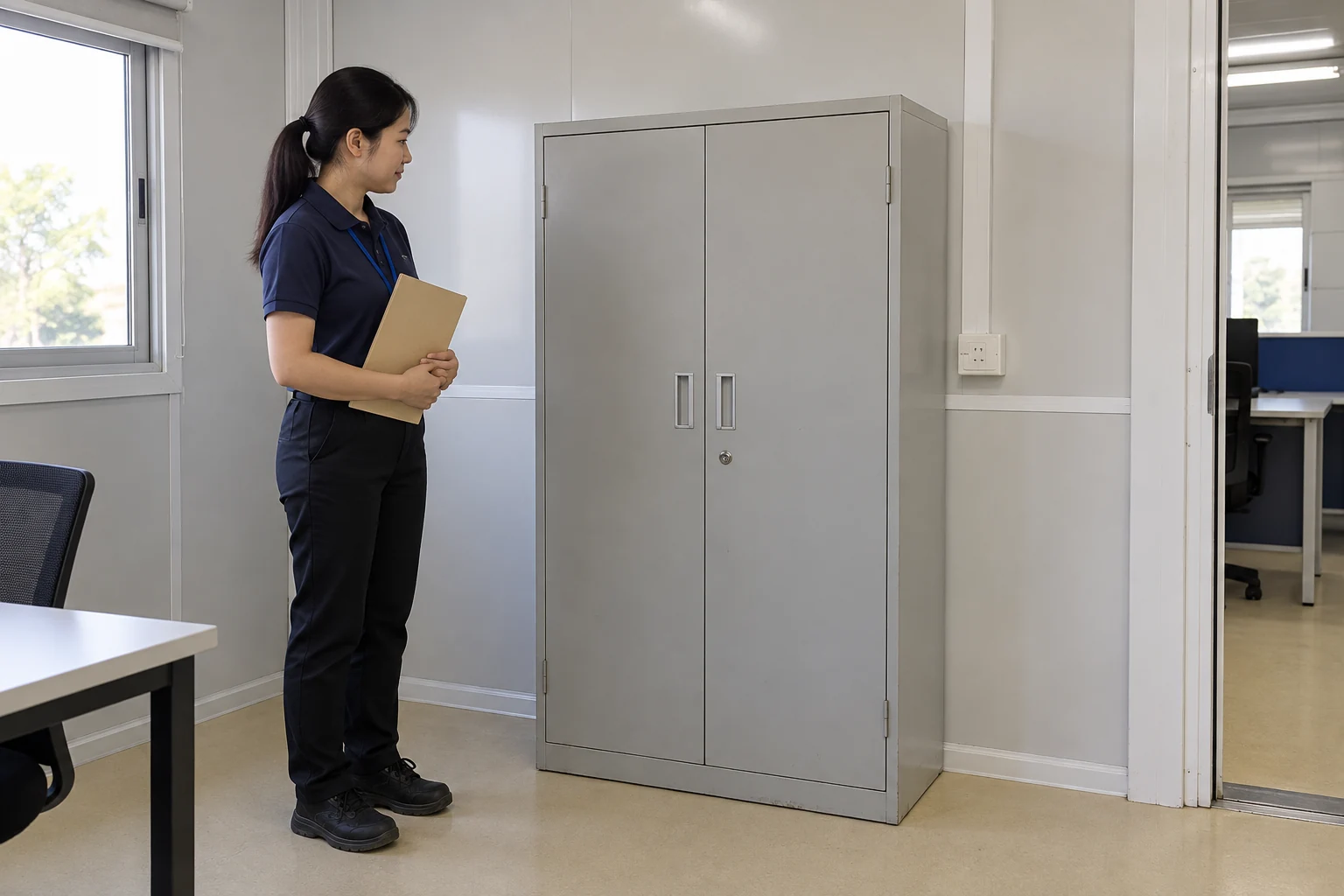
A locked storage location needs an identified access arrangement. Decide which records belong there, who may retrieve them and who takes responsibility when staff change. A visible lock alone does not tell the next shift where a required file is or whether they are authorized to use it.
The UK's ICO physical-security toolkit discusses lockable storage for physical records and documenting access, including access to keys or codes. It also considers printer positioning and communicated clear-desk arrangements. The page states that its guidance is under review following legislative changes. These are scoped references for an access discussion, not evidence that a proposed office complies with a particular law.
Translate the operational need into a brief the supplier can answer. A manager may need private access to certain files while the team shares drawings and ordinary working folders. Ask whether the proposal separates those uses and whether the furniture is supplied with the agreed locking arrangement. Do not infer a resistance rating, unique key system or protected replacement-key service from the word 'lockable'. Obtain the relevant product information where that distinction matters.
Keep replacement and absence arrangements with the office's responsible organization. The storage plan should remain understandable when the usual holder is on leave or has moved to another project. Record the responsible role and the authorized process in the organization's own system. Avoid publicly displaying sensitive key identifiers or records. If a buyer needs stronger protection than ordinary furniture offers, make that an explicit specification for an appropriately qualified supplier instead of upgrading the claim in the Blog.
Review the cabinet while somebody is actually using it
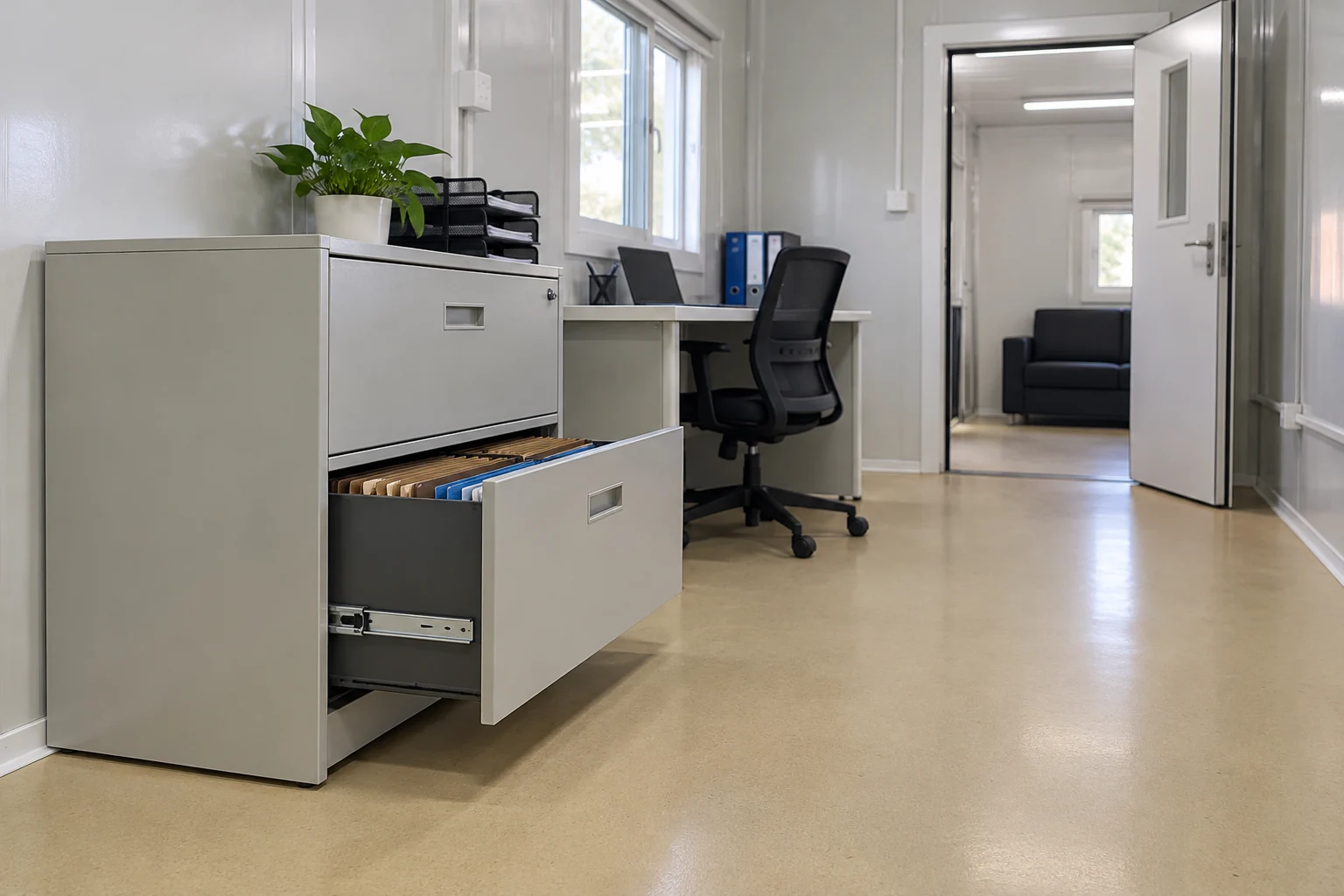
Show the proposed drawer or door open, with the nearby chair in its working position. Ask somebody to retrieve a representative folder and return it. This simple demonstration tests a use condition that a closed-furniture layout does not show.
CCOHS office-safety guidance addresses cabinet and shelf hazards, including drawers opening into routes, even loading and heavier material lower down. Its advice does not give the load capacity of this cabinet or the floor beneath it. Confirm those capacities and any furniture securing requirements from the applicable suppliers and project professionals.
Mark where the furniture stands and how it opens on the same proposed room arrangement. Include the adjacent work position and the route to the doorway. If the intended user must repeatedly move a chair, step around an open drawer or balance a folder while closing a door, the review has found a working conflict. Resolve the arrangement before treating the room as ready. A drawing of available floor area alone does not explain these movements.
Consider more than the neat demonstration case. Somebody may be carrying a folder while another person is seated or passing through the room. Review the normal overlap described by the team. Do not invent a universal clearance dimension from a photograph or this article; the chosen furniture, actual users and local access requirements determine the project check. Where the layout changes to a detachable modular room system, repeat the review against the new assembled plan instead of transferring an old cabinet position unquestioned.
Give printed paperwork a receiving and collection point
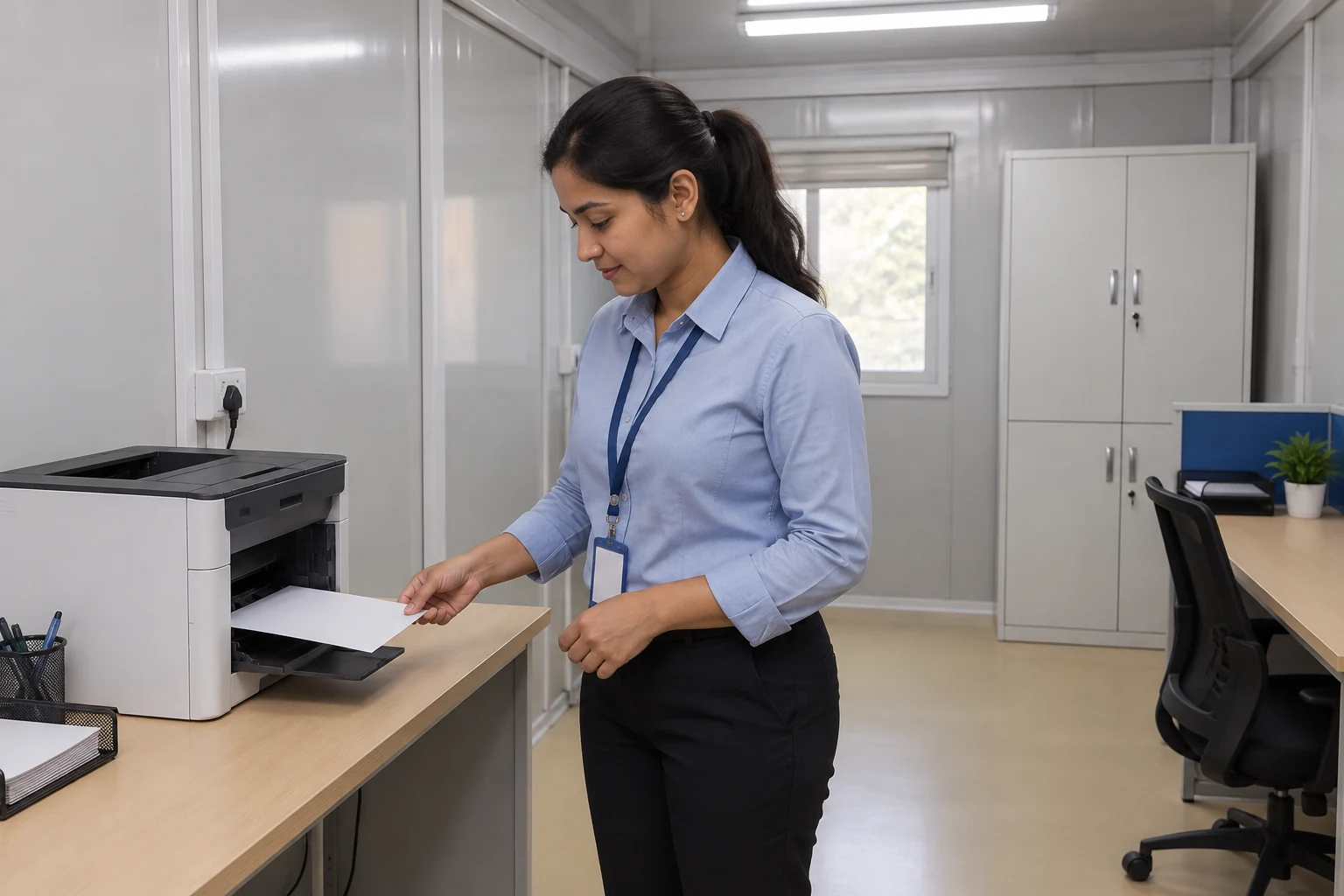
A printer produces a new paper item even when every existing file already has a place. Review who collects output, where an interrupted job waits and how an unidentified sheet is returned to its owner. The receiving point should be part of the working arrangement, not an accidental pile beside the machine.
Follow one ordinary print task from request to filing. A drawing might go straight to a meeting, while an unsigned form stays with the administrator. The same output tray cannot communicate both destinations. Ask the team what happens when the person who requested the print is called away. Record an appropriate holding arrangement without reproducing confidential documents or naming individuals in a public layout.
Include access to the machine itself in the furniture review. A location that looks tidy may make normal paper loading or a manufacturer-described maintenance task difficult. Obtain the selected printer's instructions and show how its required working areas relate to the room. Do not treat a cabinet top as a suitable equipment support until the furniture and equipment requirements have been confirmed. Avoid making cable routes or electrical provisions an improvised part of paper storage.
Coordinate this narrow decision with the wider container-office fit-out and service brief. The paper workflow explains where people want to use the printer; the equipment and service review determines whether the proposed location can support it. Keeping those responsibilities visible helps prevent a late furniture change from creating a new problem elsewhere.
Check what the working arrangement exposes from the entrance
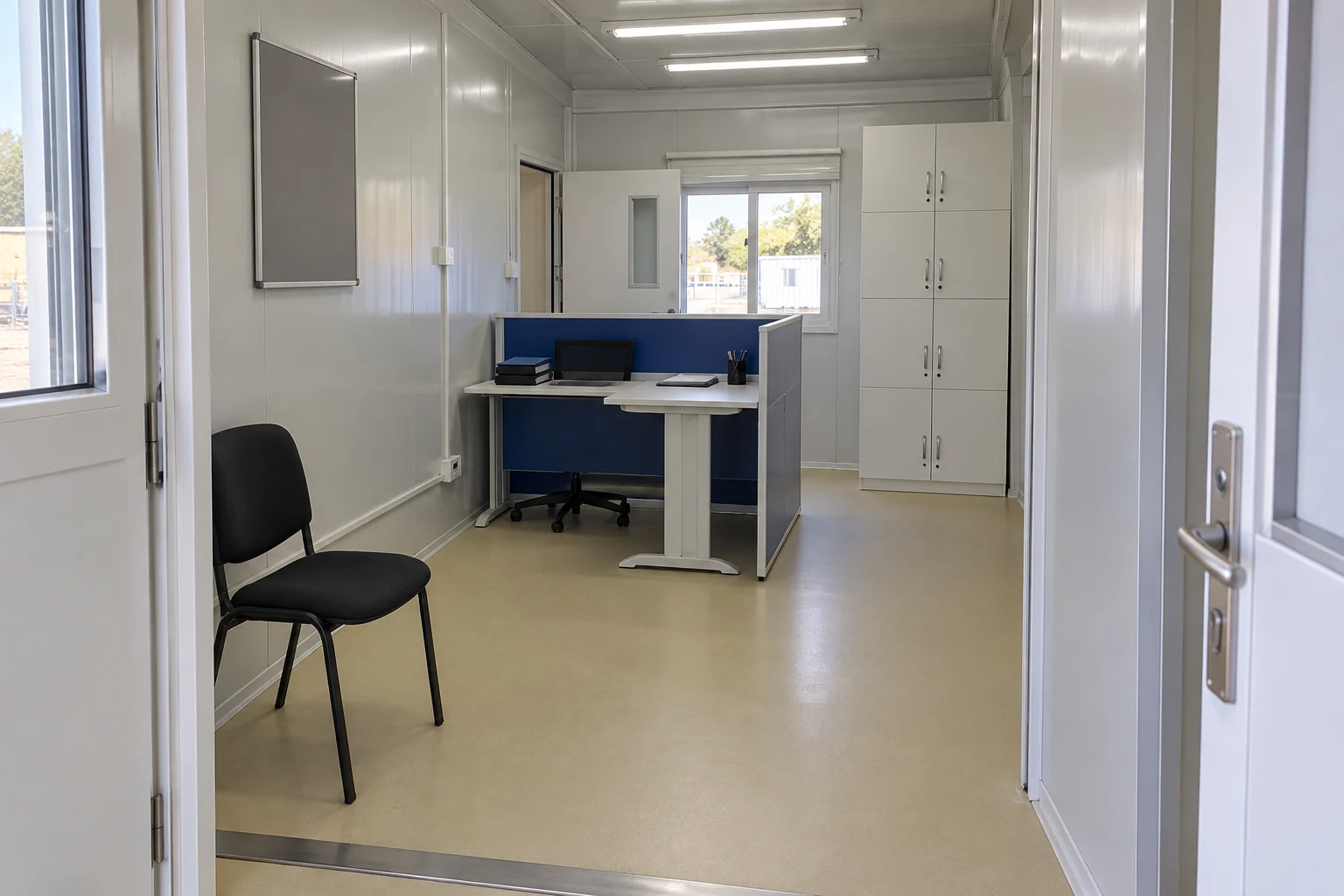
Stand where a person arriving at the office would normally wait and look toward the work area. Note whether loose paperwork is presented to that position and whether staff can receive somebody without leaving their active files unattended. Use a representative empty folder for the review, rather than a real sensitive record.
This is a practical observation about the proposed arrangement, not a promise of confidentiality. A staff-only cabinet may be appropriate while an open desk still faces a shared waiting position. Conversely, hiding every file deep inside the room can make normal retrieval cumbersome. Explain the specific task that must remain accessible and the specific material whose access is controlled. That distinction gives the team a reasoned layout choice instead of a general demand for more partitions.
Consider predictable interruptions. A delivery, a request for a signature or a colleague seeking a drawing may pause a task in progress. Ask how the user secures the working item and returns to it. The solution may involve the operating procedure and a nearby holding location, rather than another piece of permanent furniture. Any proposed partition or furniture move still needs to be assessed with the room's actual access, visibility and other requirements.
Relate the check to the site-office room and daily-operation plan. Keep the public receiving function and the record-handling function understandable to the people who will use the office. Review the arrangement again if the office starts handling a different type of paperwork or receives a different pattern of visitors.
Make returning a file as clear as taking it out
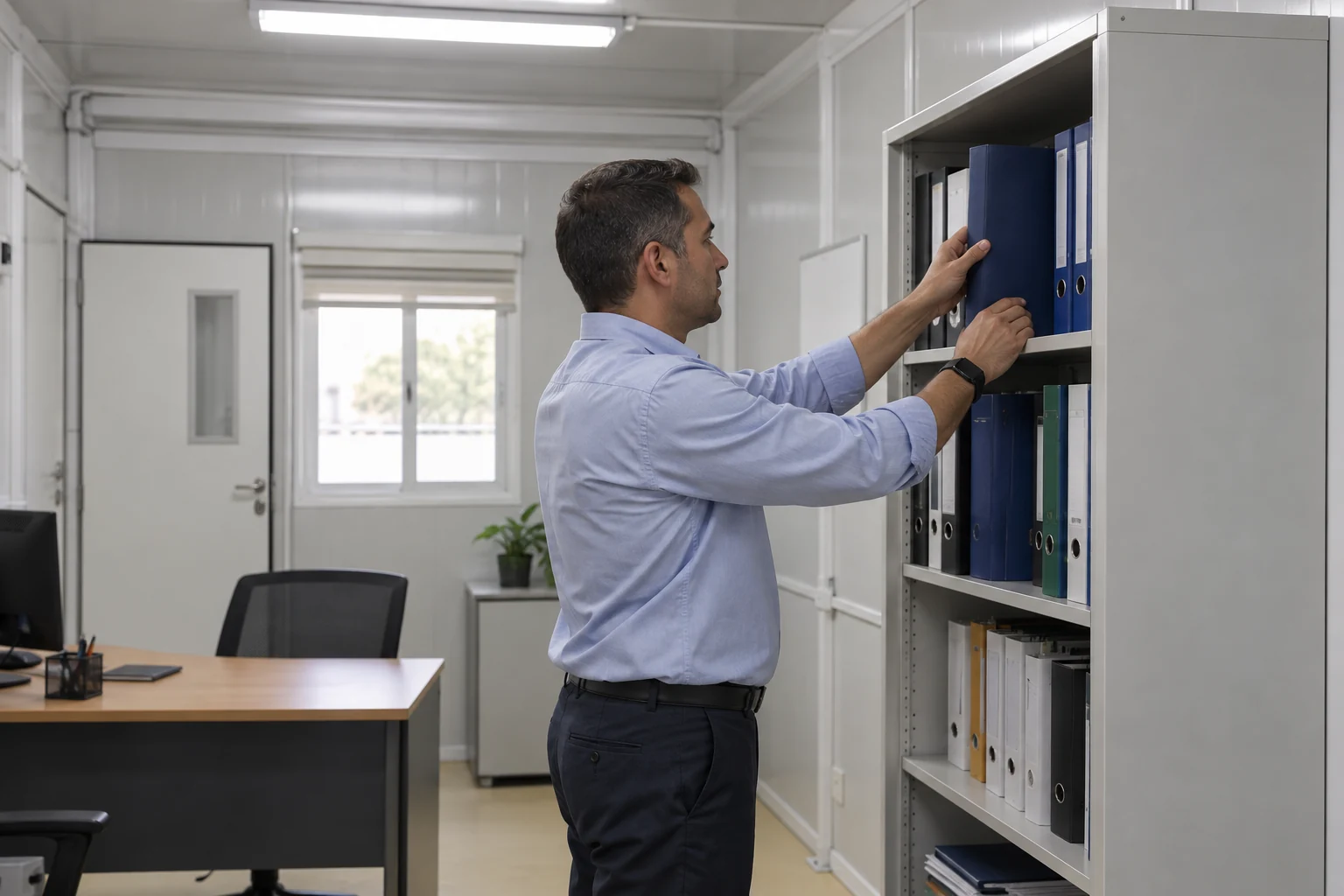
An active file needs a recognizable return location after a meeting or a desk task. Show where the closed folder goes and how a colleague can tell whether it is available. A storage arrangement that only works when one person remembers every temporary location is difficult to hand over.
Test a retrieval and return with a person who did not arrange the cabinet. Give them a normal task description and observe what is unclear. Perhaps two folders look identical, the latest working copy is on a desk, or the storage label describes a department while the person is looking for a project package. The response should address the actual confusion rather than automatically adding more labels or another shelf.
Use an identification method that the organization can maintain. Decide who may change a location, who updates its record and how a temporary loan is handled. The article does not prescribe a universal filing taxonomy. A small project office may manage its working set differently from a multi-team administrative room. What matters for procurement is whether the proposed furniture supports the agreed method without creating unexplained overflow.
Check visibility and reach using the intended users and containers. An attractive shelf photograph does not establish that a loaded folder can be handled comfortably. Where an item is unusually awkward or heavy, obtain the applicable handling advice and change the arrangement if required. Do not turn a routine sample review into an assumed ergonomic approval. Keep the observed difficulty, proposed change and responsible follow-up together.
Separate the paper condition question from the room finish
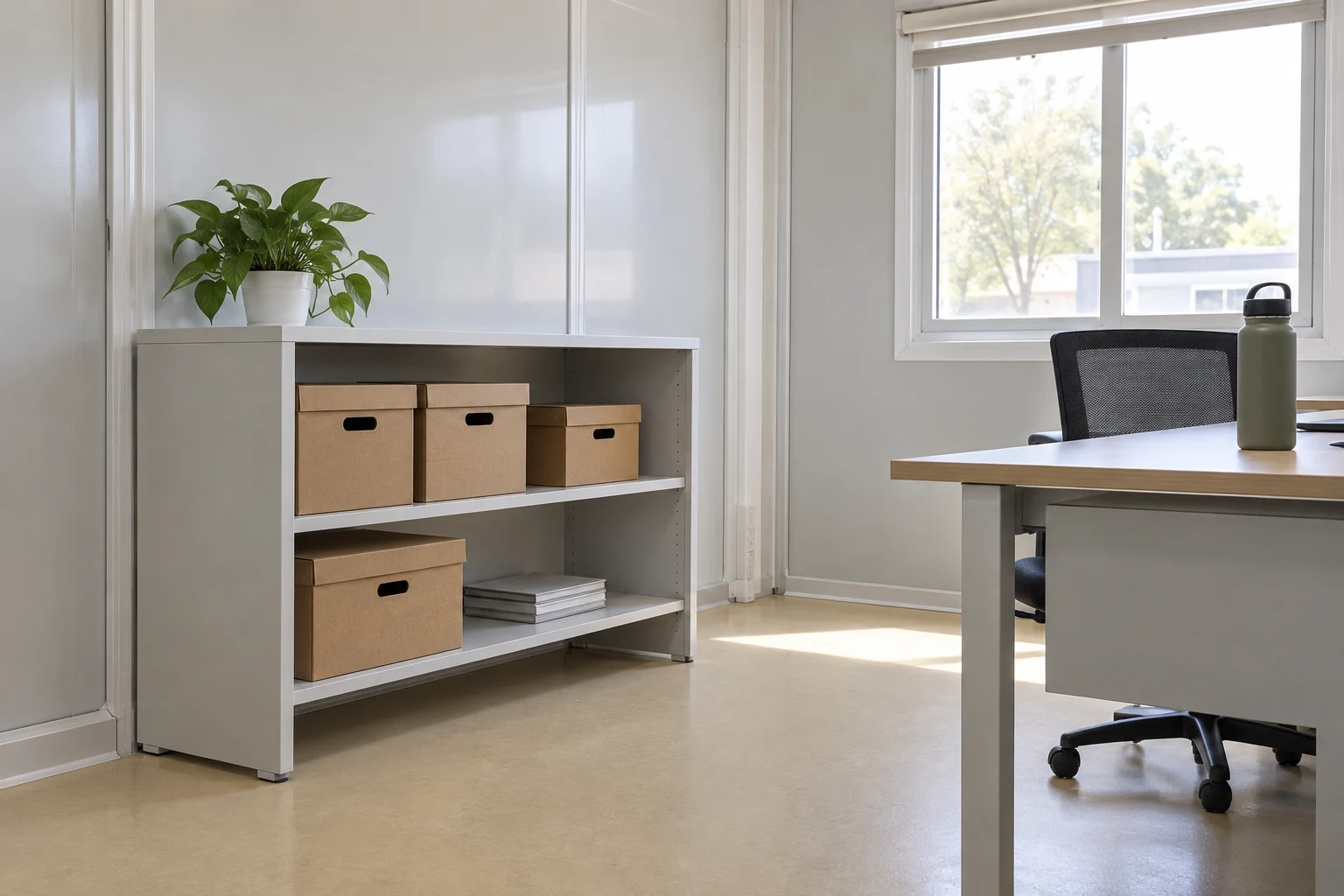
Look at where closed files wait in relation to everyday activities. A clean-looking room photograph does not establish that records will stay in suitable condition. Review foreseeable contact with drinks, cleaning work and items arriving from outdoors, using the organization's needs for those particular documents.
Ask what would happen to a folder brought in with damp or dirty outer packaging. It may need a receiving check before it joins the working set. Equally, a file taken to a site meeting can return in a different condition from the one in which it left. Define who evaluates an affected item and where it waits. This is an operational exception to plan, not evidence that a specific site has suffered damage.
Avoid writing a room-temperature or humidity target into a procurement brief simply because the contents are paper. Long-term preservation, a short-lived working copy and an irreplaceable original can require different advice. The record owner should identify what must be preserved and for how long; a specialist can then advise where necessary. The supplier's room finish or insulation description does not answer that records-management question on its own.
In an office serving worker-camp administration, files may pass between several operational roles. Explain which location is the authorized record store and which is only a working holding point. Review the route between them with the responsible people. This helps avoid treating every desk or shared room as an informal archive simply because space happens to be available.
Close the working day with a defined handover
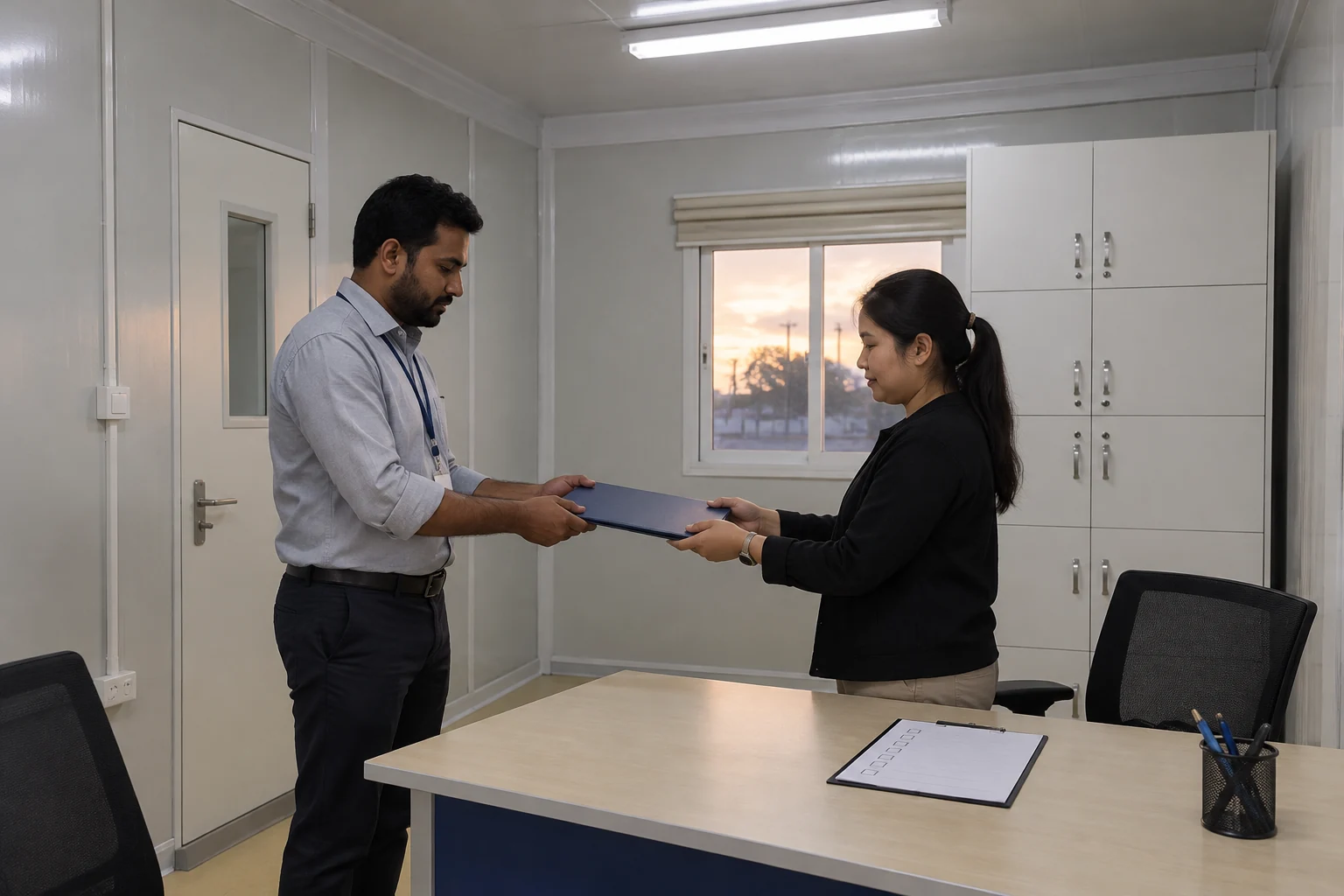
At the end of the day, a file left on a desk needs an explained status and owner. A colleague should be able to distinguish a task awaiting action from paperwork that has been returned to storage. Practice the handover with closed sample folders before normal work begins.
Use a small number of distinctions that fit the team's work. A pending signature is different from a file awaiting collection or a document whose correct location is unresolved. Identify who accepts each item next and what happens if that person is absent. Do not assume that closing the room automatically completes the handover. The building can be closed while a required file remains in an unexplained place.
Keep the process useful during ordinary disruptions. A meeting may overrun or an urgent request may interrupt the last task. Decide how exceptions are recorded without placing sensitive details on a public board. The furniture review should show the physical holding point; the organization decides the access and communication method. A tray name alone cannot establish authorization or preserve a record's meaning.
The following table is an editorial planning example, rather than a mandated process or a report of PQSE operations. Adapt the roles and terms to the actual organization. During the first working review, ask a colleague to follow one item from the last task of the day to the next morning. Record any missing owner, unclear location or inaccessible storage as a specific issue to resolve.
| Item at day-end | Question to resolve | Evidence of a usable arrangement |
|---|---|---|
| Active folder awaiting action | Who accepts the next task if the usual holder is absent? | Named responsible role and agreed controlled holding location |
| Printed item not collected | Who identifies the owner and decides where it waits? | Collection procedure understood by the staff who operate the printer |
| Folder away from its usual location | How will the next authorized user find it? | A maintained location or loan record; no dependence on one person's memory |
Include the records arrangement in the quotation and future move
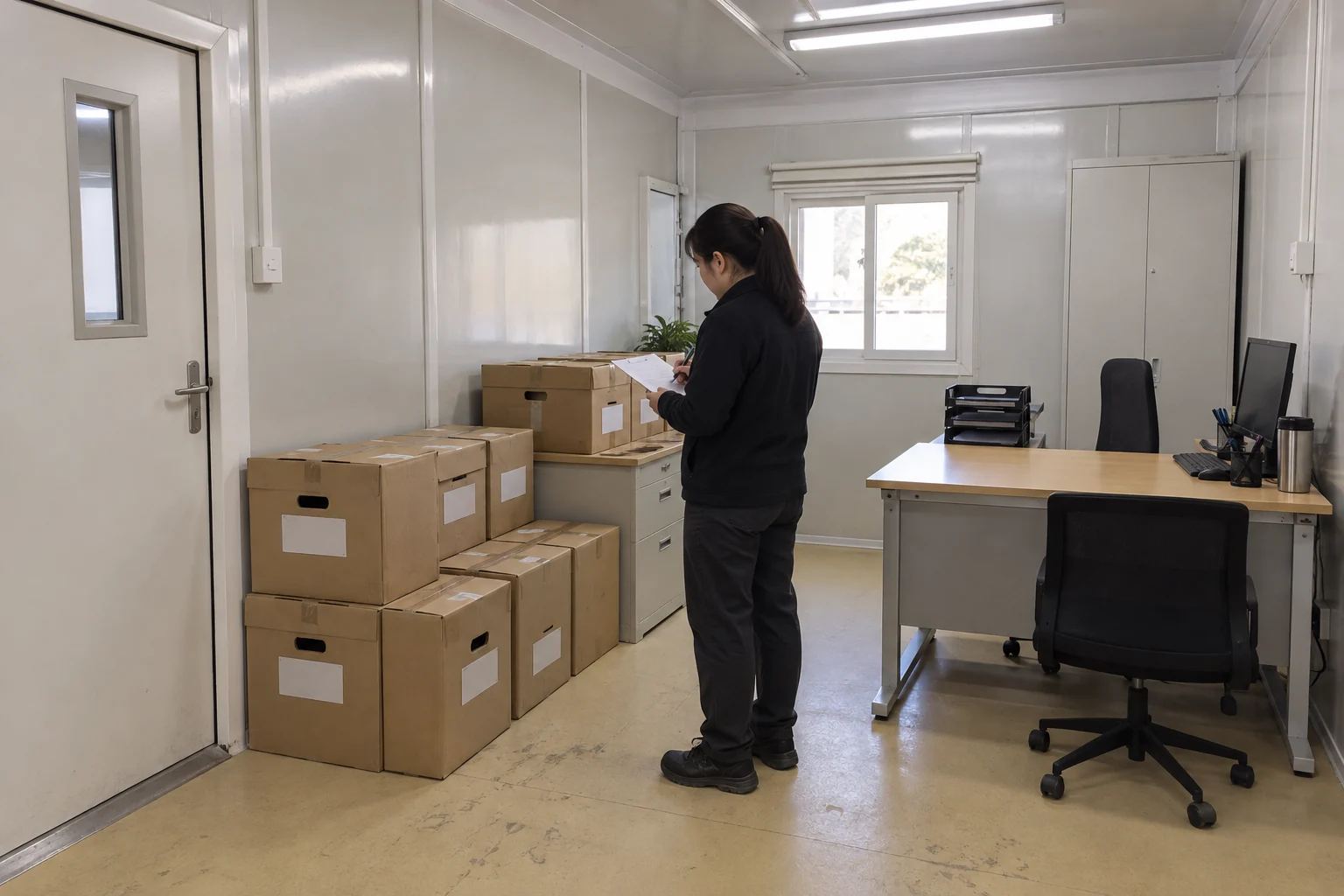
The quotation should distinguish furniture, room provisions and the operating tasks that remain with the buyer. For a later move, records also need their own authorized transfer arrangement. The office moving and the paperwork arriving are related events, but they are not the same acceptance task.
Send the supplier a concise room sketch and representative container dimensions. State which furniture is requested, which items will be supplied locally and what must be demonstrated before acceptance. Ask for exclusions explicitly. If the cabinet, printer table or document containers are outside the building order, give somebody responsibility for coordinating them with the final room arrangement. An attractive package image does not establish what will arrive.
Before relocation, the record owner should decide what travels, what is returned elsewhere and what remains under separate control. Keep the inventory and authorized recipients together in the organization's own records. Do not assume loose paperwork can remain in office furniture while the building is transported. Obtain the building mover's and furniture supplier's instructions, and use an appropriate records-transfer process. This guide does not provide packing loads or transport restraint instructions.
At the destination, review the assembled working arrangement again. A different doorway approach or desk position may change retrieval, even if the same cabinet is retained. Confirm the receiving owner and any unresolved storage issue before calling the move complete. The useful outcome is an office in which a required folder can be found, handled and returned under an understood responsibility—not merely a room with several cabinets in it.
| Part of the brief | Confirm with the relevant supplier or owner | Keep unresolved until supported |
|---|---|---|
| Cabinet and file fit | Internal dimensions, compatible containers and actual opening | Fit of a loaded sample folder |
| Room and furniture layout | Final positions, furniture access and assembly/delivery coordination | Project-specific access and fixing approval |
| Record operation and relocation | Responsible roles, access policy and transfer procedure | Retention rules, specialist storage needs and authorized recipients |
Buyer questions
Does an A4 cabinet label prove that my files will fit?
No. A4 describes a paper format, while a loaded folder has its own exterior dimensions and handling needs. Ask which folder system the cabinet accepts, obtain usable internal dimensions and demonstrate removal through the actual opening. Include tabs and binder mechanisms in the sample. If that information is unavailable, keep compatibility unconfirmed rather than assuming an external cabinet width settles the question.
Can the office order include lockable storage automatically?
Confirm it in the actual quotation. State the intended records use and requested furniture, then ask the supplier to identify included items, exclusions and the proposed locking arrangement. A photo of furnished accommodation is not an inclusion list. The buyer's organization still needs to define access holders and its own handover process. A lockable furniture description alone does not establish a certified security rating.
What if the amount of paperwork grows during the project?
Revisit the working inventory before adding another cabinet. Identify whether the growth represents active work, completed files awaiting transfer or an unresolved disposal decision. The record owner determines the appropriate destination. Then review any extra furniture in use, including openings and neighboring work positions. Moving a pile from a desk into a new cabinet may hide the underlying responsibility problem.
What should accompany a request for this office arrangement?
Send the final room use, representative loaded-folder dimensions, drawing formats, requested storage furniture and ordinary retrieval tasks. Describe who uses controlled records and how day-end exceptions will be handled, without supplying confidential contents. Include locally purchased equipment and a future relocation requirement where applicable. Ask for written inclusion and exclusion details and a sample-based fit review tied to the actual room proposal.
Sources and scope
- ICO — Physical security. UK audit-framework reference; the page says guidance is under review. Not a PQSE compliance determination.
- CCOHS — Office Safety, General. General cabinet and shelf hazard advice; not a floor or furniture load specification.
- Canon — PRO-2100 Paper Sizes. Manufacturer's listed nominal paper dimensions; not a PQSE equipment inclusion.
Prepared by PQSE House as a research-based procurement guide. External sources were checked for the stated points; layout examples and responsibilities are editorial proposals. Photographs were newly generated using genuine modular-office references and illustrate reconstructed scenes, rather than an identified PQSE project or measured test. Confirm legal, furniture, building and records requirements with the responsible parties for the actual order.