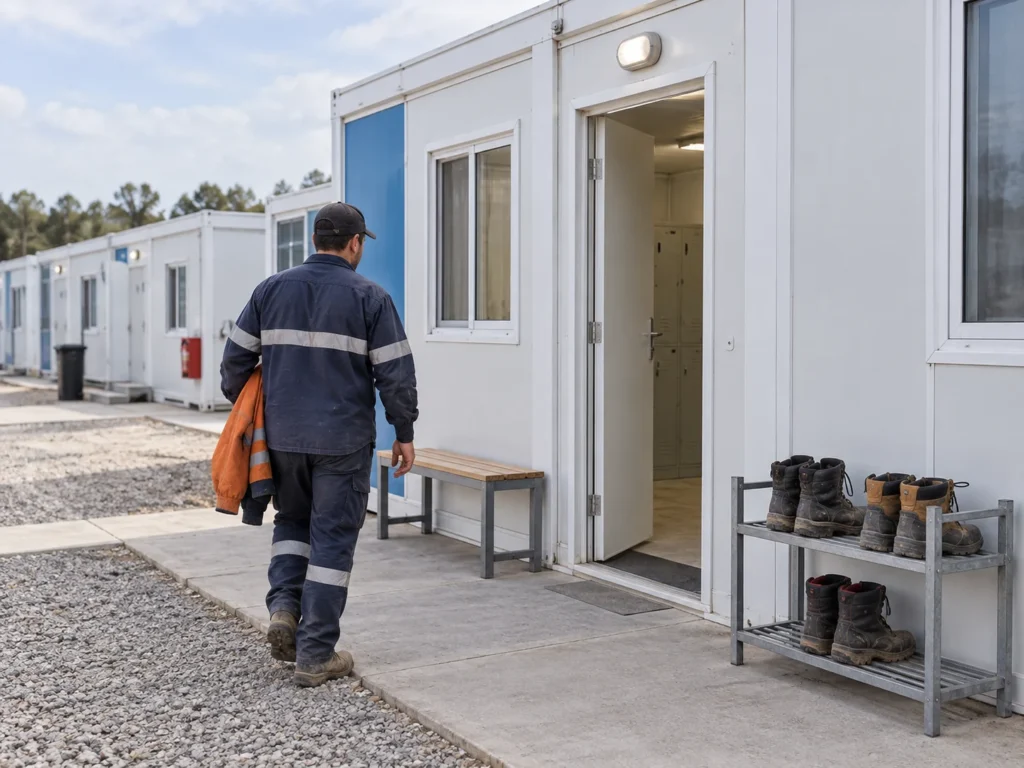
Choose a forklift charging location after confirming the truck, battery, charger and building requirements together. A spare corner beside a socket is an incomplete brief: the equipment may need a different supply, mounting arrangement, environmental conditions or operating procedure. Reserve a defined position, but let the equipment supplier and competent site designers establish its requirements before the warehouse layout is frozen.
For a buyer specifying a new prefab warehouse, the practical question is who owns this interface. The building supplier can be discussing wall panels while the fleet provider assumes that charging services will already be available. Neither conversation necessarily defines the floor position, electrical scope, protection from traffic or acceptance records. This guide sets out a procurement method for resolving those gaps. It is not a wiring instruction, battery maintenance procedure or approval of a particular PQSE charging installation. Photographs illustrate planning situations rather than measured performance or completed customer projects.
Start with the working pattern that creates the charging demand

Ask the operator to describe when each truck is in use and when it can actually stop. A break written on a shift plan is not automatically an available charging window if the same truck must unload a delivery during that break. Record the conflicting task before someone selects a charging strategy from a brochure.
Collect a representative operating record rather than guessing from the warehouse floor area. Useful inputs include the truck identities, operating periods, expected changeovers, supplier-recommended charging arrangements and who confirms that a vehicle is available. Distinguish an existing fleet with records from a new operation with assumptions. Give every assumption an owner who will review it after commissioning; do not present a proposed schedule as observed utilization.
Toyota's charging-method comparison distinguishes conventional, fast and opportunity charging and relates selection to operational demands and compatible equipment. It helps frame the questions, but does not prove which method suits this project. Obtain an equipment-specific recommendation based on the intended duty. Avoid importing another operator's battery count or downtime into the building specification merely because its shift pattern looks similar.
Then place the charging activity into the wider warehouse stock-flow and working-area plan. A charging position should remain available when receiving, picking and dispatch are busy. If dispatch routinely occupies it, the problem concerns the operating arrangement as well as the drawing. Resolve that conflict before treating the position as a dependable part of the fleet plan.
Create one equipment identity record for the truck, battery and charger

Build a small record around the actual equipment combination. Keep model and serial information, the relevant manual revisions, battery type, charger designation and supplier confirmation together. A photograph of a data plate can help identify equipment, but it does not replace a compatibility decision or the approved installation documents.
A purchasing description such as electric forklift leaves important questions open. The truck may be intended for a particular battery installation, while a replacement proposal changes weight, connections, communications or operating instructions. Ask the fleet supplier to identify the approved combination and any required integration work. Separate a verified installed arrangement from a supplier's preliminary suggestion; both can appear on the brief, but should carry different status.
EnerSys' NexSys iON manual is an example of why this matters: it identifies approved charging and truck integration arrangements for that battery system. It is not evidence that an arbitrary lithium battery can be connected to a conveniently available charger. Record the actual applicable documents for the purchased fleet, including regional versions, rather than selecting a manual solely because the brand name matches.
Include change control in the record. If the fleet supplier substitutes a charger after the warehouse services have been designed, somebody must assess the consequences before delivery. Keep the earlier specification and the replacement decision linked, rather than silently overwriting the original. This makes it possible to distinguish a deliberate reviewed change from a wrong item arriving on site.
| Record | Evidence to request | Decision owner |
|---|---|---|
| Truck and installed battery | Identities, approved combination and applicable operating documents | Fleet supplier and operator |
| Charger | Model, configuration, compatibility confirmation and installation manual | Charging-equipment supplier |
| Building services | Reviewed supply, mounting, environment and protection scope | Competent site designers |
| Substitution | Written change and assessment of affected interfaces | Named project coordinator |
Define the boundary between the building package and charging equipment

Put the package boundary on the order documents. Identify who supplies the charger, who designs its electrical installation, who provides mounting support and who verifies the result. A general promise that a building has electrical provision does not describe a usable forklift charging installation.
Ask the charging supplier for the inputs the building designers need, including equipment mass, mounting details, cooling requirements and the characteristics of its proposed supply. The competent electrical designer should establish the installation and protective arrangements under the applicable local rules. A buyer can require these decisions and identify their owner without attempting to select cable sizes, protective devices or connection methods from a general article.
A prefab warehouse project brief should distinguish the structural building, floor and foundations, internal services, charging equipment and operational commissioning. Each may be purchased through a different contract. List exclusions alongside inclusions so that a necessary item cannot disappear between two quotations that both seem complete when read separately.
If administration occupies an adjacent container office, identify its separate services and access arrangements. Office sockets or an office distribution schedule should not be assumed to cover the charging installation. The office power and fit-out brief remains useful for its own users while the warehouse equipment interface receives its own design review.
Test the charging position against real movement and access

Show the parked truck, charger, approach and departure movement on the working layout. Include pedestrian destinations and maintenance access, not just the rectangle occupied by a vehicle. Check whether an operator must cross a picking route to reach the equipment or whether a parked truck hides a doorway. These are proposed layout tests; their dimensions must come from the actual equipment, users and applicable design requirements.
In covered US powered-industrial-truck workplaces, OSHA 1910.178(g) requires designated battery-charging areas and addresses facilities associated with the actual charging hazards. The provision does not give a universal charging-bay floor area. Do not convert the word designated into a painted box of an invented size, or assume that a line alone resolves traffic, ventilation and equipment-protection questions.
Walk the proposed route with the operator and facilities team before approving the layout. Discuss the busy condition when another truck is waiting, a maintenance person is working nearby or a delivery arrives. Identify where that activity is permitted without consuming the charging position or obstructing a required route. A drawing reviewed only under an empty-warehouse assumption misses the condition most likely to expose a space conflict.
Keep the outcome tied to the drawing revision. If a later rack arrangement moves the pedestrian path or reduces service access, reopen the relevant decision. The aim is not to create an elaborate approval ritual; it is to stop a previously reviewed location from being treated as unchanged when its surrounding operation has moved.
Plan cable storage and the operator's permitted sequence

Observe where the approved connection is made and where the cable is kept when it is not in use. Resolve this through the equipment instructions and site operating procedure. An unused cable that lies across a route is a different problem from a correctly specified charger, and deserves an explicit owner.
Ask the supplier to demonstrate the intended operator sequence on the installed system. Record what the operator may do, what requires a trained maintenance person and what condition means the equipment must remain out of service. Do not improvise that sequence from a photograph. A connector shape, cabinet color or charging light does not establish compatibility or tell a new employee which action is permitted.
Consider ordinary interruptions: an operator changes shift, a cable fails to reach its approved connection point, or the truck returns to a different position. Decide how the operator reports the problem and who resolves it. Avoid treating a different parking angle or an extension arrangement as a harmless convenience; the equipment and installation owners should assess any proposed departure from the agreed configuration.
Document storage and inspection responsibilities without turning the article into repair advice. Damaged leads, unfamiliar adapters and unexplained equipment faults need the appropriate specialist response. The project buyer's task is to ensure that the procedure, reporting route and supplier support exist, rather than requiring warehouse staff to troubleshoot electrical equipment beyond their authorized role.
Keep battery limits separate from charger environment limits

Two acceptable-looking numbers can describe different things. Battery temperature is not the same measurement as room temperature around a charger. Record the measured object, the model, the manual revision and any stated condition before putting a numerical limit into a project table.
The following transcription compares instructions from two EnerSys documents only to show those distinctions. It is not a compatibility certificate for the combination, a performance comparison or a universal warehouse standard. Confirm the manuals for the exact purchased equipment. Do not select the larger temperature range and apply it to every item simply because it would make the proposed location easier to accept.
Treat the environment brief as a question for the installation designers and supplier. Identify where relevant conditions will be assessed, who maintains the records and what happens when the equipment is outside its permitted conditions. A one-time reading in a comfortable season does not describe the whole operating year. Conversely, an estimated extreme should be labeled as a design assumption rather than a field measurement.
The dimensional entries below also use different baselines. One is a recommendation referenced to the battery's closest top edge; another is a stated minimum between chargers. Neither is a pedestrian aisle width or a general fire-separation rule. Preserve that distinction on the layout and ask the equipment supplier to interpret its instruction for the proposed mounting arrangement.
| Equipment/document | Parameter and basis | Published value | Status and boundary |
|---|---|---|---|
| NexSys iON, manual 0626, p11 | Battery temperature during charge operation | 0–55 °C | Battery limit; not room temperature or a performance rating |
| NexSys iON, same page | Environmental relative humidity | 0–95%, non-condensing | Battery-system environmental limit |
| EMEA NexSys+, manual 0625, p8 | Charger operating environment | 0–45 °C; 0–70% RH | Separate charger limits; moisture restrictions also apply |
| EMEA NexSys+, p8, Location | Radial separation from closest battery top edge | At least 72 cm recommended | Model-specific recommendation; not general fire separation |
| EMEA NexSys+, p8, Cabinet Mounting | Distance between two chargers | Minimum 31 cm | Model-specific mounting requirement; not aisle width |
Review ventilation and fire measures for the actual battery system

Begin this review with the battery identity and the work being done in the area. Charging a gas-generating battery, replacing a battery and parking a truck are different activities. Ask which ones the operation includes. The responsible specialists should assess the relevant hazards and protection measures under local requirements and the equipment instructions; a general warehouse ventilation description does not close that assessment.
HSE's lift-truck guidance discusses a designated ventilated charging area and ignition control in its battery-care guidance. Its battery-charging leaflet explains considerations for batteries that generate gas. Those documents help identify the questions for that context. They should not be turned into a universal lithium-ion gas-generation rate or a fixed air-change figure for every charging area.
Similarly, changing battery chemistry does not automatically remove the need to review the charger environment, traffic protection or site fire arrangements. Nor should an instruction for one installed system be treated as an exemption from applicable law. Ask the designers and equipment supplier to reconcile their requirements explicitly, including any conflict, rather than allowing a brochure phrase to decide the site procedure.
Record the selected arrangements and the evidence supporting them. Where an item remains unresolved, carry it forward as an open design input, not a favorable assumption. Do not use illustrative pictures of louvers, posts or a charger to suggest that a location has passed a ventilation calculation or fire review. The engineering records must do that work.
Coordinate mounting support, impact protection and usable access

Review what supports the charger and what protects it from vehicle movement. These decisions belong with the actual equipment and building structure. A wall surface that looks convenient is not proof that its panel can carry the proposed equipment, and protection posts need their own reviewed positions.
Provide the building supplier with the proposed mounting information early enough to identify the relevant structural support. Keep equipment fixing requirements separate from the appearance of the internal wall finish. If additional support is necessary, include its supply and installation in the coordinated scope. Do not assume the installer can attach heavy equipment to any part of a finished enclosure without a reviewed detail.
Assess vehicle damage to charging apparatus alongside routine access. A barrier that prevents an obvious approach may also interfere with inspection, cabinet access or cable movement. Ask the equipment and site designers to review the combined arrangement. No numerical impact rating or protective-post spacing is proposed here; those values require the specific risk, foundation and protection-system design.
Use the controlled design-change process for a customized building package to preserve decisions affecting its structure or services. Record the accepted arrangement, relevant drawing and responsible party. A late change should carry an assessment of affected interfaces rather than appearing only as an extra item on the installation crew's informal list.
Keep maintenance access available after the warehouse fills

Check the proposed area as a maintenance location as well as a charging location. The service specialist may need access that a parked truck does not use. Show how stock, tools and temporary work are kept from consuming that access once normal warehouse pressure begins.
Agree who inspects the installed equipment, which records are kept and how a fault changes the operating plan. Define a reporting route that still works when the usual supervisor is absent. A spare truck may help some operations, but its availability must be established rather than assumed. Where there is no alternative, the operational consequence should be visible in the project decisions.
Ask the supplier to identify restrictions on cleaning, moisture exposure and access to enclosures. The warehouse housekeeping method must fit the selected equipment. Keep these instructions in the operator handover rather than burying them in a supplier attachment that nobody responsible for cleaning receives. Do not infer a washable or weatherproof cabinet from a photograph or from the word industrial.
Review replacement arrangements at the same time. A different charger introduced later may alter supply, mounting, cooling or compatibility requirements. Preserve an understandable equipment record so that a maintenance purchase can trigger the necessary design checks. Routine procurement pressure should not turn the original coordinated installation into a collection of individually plausible but unreviewed substitutions.
Compare quotations using the same installation and handover scope

Ask each bidder to identify the equipment and services it is pricing against the same brief. Compare scope rather than only the charger purchase figure. A quotation for delivered hardware and a quotation for an installed, reviewed system do not describe the same procurement boundary. Keep exclusions, provisional items and client responsibilities visible so that the cheaper headline cannot conceal missing work.
The comparison below is an editorial procurement framework. It contains no invented market prices, installation times or performance scores. Request project-specific quotations after the equipment and site inputs are established. The outcome should be a clearer division of responsibility, not a claim that one supplier's price proves the quality or operating economy of the entire warehouse.
Use the building delivery and shipping scope to distinguish what travels with the building package from separately supplied charging equipment. Agree arrival sequence, receipt inspection and storage instructions for each package. A completed warehouse shell does not establish that a charger is available, installed or ready for operation.
Keep commissioning dependencies in the procurement schedule. Identify which documents and completed works the responsible specialists need before their acceptance activities. If an input is missing at delivery, record that state and agree its resolution. Do not describe an unloaded cabinet or a successful display power-up as proof that all equipment, installation and operating interfaces have passed review.
| Scope line | What must be explicit | Evidence at handover |
|---|---|---|
| Equipment | Actual truck–battery–charger combination and allowed substitutions | Identity records and applicable supplier documents |
| Installation | Design, supply, mounting, protection and specialist responsibilities | Reviewed documents and completed-work records |
| Operation | Training, permitted sequence, checks and fault reporting | Operator documents and agreed reporting route |
| Acceptance | Who verifies what, dependencies and unresolved items | Named sign-offs and an open-item register |
Accept an operating arrangement, not just a painted parking position

Bring the operator, equipment supplier and installation owners together around the completed arrangement. Check the installed identities against the agreed documents and record each party's verification. An orderly-looking area is useful, but the acceptance evidence should establish what was actually supplied and reviewed.
Separate receipt, installation checks and operational handover. Receipt establishes the identity and condition of delivered items. Installation records describe the work and the responsible verification. Operational handover establishes the permitted use, people and reporting process. These records may be linked, but should not substitute for one another. Make unresolved items visible rather than treating the final meeting as a reason to erase them.
The building quality-control and acceptance record can help organize building-package checks, while the charging-equipment specialists own their corresponding technical evidence. Retain the actual boundaries. A building inspection should not be reported as certification of the truck, battery or charger simply because the equipment sits inside the finished building.
Finish with an operating review date chosen by the project team. The purpose is to compare the actual workflow with the assumptions that selected the location, especially interruptions and congestion. No universal review interval is prescribed here. If the observed operation differs, assign the change to the relevant owner and assess it before the charging position or equipment arrangement is altered.
Buyer questions
Can the charging area be designed before the fleet supplier is selected?
A provisional location can be reserved, but mark its equipment and design assumptions clearly. Request the information needed to complete supply, mounting, environment, access and operating decisions. Do not freeze those interfaces against a generic electric-forklift description and assume that any later equipment will fit. The final reviewed scope should use the actual proposed combination and applicable manuals.
Does a lithium-ion battery remove the need for a designated charging review?
Battery chemistry changes the questions rather than answering the whole site brief. Confirm the installed system, its charging instructions and the applicable workplace requirements. Charger cooling, environment, compatibility, traffic and site fire considerations still need their respective owners. Neither conventional-battery gassing guidance nor one lithium-system instruction should be presented as a universal rule for every installation.
What should accompany a warehouse charging-area quotation request?
Send the site and operating context, actual or proposed fleet identities, battery and charger documents, layout revision, available services and the proposed division of responsibilities. Mark unknowns. Ask each bidder to state inclusions, exclusions, required client work and acceptance evidence. Keep technical design with the competent specialists rather than supplying guessed electrical or ventilation values to make the request look complete.
Sources and scope
- OSHA 1910.178 — Powered industrial trucks. Subsection (g), covered US workplaces; not a universal bay-size specification.
- HSE L117 — Rider-operated lift trucks. Third edition 2013, printed pp33–34, battery-care guidance; distinguish guidance from ACOP clauses.
- HSE INDG139 — Using electric storage batteries safely. Revision 1, July 2011; gas-generating battery context, not universal lithium-ion calculations.
- EnerSys NexSys iON owner's manual. Actual document footer revision 0626; pp11 and 13–15. Instructions concern the stated NexSys iON system.
- EnerSys EMEA NexSys+ charger owner's manual. Actual document footer revision 0625; pp8–9. Model-specific environment, mounting and installation instructions.
- Toyota — Assessing Forklift Charging Methods. Published July 20, 2026; comparator for operating-method questions, not proof of this project's performance.
Source review: October 2, 2026. Numerical entries are manual transcriptions, not PQSE test results. Planning tables and procurement judgments are editorial synthesis; confirm equipment revisions, regional requirements and project responsibilities. Generated photographs are illustrative and do not document an approved installation.