Portable toilet lighting needs to cover the complete visit: finding the facility, reaching its door, using it with the door closed, washing, and returning to the intended route. A lamp inside the cabin answers only part of that question. Before comparing products, define where lighting is supplied, when it operates, how its controls behave during normal use, and who responds if a part of the visit becomes unavailable.
A useful order starts with the proposed operating day, rather than a catalogue photograph taken in daylight. Include the last work shift, resident access, cleaning and any authorized service attendance. The facility may be open after an adjacent office has closed, or a handwashing point may stand outside the lit cabin. Those are different supply and management interfaces. Specify them explicitly when discussing portable toilet facilities so a quotation can be compared against the actual need.
This is a research-based purchasing guide, not an electrical installation procedure or a finding that a particular project complies with local rules. The numerical example below retains its United States construction scope. Project requirements, equipment selection and approved verification belong to the responsible local parties. The planning questions are intended to make their scope and your operating arrangements understandable.
Draw the visit from departure to return
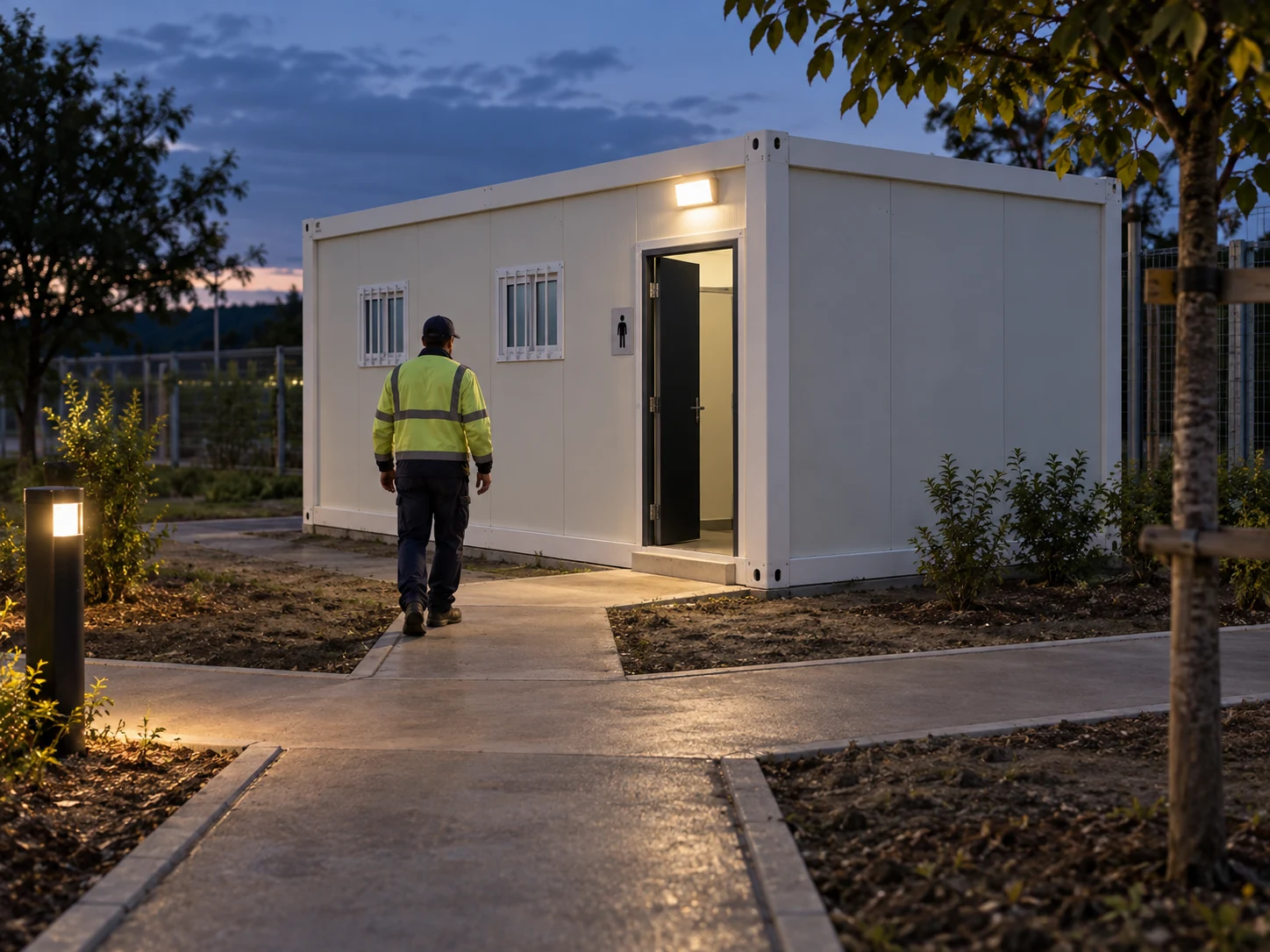
A person begins using the facility before reaching its entrance. Mark the normal departure point, the route decision, the chosen toilet, the washing point and the way back on one site sketch. This connects the lighting proposal to a recognizable visit and reveals where the toilet supplier’s package ends and the surrounding site arrangement begins.
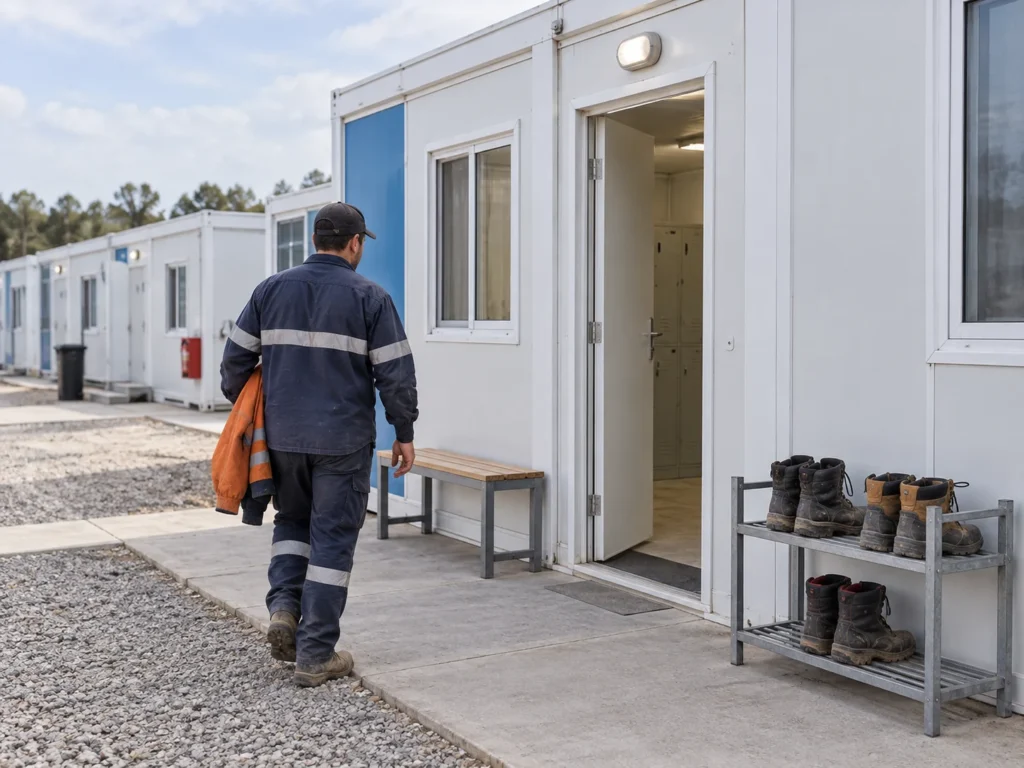
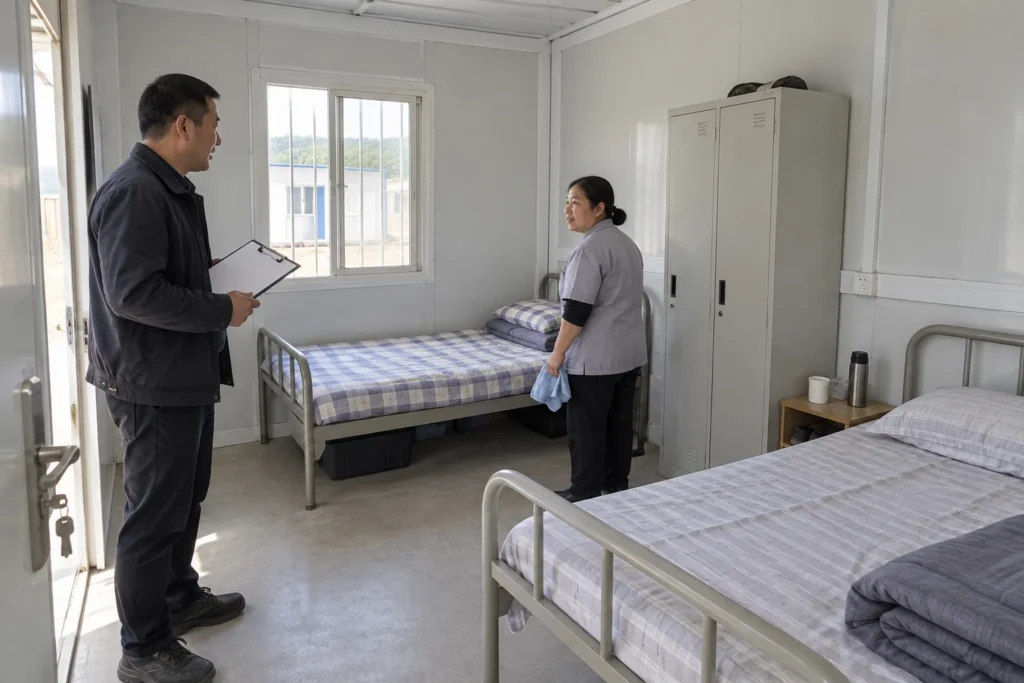
Use that sketch to distinguish ordinary routes from temporary alternatives. A toilet beside the work area can have a different approach from one serving an accommodation compound. In worker camp accommodation, the operator also needs to describe access outside the working shift, without assuming that site-office opening hours govern residents. Record which arrangements are proposed and which are actually available; a future path drawn on a plan is not an existing illuminated route.
Ask the purchaser of site services and the toilet supplier to mark their respective boundaries on the same drawing. The useful question is who supplies light at the junction, entrance and washing point, not simply who supplies the cabin. Where separate packages meet, name the person who checks the combined arrangement. That avoids treating two individually complete quotations as proof that the intervening space has an owner.
For the relevant UK construction context, HSE’s site-lighting guidance addresses artificial lighting when natural light is inadequate or absent, and notes that shadows can conceal hazards. Treat that as a scoped source statement. Your sketch is an editorial purchasing tool for identifying the locations that the responsible project team must consider, not a lighting design or a substitute for their assessment.
Make the entrance understandable before the door opens
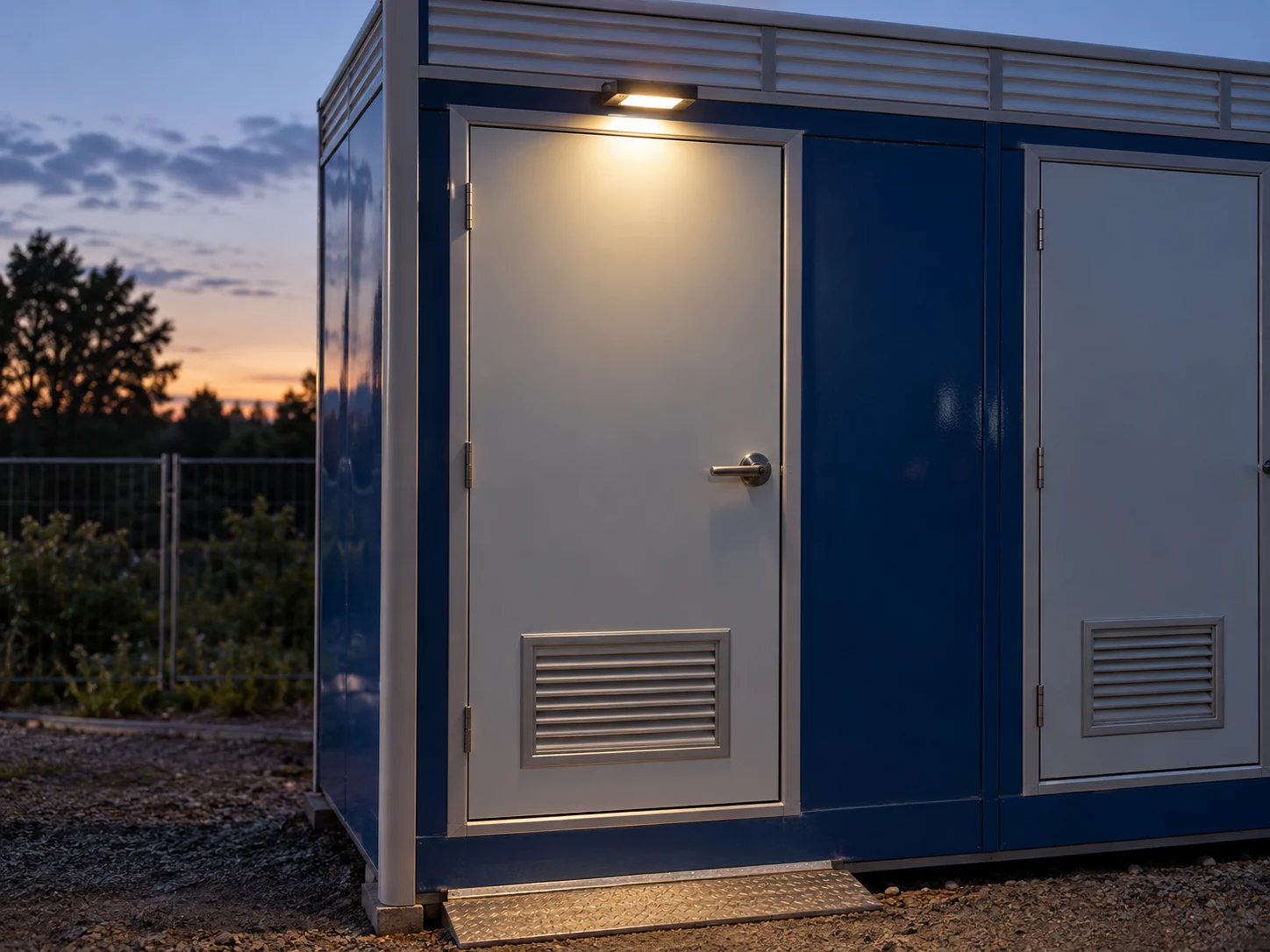
At the entrance, the person needs to recognize the correct door and its ordinary controls. Review the approach with the actual proposed door furniture, surrounding fixtures and any adjacent toilet entrances. A photograph of an open cabin does not show whether the handle or occupancy information can be understood when all the doors are closed after dark.
Keep the entrance review specific to what the unit will contain. A door-mounted fitting, an overhead canopy or an external handwash station can change the visible arrangement. Ask the supplier to identify those items on the current drawing instead of approving an unspecified “light included” line. Where a separate site contractor provides entrance lighting, include that item and its owner in the combined scope rather than adding it informally after delivery.
Consider the person leaving a construction site office after the main daytime group has gone. Who confirms which facility remains available? Can the usual entrance still be identified? Where does the person go if it is closed? These are operating questions to resolve with the project team. They do not require the buyer to make a technical judgement about wiring or to invent a universal placement distance.
Preserve the distinction between a visible light source and a useful entrance view. A supplier image can help you understand the proposed fitting, but acceptance should concern the installed arrangement and agreed operating conditions. Retain the chosen door configuration with that record. If the door furniture or entrance surroundings change before handover, the original demonstration no longer describes precisely the same visit.
Review the cabin with the door in its normal position
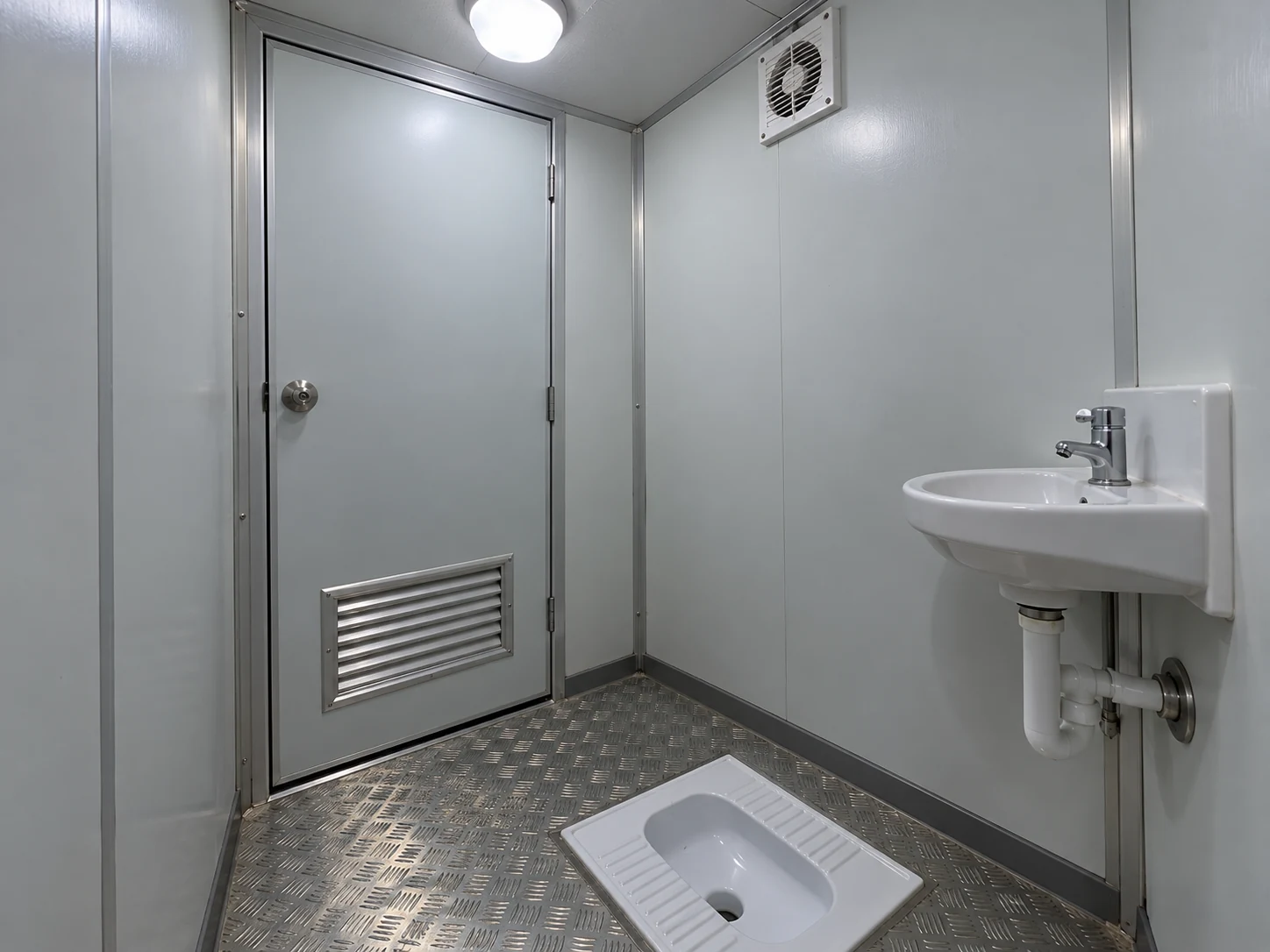
An open doorway can lend light to a cabin during a demonstration. For normal private use, review the proposed interior with the door closed and the actual lighting controls in their intended mode. The operator should know how the occupant receives light, what behaviour is expected from a sensor and how an unavailable cabin is reported.
Retain the demonstrated configuration
Ask for the operating instructions that belong to the exact supplied light and control, not an instruction sheet from a similar unit. An occupant may pause or move little during a visit. The review should therefore include the ordinary positions and sequence that the supplier says its control supports. The buyer records the stated behaviour and any unresolved limitation; the equipment provider determines suitable settings and technical suitability.
A demonstration should also retain the room configuration. Moving a light, adding a partition or placing equipment beside a sensor changes what has been shown. Identify which fixtures and controls were present in the accepted cabin and whether the demonstration represents the ordered layout. That is more informative than collecting a generic photograph in which the door, interior and control model cannot be linked to the delivery documents.
The agreed response matters when an occupant reports a problem. Name the reporting contact and who decides whether a cabin is available for further use. The purchasing record can specify a practical alternative arrangement and the evidence needed before normal service resumes. It should not instruct an occupant or cleaner to open a technical enclosure, modify a control or attempt an electrical repair.
Read numerical requirements with their area and jurisdiction
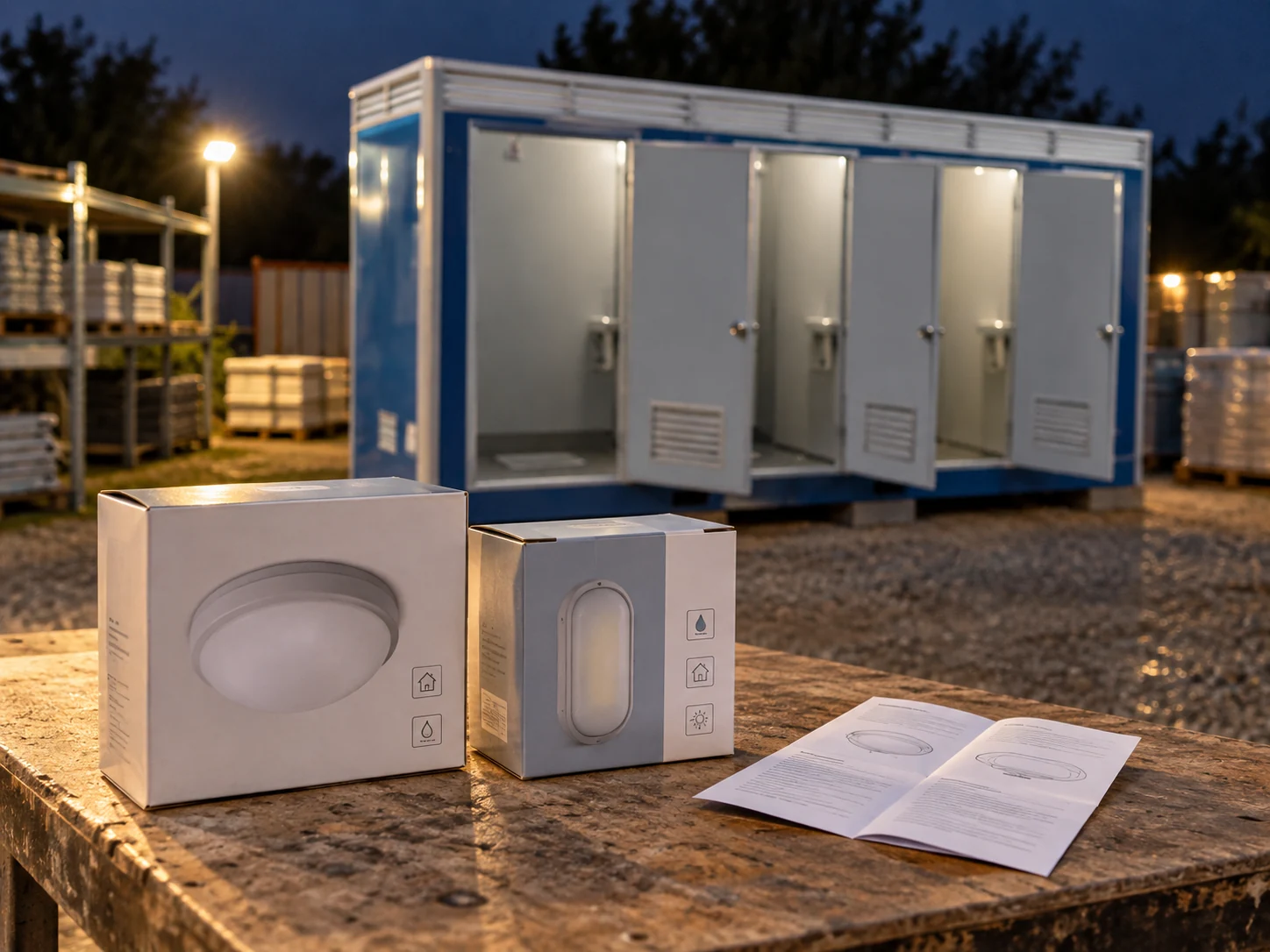
An illumination value becomes useful only when its source, unit and area category remain attached. Before inserting a number into an order, ask the responsible project professional which requirement applies to the actual facility and route. A value extracted from another country’s construction standard is a reference example, not automatic approval for your particular project.
In OSHA 1926.56(a), Table D-3, the selected US construction categories below have different minimum values while work is in progress. The table includes indoor toilets within one category, indoor circulation spaces within another, and access ways within another. The transcription preserves foot-candles; it is not a set of readings taken in a portable toilet or a PQSE performance claim.
The distinction is useful when comparing specifications. A quotation saying that its lamp is suitable for a toilet does not establish the criterion for an adjoining passage, the chosen measurement locations or the accepted operating state. Ask for the applicable project criteria and the responsible verification record. Keep that record separate from a product description, since the two documents answer different questions.
Building type alone cannot decide the answer. A construction-site toilet, a resident camp facility and an event unit can sit within different regulatory and contractual settings. The broader portable toilet planning guide helps define use, location and servicing before an equipment discussion. Confirm those facts first, and then have the relevant parties resolve the numerical requirement without blending unrelated categories into one universal target.
| Selected source area category | Minimum (foot-candles) | What this does not establish |
|---|---|---|
| Category including indoor toilets and workrooms | 10 | The applicable target or acceptance method for every portable toilet |
| Indoors: corridors, hallways and exitways | 5 | The classification of every outdoor route |
| Category including access ways | 3 | The correct criterion for an indoor toilet or another jurisdiction |
Give handwashing its own place in the review
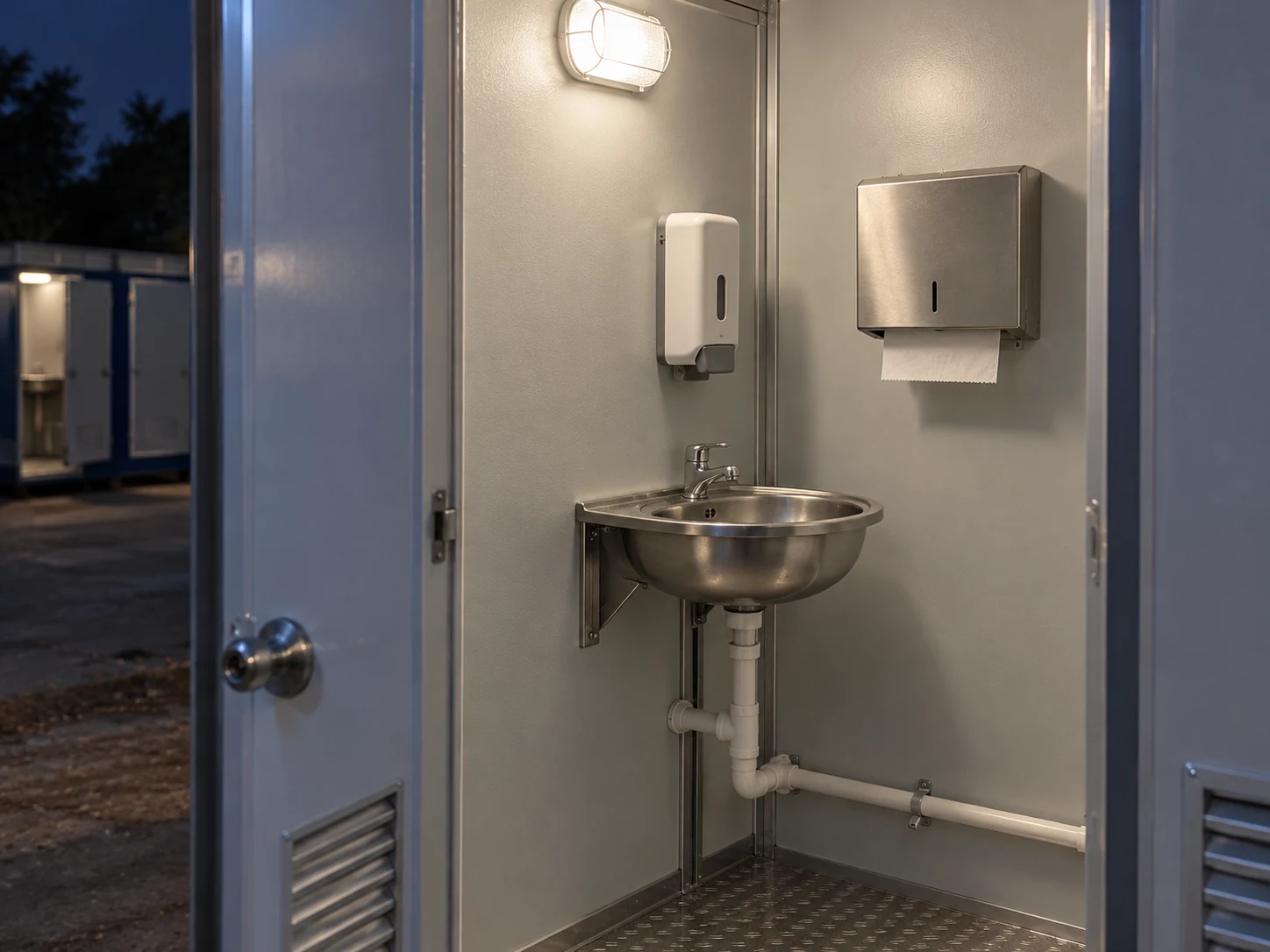
The visit is incomplete if the toilet is lit but its washing point is not usable under the intended conditions. Identify whether washing takes place inside the same unit, in another room or at an external station. Review the actual basin, tap, soap supply and drying provision together, rather than assuming the cabin light serves them.
For UK construction welfare, HSE’s toilets-and-washing guidance includes adequate lighting for washing facilities and good lighting for toilets. That scoped statement supports treating the washing task as part of the proposal. It does not provide a model-specific fitting layout or authorize applying an imported numerical criterion to your site. The relevant design and operating responsibilities still need to be named.
A combined portable bathroom arrangement can place several tasks within one enclosure. A separate washing station creates another physical and service boundary. Compare quotations on the arrangement you will use: the location of the washing point, supplied controls, operating hours and the person who checks it. Neither arrangement is automatically preferable merely because it has more fittings or shares a roof with the toilet.
Include ordinary replenishment in the discussion. The person checking soap or drying supplies may attend at a different time from an occupant. Describe that task to the supplier and operator without turning it into a technical cleaning or electrical procedure. At handover, retain the location and configuration that were reviewed, so moving the station or changing adjacent equipment is recognized as a change to the accepted arrangement.
Compare the control behaviour as well as the power label
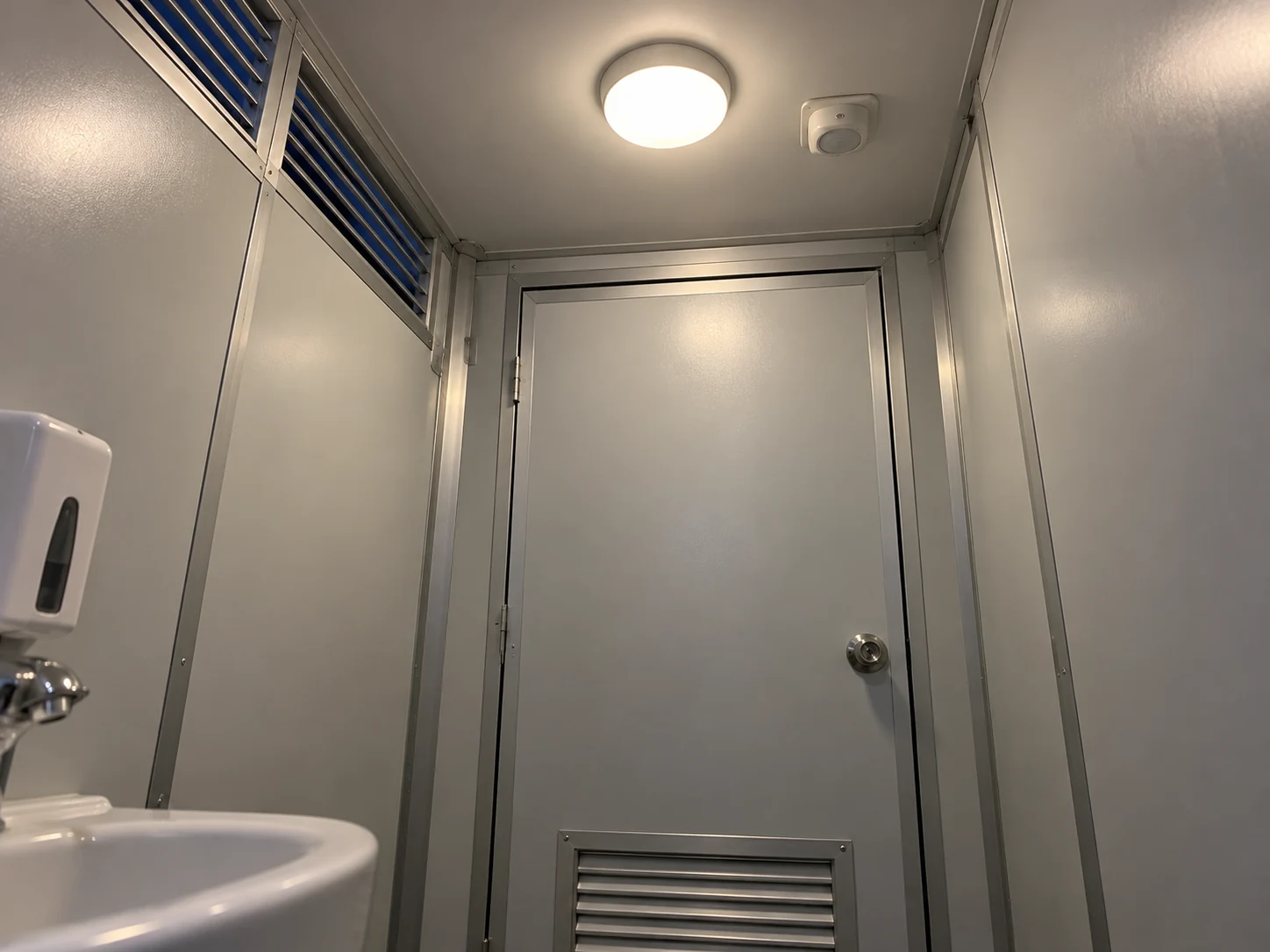
“Solar”, “battery” and “mains” describe aspects of a supply arrangement; they do not tell you how a person experiences the light. Request the exact equipment identity, operating instructions and control behaviour for the proposed unit. Compare what must be available for the complete visit, including any separate entrance or washing lights, rather than ranking labels in isolation.
A named product illustrates the distinction. Davlav’s Solarlav page describes solar-powered internal lighting with battery storage and motion activation. This is a manufacturer’s description of that product, not a PQSE specification or evidence that its arrangement serves another site. It prompts a useful purchasing question: what supplies and controls the other parts of the proposed visit?
For any offered arrangement, ask what operating assumptions sit behind the supplier’s proposal. An expected attendance pattern, the equipment’s location and the service plan should be identifiable in the documents. If the quotation relies on a condition that the site team has not confirmed, keep it as an open item. Avoid replacing that missing information with a guessed battery duration, a panel-output calculation or an assurance based on another model.
Control ownership deserves similar attention. The person authorized to manage operating schedules may differ from the cleaner or the person reporting an unavailable cabin. Document who can request a change and who supplies the corresponding approved instructions. A comparison becomes meaningful when both offers answer the same tasks and operating conditions, not when one lists an extra technology word.
Agree what remains available after the site closes
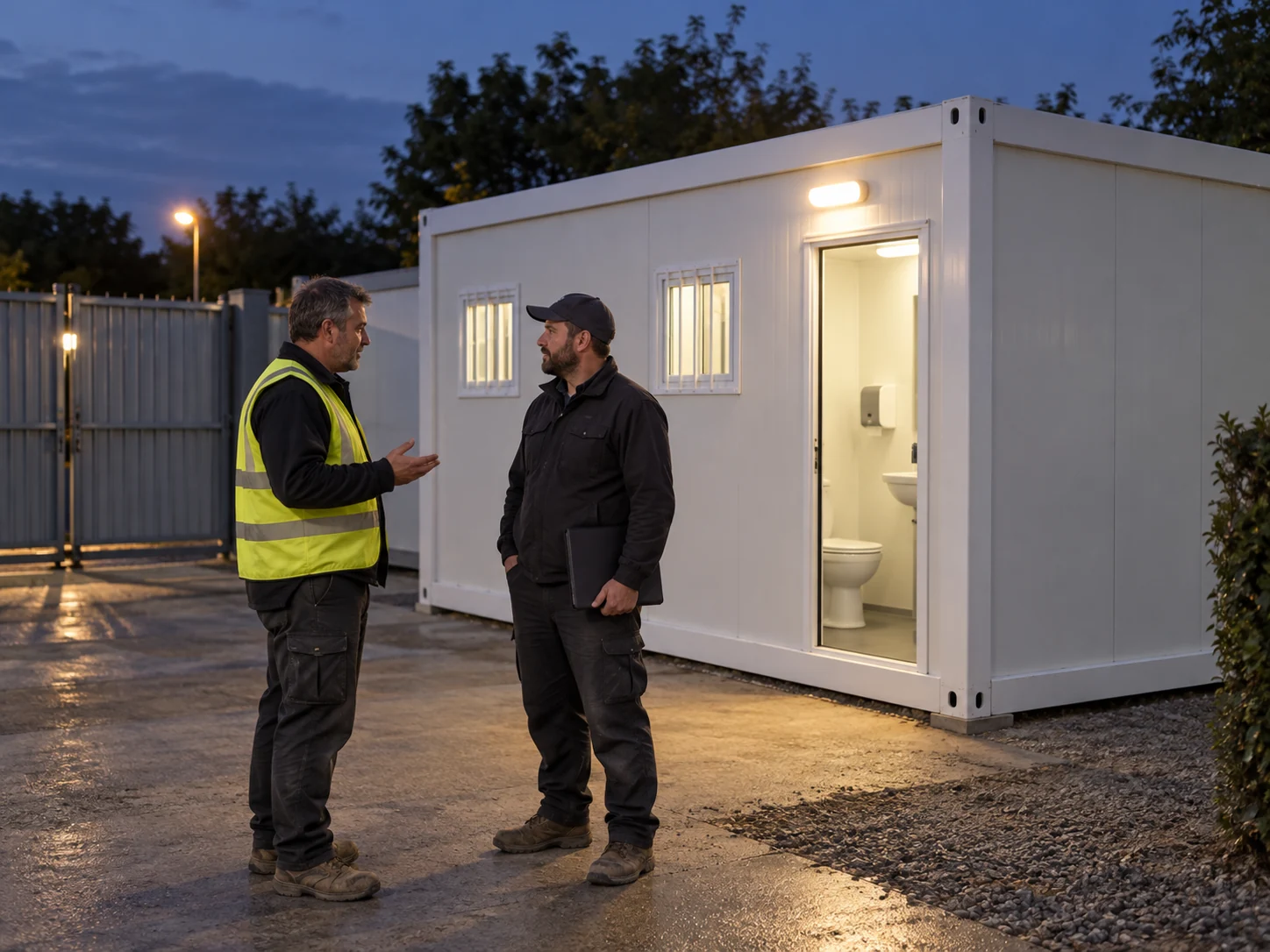
A toilet can remain open after equipment elsewhere has been shut down for the day. Put the facility’s opening period beside the actual site operating schedule and ask the responsible parties to reconcile them. Include who confirms that the agreed arrangement remains available and how the operator learns about a planned change affecting it.
Separate supply, operation and reporting
The modular building utility-planning guide separates building supply from site interfaces. Apply that distinction here without trying to design the connection yourself. A supplier can state what its unit requires; the site’s responsible electrical party confirms the proposed provision and approved handover. The operator needs a clear record of what is intended to stay available, not an assumption that every site circuit follows the same schedule.
Discuss interruptions as an operating condition with the responsible team. If the normal arrangement is unavailable, what information reaches the operator and what alternative facility is authorized? Any technical provisions or required emergency-lighting performance belong to the applicable design and assessment. The buyer’s role is to ensure that the order and handover records identify who supplies those decisions and how they are communicated.
Keep planned interruptions distinguishable from faults. A scheduled service attendance, an equipment problem and a site-wide change may call for different contacts. A concise contact and responsibility record can preserve those distinctions without asking users to diagnose the supply. Where an offer leaves a necessary interface outside its price, identify that exclusion before comparing totals or accepting a delivery date.
| Offered arrangement | Information to request | Interface that still needs an owner |
|---|---|---|
| Site-supplied lighting | Exact equipment requirements and approved operating provision | Availability outside the wider site’s shutdown schedule |
| Self-contained supply | Model instructions, stated operating assumptions and service arrangement | Separate route, entrance or washing lighting outside the package |
| Automatic control | Documented activation and continued-use behaviour | Authorized settings review and response to an unavailable cabin |
| Scheduled or manually managed control | Who manages the intended operating period | Changes between occupant access and cleaning or service attendance |
Buy an understandable service arrangement
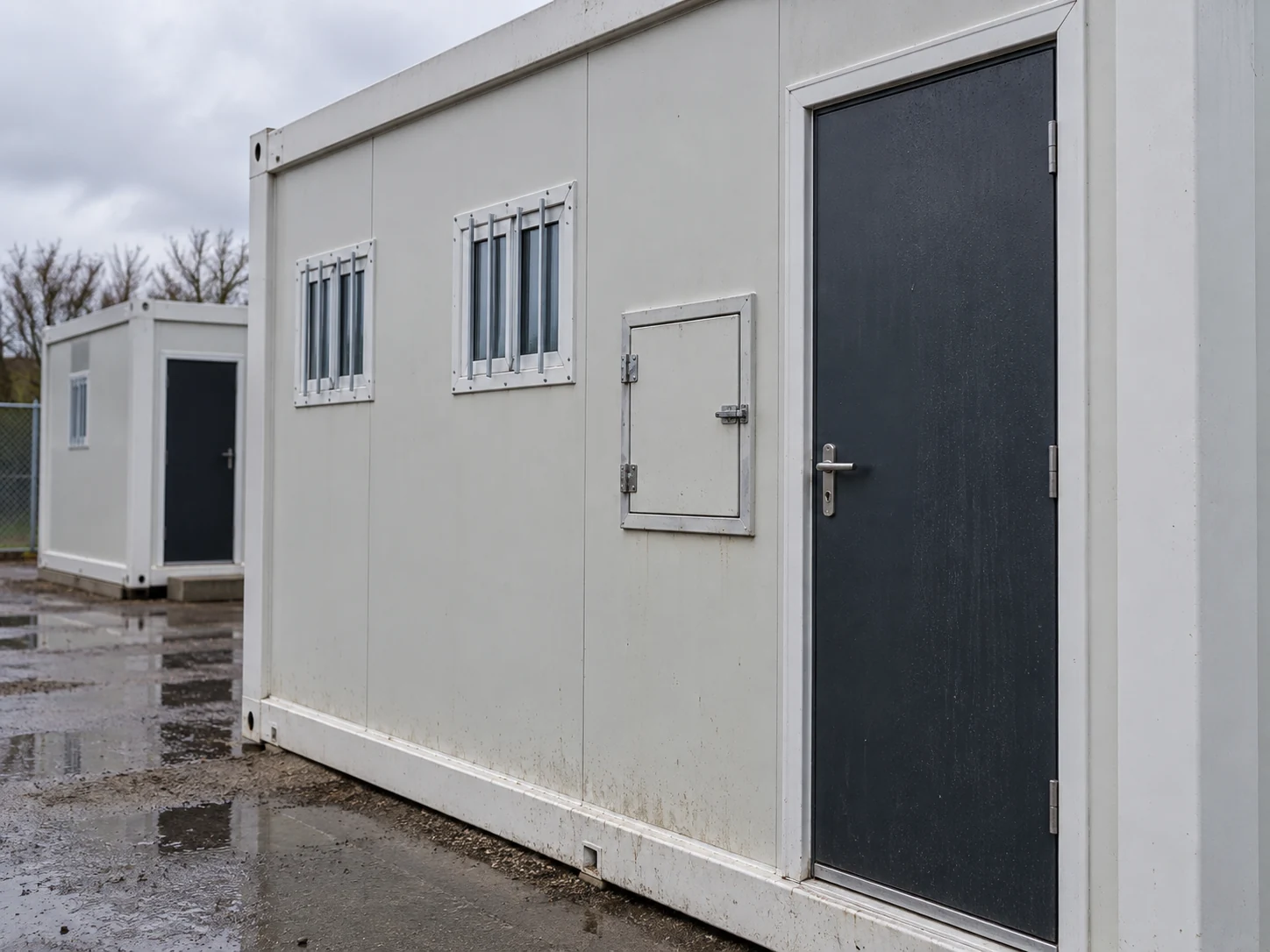
A technical hatch or concealed fitting can belong to equipment that only an authorized service provider handles. Ask the supplier to identify the relevant equipment, supplied instructions and approved service contact. The operator needs to know what can be reported and who attends, without treating general access to the toilet as permission to open electrical components.
Include the replacement route in the quotation discussion. Ask how the service provider identifies the correct light or control for this unit and what information it needs when a problem is reported. A generic description such as “standard LED” is not a complete replacement identity. Retain the delivered item’s documented model or part reference where the supplier makes it available, together with the equipment and room identity.
Physical access and contractual responsibility answer different questions. A clearly identified hatch can still require an authorized technician, while a maintenance contract can still omit equipment outside the cabin package. Request a scope that links the actual service points to the responsible provider. This is a purchasing clarification; it does not instruct the buyer how to remove a panel, isolate a circuit or test a component.
Finally, distinguish stock availability from restoration of service. A spare package on a shelf does not prove that anyone is authorized or equipped to fit it, or that the room can reopen without the agreed check. Ask how a reported issue moves through the service arrangement and who records the resulting decision. Keep technical procedures with the appropriate provider rather than improvising them in an accommodation or cleaning instruction.
Include the cleaning visit, not only the occupant visit
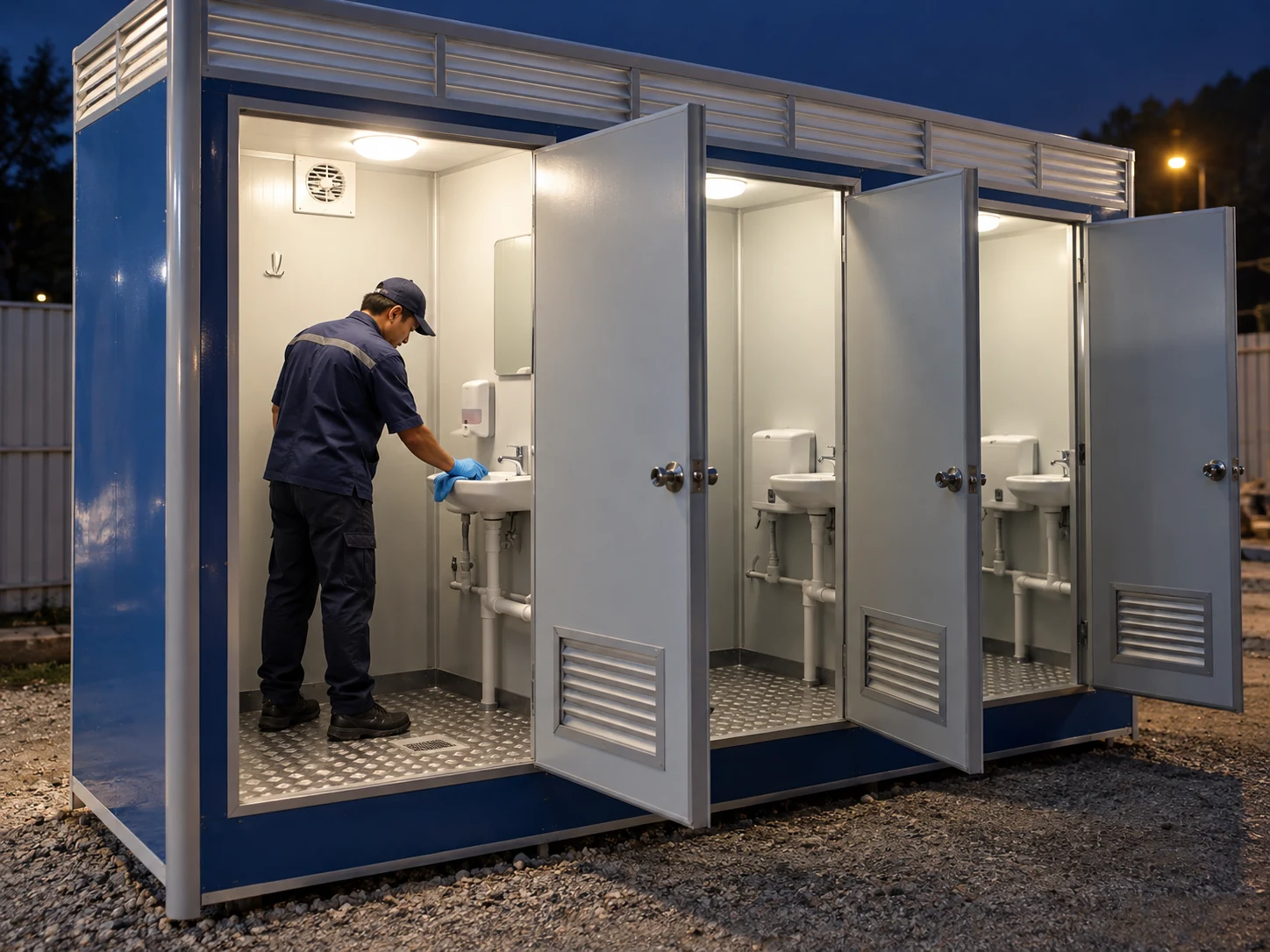
Cleaning and replenishment can take place when the usual occupancy pattern has ended. Describe where the cleaner attends, which facilities are available and who reports a lighting problem before the service starts. Keep that attendance in the operating brief, so a control arrangement approved only for occupant use is not assumed to cover every contracted task.
Use the existing construction site toilet service plan to coordinate cleaning, washing supplies and downtime. Add lighting ownership to those arrangements without substituting it for sanitation service. A bright cabin still needs an adequate cleaning and supply plan, while a complete pump-out or replenishment contract does not necessarily include the light, control or adjacent site installation. Confirm what each provider actually supplies.
Ask the contractor how a lighting limitation is recorded and communicated to the operator. The useful record identifies the facility, time, observed issue and person notified. It does not need a cleaner’s unsupported diagnosis. If the contract relies on a different attendance period or an alternative facility, state that arrangement clearly enough that the operator can manage availability and the contractor can plan its visit.
HSE’s site-lighting guidance also distinguishes normal lighting from provision for circumstances in which its loss creates risk, and discusses emergency-route lighting. That remains a UK construction reference, not an instruction to improvise a backup on this project. Have the responsible team establish applicable provisions; then ensure the operator and service contractor receive the relevant, approved information for their respective work.
Accept the combined arrangement in its intended conditions
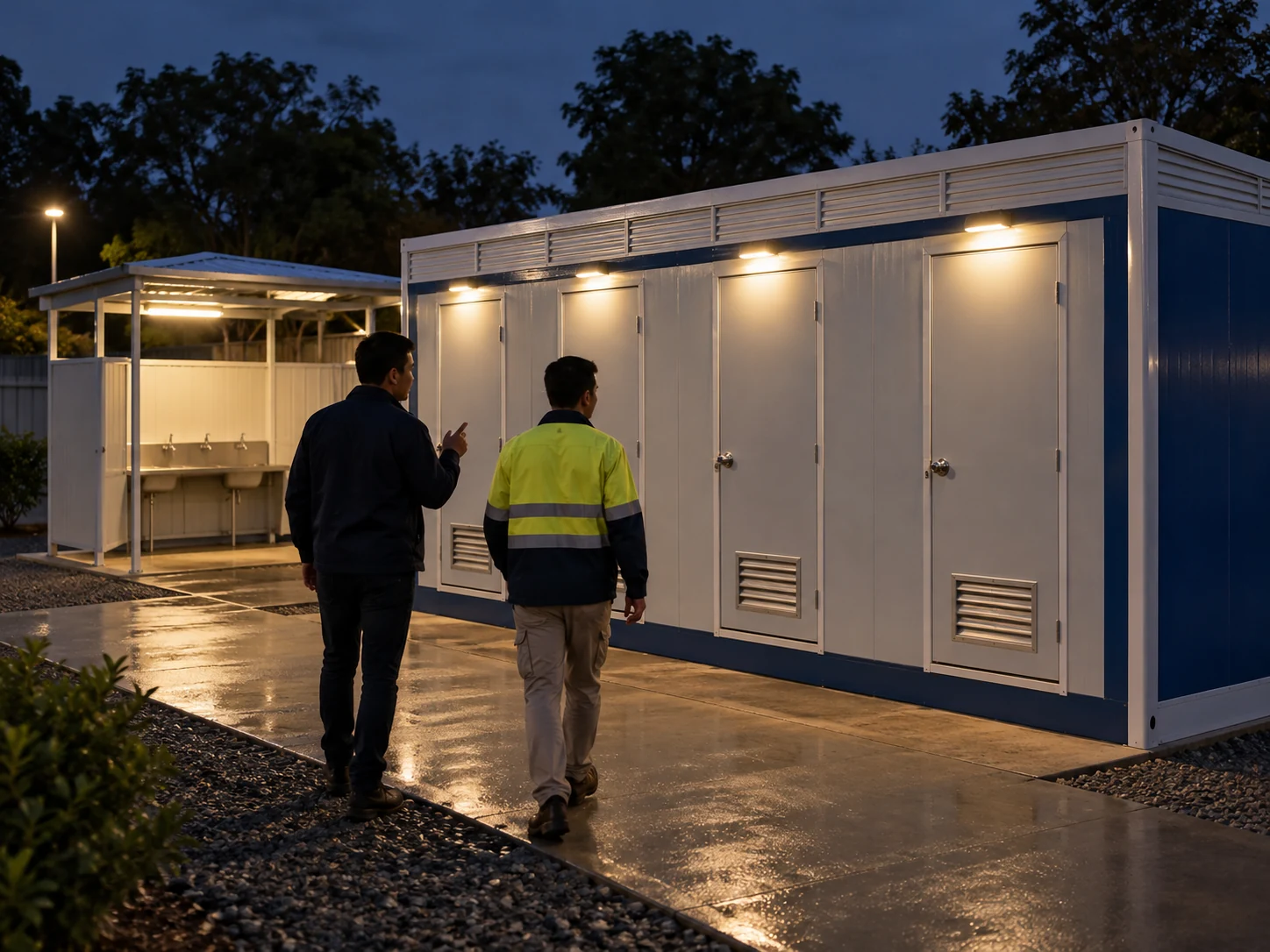
The acceptance record should connect the ordered unit, the completed site interfaces and the stated operating conditions. Agree who demonstrates the relevant functions and who supplies any required technical verification. An after-dark walkthrough can identify unresolved purchasing or operating questions, but it does not by itself constitute a competent electrical inspection or a compliance certificate.
Keep open items tied to an owner
Prepare a short acceptance brief before the visit. It should identify the unit and location, the actual supplied equipment, the route and washing arrangements, and the operating state to be demonstrated. Where a numerical criterion applies, the responsible party supplies the applicable requirement and verification method. Record its results as that party’s evidence instead of turning a photograph or informal impression into a measurement.
Close out each unresolved item with its owner and a defined recheck. A successful interior demonstration cannot settle an unprovided route light, just as a complete drawing cannot show that the delivered control behaves as ordered. Retain the accepted configuration and the corresponding instructions together. Changes to location, equipment or the operating schedule should be visible to the parties who decide whether further review is necessary.
For an order-specific discussion, give PQSE House the destination, proposed toilet arrangement, operating and cleaning periods, site layout and known interface responsibilities. Mark requirements that still await local confirmation. This lets the supplier describe its actual inclusions and exclusions against a clear brief. It also gives the operator a usable handover record, rather than leaving the whole after-dark visit implied by one catalogue line.
| Scope item | Evidence or clarification to retain | Responsibility to identify |
|---|---|---|
| Supplied cabin lights and controls | Delivered equipment identity and applicable instructions | Unit supplier and approved service provider |
| Route, entrance and washing interfaces | Current layout, supply boundaries and outstanding items | Relevant site and facility package owners |
| Operating periods | Agreed occupant, cleaning and service availability | Site operator and contracted service team |
| Applicable technical acceptance | Project criteria and the responsible party’s verification record | Competent party appointed for the relevant work |
| Open issues and return to service | Issue, owner, required check and recorded decision | Operator and relevant responsible provider |
Buyer questions
Does a motion-activated interior light settle the whole lighting requirement?
No. It describes a control for the equipment to which it is connected. Ask how the specific supplied arrangement behaves during the intended visit, including ordinary pauses, and identify the entrance, washing point and return route separately. Obtain the actual model’s instructions rather than treating another product’s operating description as interchangeable. The operator also needs a reporting route and an understood alternative when a cabin is unavailable. None of these questions proves that the project meets its applicable lighting requirements; the responsible parties must establish those requirements and provide the appropriate verification. Comparing offers against the complete visit makes their inclusions and unresolved interfaces clearer.
What if the quotation does not identify the applicable lighting criterion?
Keep that point visible rather than supplying a number yourself. Give the intended use, destination and layout to the party responsible for the project requirements, and request the applicable criterion and acceptance record. Ask the supplier which equipment and documents its offer actually includes. The buyer can then compare the two scopes and identify any outstanding interface. A quotation may correctly describe a lamp yet still leave project verification to another provider. Agree who owns that remaining work, when the necessary information is due and what must be confirmed before acceptance. Do not treat a catalogue photograph, a technology label or an informal walkthrough as a replacement for a required technical assessment of the actual arrangement.
What information makes an after-dark quotation easier to compare?
Provide the proposed location and route sketch, facility and washing arrangement, occupant access periods, cleaning attendance and known site-supply responsibilities. Ask each supplier to identify the exact equipment it offers, its controls and instructions, service arrangements, inclusions and exclusions. Request that assumptions and unresolved local requirements remain visible. Compare those answers against the same brief instead of counting lights or comparing technology names alone. Before handover, agree who demonstrates the delivered functions, who supplies any technical verification and who owns outstanding items. Keep the accepted configuration with the operating contact record, so the operator can distinguish an equipment issue from an unresolved site interface or a planned change.
Sources and scope
- HSE — Site lighting. UK construction guidance; page dated 2024-10-30. No project-specific lighting design is inferred.
- HSE — Construction welfare: Toilets and washing. UK construction welfare guidance, updated 2024-11-06; lighting, washing and ongoing operation.
- OSHA — 1926.56 Illumination, Table D-3. US construction categories in stated working conditions; selected foot-candle minima, not product measurements.
- Davlav — Solarlav. Named manufacturer arrangement for internal solar/battery/motion lighting; not PQSE specifications.
Prepared for PQSE House as a research-based purchasing guide using the linked source text and independent planning analysis. The photographs are newly generated illustrative scenes guided by genuine original structural references; they do not document an installed PQSE project, a measured lighting result or an approved electrical installation. No human professional review or independent endorsement of PQSE is claimed. Confirm local requirements and the actual supplied configuration with the responsible parties.