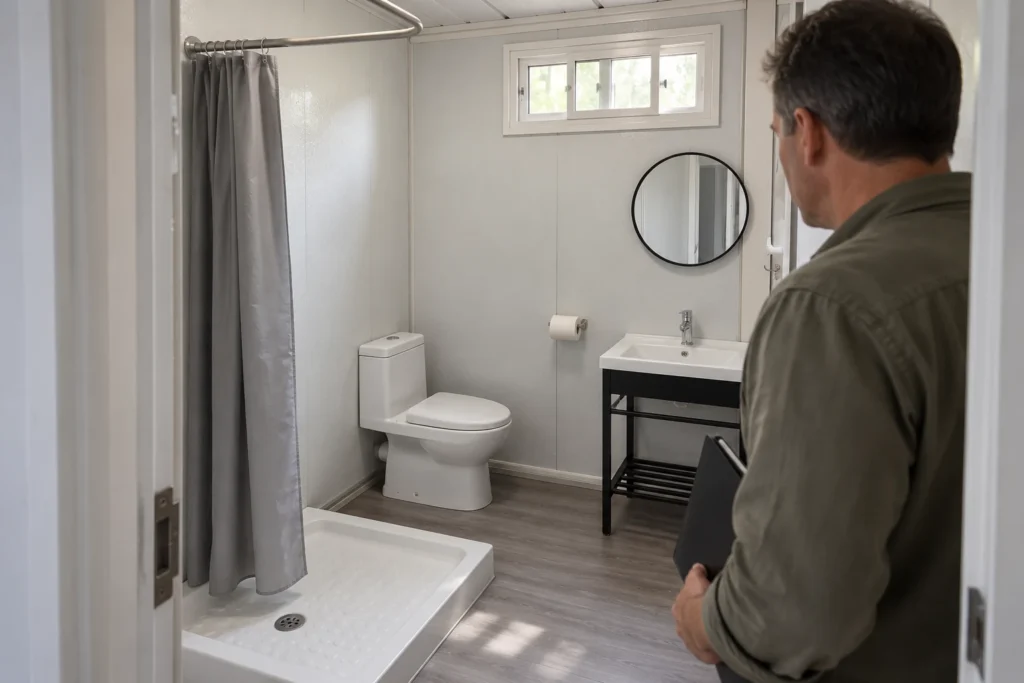
A construction toilet can be correctly installed and still become unusable before the next shift. The door works, the fittings are in place and the site has enough cubicles on the drawing, but paper has run out, the washbasin has no water, a service vehicle cannot reach the facility or a leaking connection has taken one room out of use. The practical answer is an operating plan with named people, observable checks, an agreed service route and a way to keep a usable alternative available during a fault.
A recent r/Construction discussion about bathroom standards makes the distinction visible. Commenters describe cleaning, supplies, handwashing and heat as day-to-day problems. These are individual experiences and advocacy, not proof of a universal failure rate or a legal standard. They are a useful prompt for a buyer: after the building is delivered, who is responsible for keeping every required function available? This article answers that question for a prefabricated toilet cabin or modular restroom block and explains where a rented plastic chemical toilet requires a different service arrangement.
Start with the sanitation system you have actually bought
“Portable toilet” can describe several different systems. A small plastic chemical unit may be hired with a waste tank and a regular pumping contract. A prefabricated panel cabin may instead contain a flush WC and basin that need a site water supply and an approved wastewater route. A larger steel-frame block may combine several cubicles, basins, ventilation and lighting. One operating procedure cannot assume that these packages share the same waste storage, cleaning materials or service responsibility.

PQSE’s portable toilet cabin specifications show compact cabin configurations and a separate multi-cubicle steel-frame block. The illustrated flush configurations need coordinated water and wastewater connections. A holding tank, pumping service or off-site waste contract should be treated as an explicit project item, not an implied feature of the basic cabin. Ask for the selected model drawing, fixture schedule, surface materials, connection positions, delivery format and care information before assigning cleaning or maintenance work.
The portable sanitation product range also includes bathroom and shower arrangements. A mixed facility can share site services, but a cleaning plan for a toilet cubicle does not automatically cover a wet shower room. Identify each room and its purpose in the operating inventory. Mark which fixtures are supplied inside the module and which external services the destination team must provide. This prevents a service contractor from discovering after handover that a drain, tank, water source or spare-part route was never included in its scope.
Give the daily operation a named owner
The owner of a toilet building is not necessarily the person who can restore it during a working shift. Split the work into four lanes: the project employer or site manager establishes the required provision; the facilities operator checks use and arranges cleaning; the technical maintenance team resolves building and service faults; and any external sanitation provider performs the specific pumping or contracted service it has agreed to deliver. Write the names, contact method and escalation path beside each lane. A supplier quotation for a building is not a promise to run the facility afterward.
Separate a site check from a specialist service visit
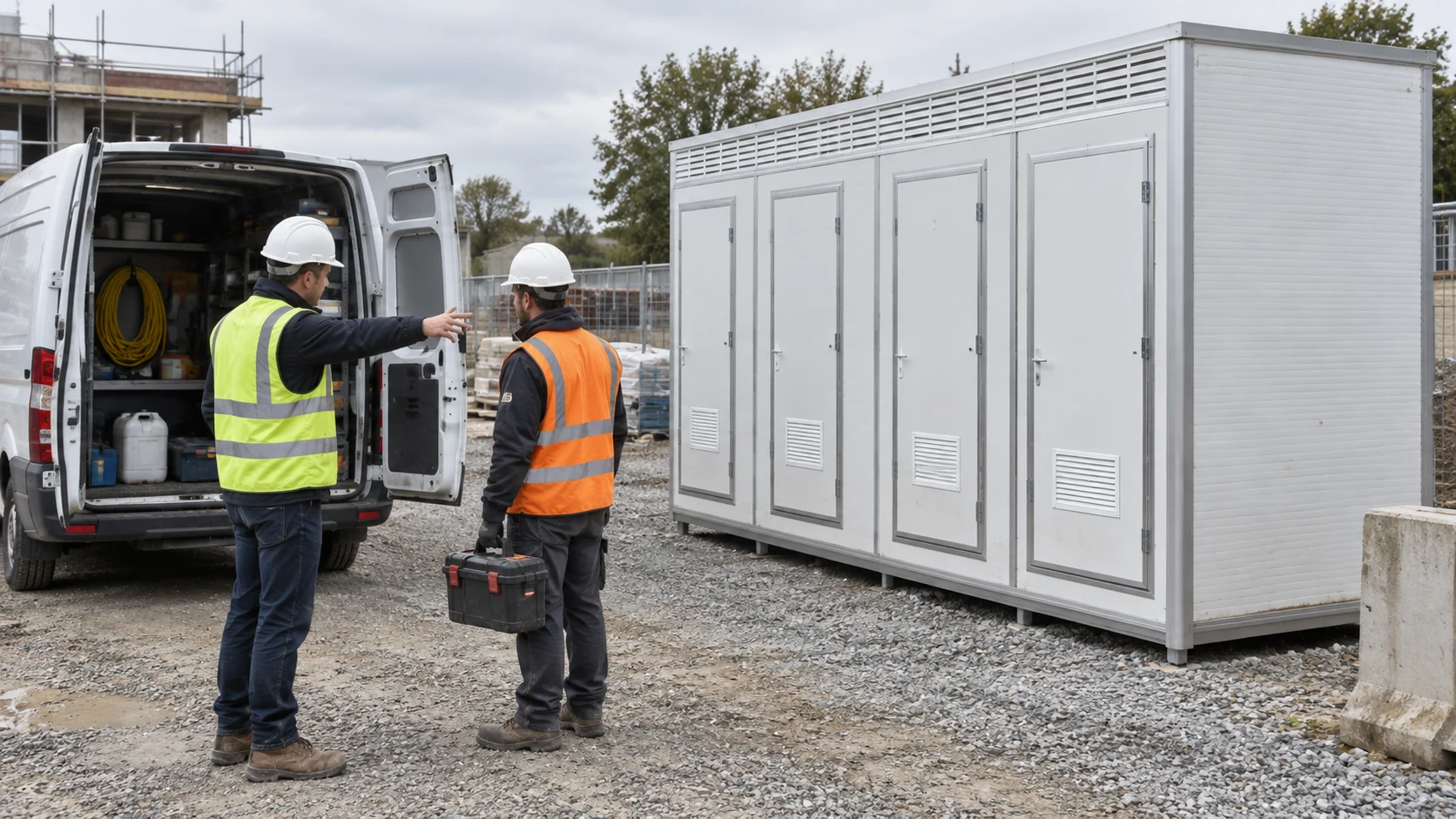
A site attendant can check whether a door opens, lighting works, floors are clean, paper and soap are present, basins function and the path remains usable. That is different from a specialist emptying a waste tank, repairing a supply line or testing electrical equipment. The service schedule should say which observations the attendant records and which work only a qualified contractor may undertake. It should also identify the person who decides whether an affected room is temporarily withdrawn from use.

Make the reporting route visible to the people using the facility
Workers should know how to report a missing consumable, failed light or unusable cubicle without guessing which subcontractor owns it. A simple message route can work if somebody is assigned to receive it, act, and confirm the result. A report left on a general project group may be seen by many people and owned by none. Ask the operating team to test the route during commissioning: report a staged low-soap condition, observe who receives it and time how the response is closed. This is an operational rehearsal, not a claim about a manufacturer’s response time.
Check the room before the first users arrive each day
Make the first check a walk through the actual user route, not a signature at the site office. Approach the facility from the work area. Is the path clear, lit when needed and usable in the current weather? Does the door latch and preserve privacy? Is the floor reasonably clean and dry for its intended use? Are the toilet, flush, basin, soap and drying supplies working? Is the space ventilated and is the waste system behaving normally? The check should include the exterior service side, because stored pallets or parked vehicles can block the next visit even while the inside appears acceptable.

Use a short record that distinguishes three outcomes: available, available after a minor correction, or out of service. Record the cubicle or module ID, the observation, who was assigned, and when it was rechecked. A blanket “all okay” mark gives the next shift little help when one basin has failed. The site should decide which conditions require immediate restriction and who authorizes return to use. Where one module contains several cubicles, a single-room fault may be managed differently from a shared water or drainage failure that affects the whole block.

The daily check complements, rather than replaces, the underlying toilet quantity and layout plan. A correctly calculated cubicle count is a planning input; it does not tell the operator how many cubicles were actually available at 07:00 today. Compare the planned provision with the open and usable rooms at the shift start and after any closure. If the usable provision falls below the site’s applicable requirement, the project must implement its approved alternative immediately rather than wait for a routine visit.
Set cleaning frequency from observed conditions
Calendar intervals are a starting point, not a guarantee of cleanliness. The UK HSE guidance on construction toilets and washing says these facilities need regular cleaning and that daily cleaning may not be sufficient on muddy sites. The relevant standard for your destination may be different, so the responsible team should confirm local requirements. For the operating plan, observe traffic by shift, floor dirt, consumable use, the state of basins and the time before a room becomes unacceptable. Increase the check or cleaning interval when those observations require it.
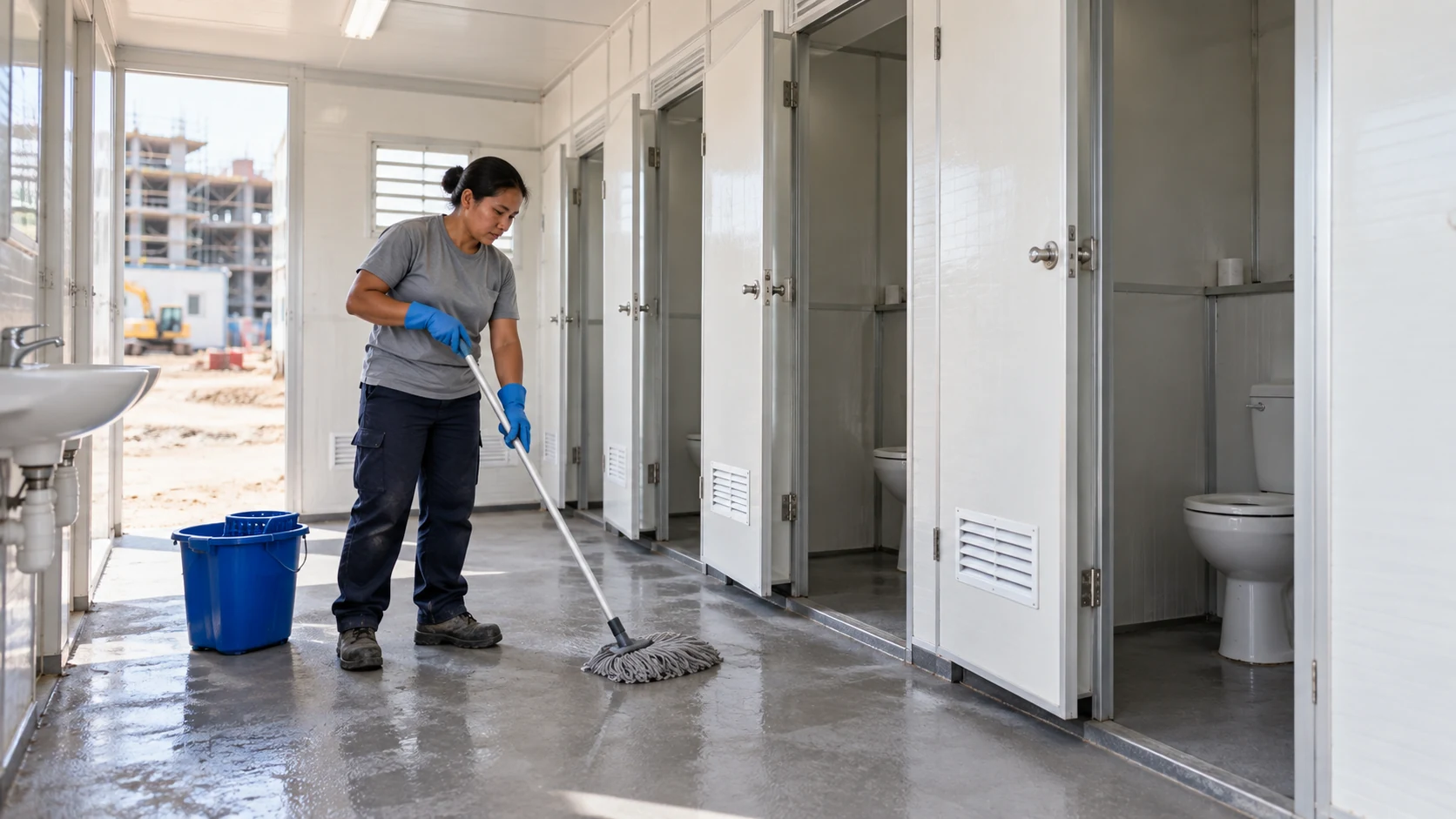
Define what “cleaned” means for the selected materials. A contractor should know which surfaces, floor junctions, door handles, basins and fixtures are included; what products are compatible with the supplied finishes; where cleaning water comes from; and where used water goes. Do not assume an aggressive product is suitable for panel skins, seals, flooring or metal fittings. The manufacturer’s care information and the local cleaner’s risk assessment should guide the method. A photograph of a freshly washed floor is not evidence that hidden leaks, supplies and handwashing have been checked.
Keep routine cleaning and fault repair separate in the record. A cleaner can note a loose handle or dripping pipe, but a technician must own the repair. If the same defect appears after several cleaning visits, the service process has not closed the issue. Track repeated failures by fixture or location so the operator can decide whether a small repair, component replacement, layout change or higher capacity is needed. This is more useful than repeatedly increasing cleaning visits when the root problem is a failing fitting or inadequate access.
Make handwashing a functioning service
A basin shown on a floor plan is only part of handwashing. The user needs a workable water supply, suitable soap or cleanser, a means of drying hands, a drain or collection route and a location that is practical after leaving the toilet. The HSE toilet and washing guidance describes these elements for UK construction welfare and warns that a tiny basin with only sanitizer may be inadequate without other suitable washing facilities nearby. The U.S. OSHA construction sanitation rule applies in a different jurisdiction. Do not copy one country’s fixture or service rule into a global procurement specification; ask the destination’s competent team to identify what applies.
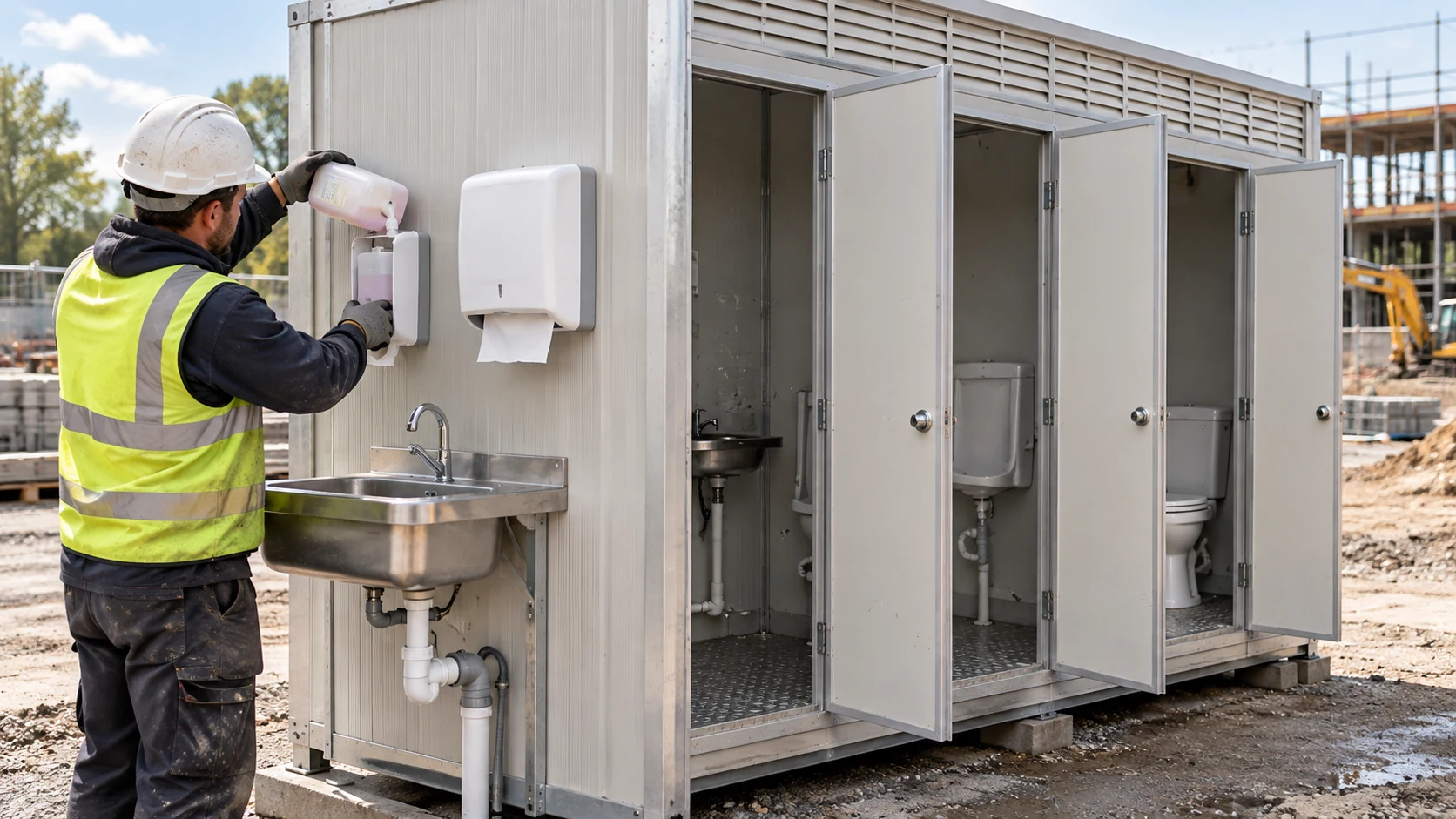
The operational question is what happens when a supply fails. Is there enough spare soap and paper on site? Who refills it between formal cleaning visits? Can someone reach the basin without crossing a hazardous vehicle area? If a water tank is used, who monitors replenishment and water quality under the applicable plan? If a connected supply is used, who isolates a fault and verifies restoration? If the facility also serves workers exposed to specific contaminants, the responsible safety team must review suitable washing separately from general comfort.

Where a project uses portable bathroom units or separate shower units, map the wash and drying sequence rather than treating all fixtures as interchangeable. Show where clean and wet routes meet, how a shower room is cleaned while users still have access to toilets, and which hot-water or drainage interruption would affect multiple rooms. The portable shower planning guide addresses the user-flow and capacity decisions; the operating team must then turn that plan into a workable cleaning and downtime schedule.
Keep the service route open when the site changes
A site may have a clear access road at installation and lose it a month later to material laydown, fencing or a new phase of work. Walk the servicing path with the actual vehicle type or contractor information, including gate hours, turning space, ground bearing, pedestrian separation and the position where supplies are unloaded. The Portable Sanitation Association International asks customers to discuss terrain, curbing and access for larger service vehicles when renting units. Those rental considerations are not a specification for every connected modular cabin, but the access principle carries over: cleaning, repairs and waste handling fail when the responsible team cannot reach the equipment safely.

For a connected prefab toilet block, identify the clean-water connection, wastewater destination, isolation point and maintenance side on the current site drawing. A suction truck may be unnecessary if the block is connected to an approved sewer; it may be essential if a separate holding system was selected. Do not promise a vehicle service method until the actual wastewater design is known. Also keep the worker approach distinct from waste handling and heavy vehicle movement. A route that saves service time but conflicts with the normal pedestrian path can create a different operating problem.
Review access whenever construction phases change. Put the check on the same change-control list used for fences, stores and temporary roads. The service provider should be told before a gate moves or a unit is relocated, rather than discovering a blocked route during a scheduled visit. If servicing cannot occur, record an alternative date and how the site will maintain sanitation in the meantime. “The truck could not get in” is a failure of the site plan that needs an owner, not merely an excuse to skip a visit.
Distinguish connected cabins from tank-serviced units
For a connected cabin, routine work may focus on flushing performance, water pressure, basin function, leaks, traps, ventilation and the approved wastewater interface. A plastic chemical toilet rental usually has a different waste tank and pumping process. A modular block can also be configured with a tank, but it is not safe to infer that from the word “portable.” The PQSE toilet product page explicitly asks buyers to agree the inlet, outlet and sewer or tank arrangement with the site plan.

Put the selected waste route in the handover pack. It should identify who supplies the external pipe or tank, who connects and tests it, who receives a blockage alarm or complaint, and who disposes of waste in accordance with local requirements. If the operator assumes the manufacturer included pumping while the manufacturer supplied only a building and internal fixtures, a service gap appears immediately. Use a scope matrix that names the building-side interface, external service, operator and evidence of successful testing.

Do not turn this article into a do-it-yourself plumbing method statement. Connection design, wastewater handling and electrical isolation need qualified local review. The buyer can still ask effective questions: Can the maintainer safely reach the connection? Is there an isolation method? Can a leak be identified without closing the entire block? Are replacement parts available for the selected fixture brand? What signs require withdrawal from service? The answers belong in approved project documents, not in a generic marketing image.
Stock consumables and simple spare parts close to the need
Paper, soap, drying supplies, cleaning tools and compatible replacement parts have different replenishment cycles. A storeroom may have plenty of toilet paper while a remote toilet block runs out during a shift. Decide what minimum stock is held at each facility, what remains in a central store and who moves it. The number should be based on observed use and supplier lead time, not an arbitrary claim that one pack lasts a certain number of workers. Track issued quantities and repeated shortages by location.

For an extended worker camp accommodation project, the toilet block may be used at night and outside a normal construction shift. A mining camp accommodation site may also face long resupply routes and shift-change peaks. The operator should verify that essential consumables and basic repair parts remain available when the usual storekeeper or supplier is not on site. This does not mean every site needs the same stock list; it means the stock list should reflect the site’s actual operating hours, distance and approved alternatives.
Separate consumables from parts requiring a skilled installer. A spare door latch can be held in the store, but a faulty electrical fitting or wastewater connection needs the designated technician. Match parts to the actual model and keep their identification in the handover record. If a substitution changes a fixture’s performance or required clearances, obtain the appropriate review before installation. A generic “spares included” line is less useful than an itemized list with quantities, storage location and reorder responsibility.
Decide what happens when a cubicle is unavailable
An operating plan should describe failure in plain language. If one latch will not secure privacy, that cubicle may be closed while others remain available. If the shared water supply, drainage or electrical service fails, the whole block may be affected. The response depends on the project and its local requirements, but a practical sequence is to identify the affected rooms, prevent use where necessary, tell users the alternative, assign repair, verify the function and record the reopening decision. Someone should be able to make that decision during nights and weekends when the facility is in use.
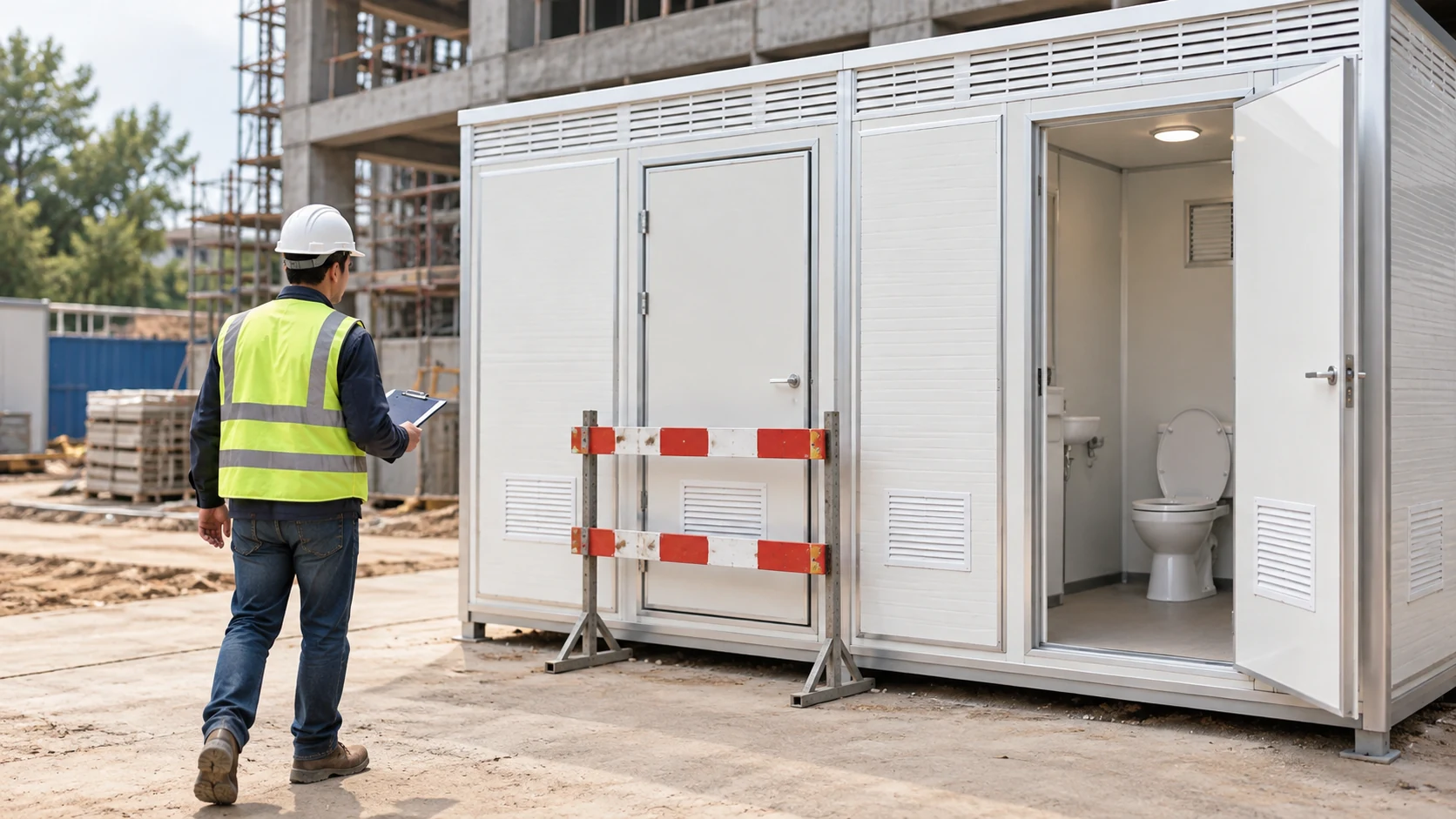
Test the alternative before the failure happens
An “alternative facility” on a drawing is only credible if it is open during the relevant shifts, reachable from the work area, appropriate for the users and still within the site’s applicable sanitation plan. Walk that route. Check whether access requires a locked gate, transport or a shared building that closes at night. Then rehearse a short interruption: one cubicle closed for a leak, a basin without water, or a missed contracted visit. Who informs the next shift, and what evidence shows the problem was actually corrected?

Keep the reason for closure visible in the service record
Avoid vague entries such as “maintenance.” A concise record can state that a basin had no water, a door would not latch or a connected drain showed a leak. Include the time, affected unit, temporary arrangement, assigned contractor, repair evidence and final check. The public-facing message can remain simple and protect privacy. This record helps the operator see whether the same defect is recurring and whether the backup capacity was sufficient. It also prevents a closed room from being accidentally counted as available in the next day’s provision.
Review demand at shift peaks and after project changes
The highest demand may occur at shift change, before a meal or after a dirty work activity. A quiet mid-morning inspection can miss these patterns. Observe the queue and the condition of the facility during relevant use windows, without collecting personal information. Ask whether cleaning can be scheduled without removing all nearby provision at the busiest time. For a site with sleeping accommodation, protect the rest period of off-shift residents from service noise and vehicle movements.
When the number of users, working hours or site footprint changes, revisit three separate questions: is the number and type of open cubicles still appropriate; can handwashing and consumables keep pace; and can the service team still reach the facility? Additions to a camp or a new remote work front can make one previously adequate block inconvenient or overused. The existing toilet planning guide covers initial user population and layout; use its assumptions as a baseline, then amend the operating plan as the actual project changes. Do not treat an opening-phase count as permanent approval for later phases.
Write a service agreement that can be checked
If an outside operator handles cleaning or tank service, define the included tasks and evidence. State the facilities covered, normal service window, work performed inside and outside each room, consumables supplied by each party, waste-handling scope, missed-visit reporting, emergency contact, and repair exclusions. The agreement should distinguish a visit attempted from a visit completed. If a locked gate or unsafe route blocks access, the service provider should report that promptly and the site should have a named person to restore access or arrange an alternative.
Separate routine response from emergency response. A service contract can be checked against a dated visit record, supply log and condition observations. It cannot guarantee a clean room every minute when users, weather and site conditions vary. Record how the site will request an additional visit and who may authorize it. Review the first few weeks of operation against observed conditions rather than assuming the initial frequency is correct. The HSE guidance explicitly ties cleaning needs to the nature of work and conditions, which is a better planning principle than copying a supplier’s standard interval to every project.
The agreement should also say what the building supplier provides at handover. For a PQSE unit, confirm the selected configuration, fixture documentation, internal connection scope, packing and installation information, and agreed care records in the quotation. The employer or operating contractor remains responsible for the ongoing service arrangements it has accepted. This boundary helps a buyer compare offers without confusing the factory price of a cabin with the lifetime cost of water, wastewater, cleaning, consumables and maintenance.
Commission the facility as a working service
Before the first users arrive, walk through a complete operating cycle with the people who will run the facility. Confirm the selected rooms and fixture list against the approved drawing. Test doors, locks, lighting, ventilation, toilets and basins. Check water and wastewater interfaces under the responsible local team’s procedures. Walk the user’s approach and the service team’s route. Place initial supplies and confirm the location of spares. Then test a report, an out-of-service decision and the return-to-use record. A newly delivered block should not be assumed ready merely because it looks finished from outside.

Collect evidence appropriate to the project: selected drawings, connection records, equipment and care information, cleaning method, service contacts, inspection form and the list of unresolved items. The operator should know which issues are accepted for later correction and which prevent opening. Do not let a building handover certificate silently stand in for approval of external water, drainage, accessibility or workplace welfare arrangements that belong to other responsible parties.

The first operational review should occur after real use, not only at the delivery meeting. Ask cleaners what takes unexpectedly long, ask workers whether the handwashing and approach are usable, and review faults and supplies. If the facility is part of a larger portable sanitation package, coordinate toilet, bathroom and shower service windows so one cleaning closure does not remove every washing option at once. Adjust the service plan and keep the approved building specification separate from operational changes.
Send suppliers a brief they can answer precisely
Tell the building supplier the destination, workforce and shift pattern, whether you need single cabins or a multi-cubicle block, the desired fixture arrangement, water and wastewater conditions, power availability, cleaning access and expected service life. Ask for the exact model drawing, materials, fixtures, connection points, delivery format, care information and exclusions. Tell the service operator which systems will actually be installed, the access route, operating hours, intended cleaning and replenishment tasks, and the response needed when a room fails. The two suppliers may need to review the same interface drawing, but their contracts should not silently duplicate or omit work.
If the site has not decided between a connected cabin and tank-serviced units, resolve that choice before requesting a fixed service price. The wastewater method changes the vehicle, visit and disposal requirements. If the site also needs showers, explain when workers use them and who runs the hot-water, drainage and cleaning operation. A good enquiry makes unresolved assumptions visible rather than inviting a generic package that appears complete until the first day of use.
PQSE House can review the manufactured cabin or block configuration and identify the information needed for a project quotation. Use the contact page to share your room count, site services, destination and planned handover date. The project team should separately confirm the applicable welfare requirements and the local operator who will keep the facility usable after delivery.