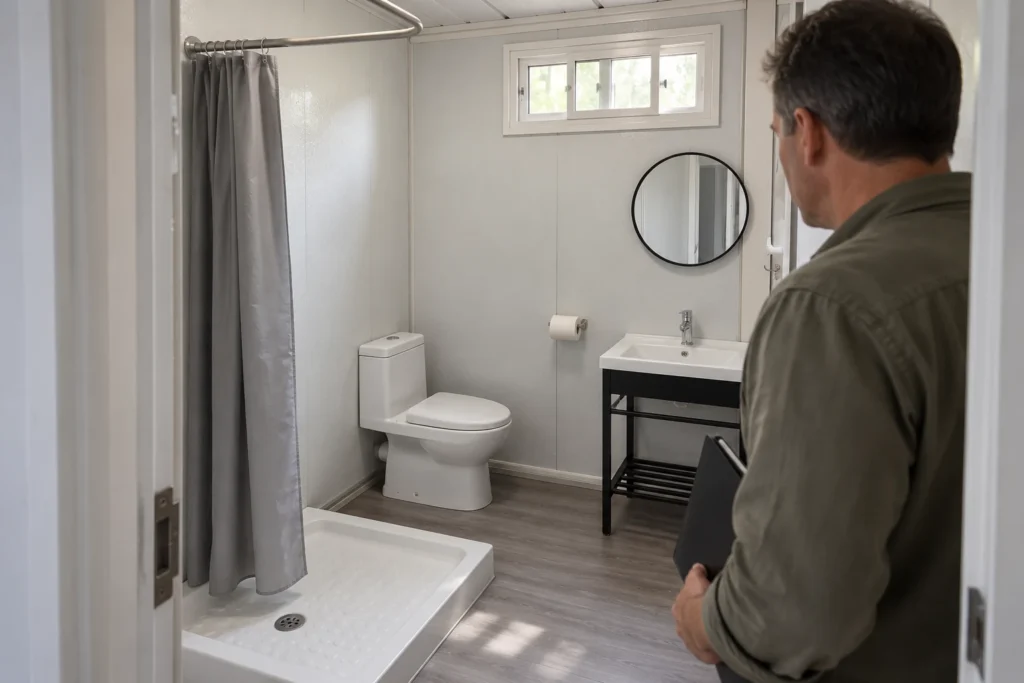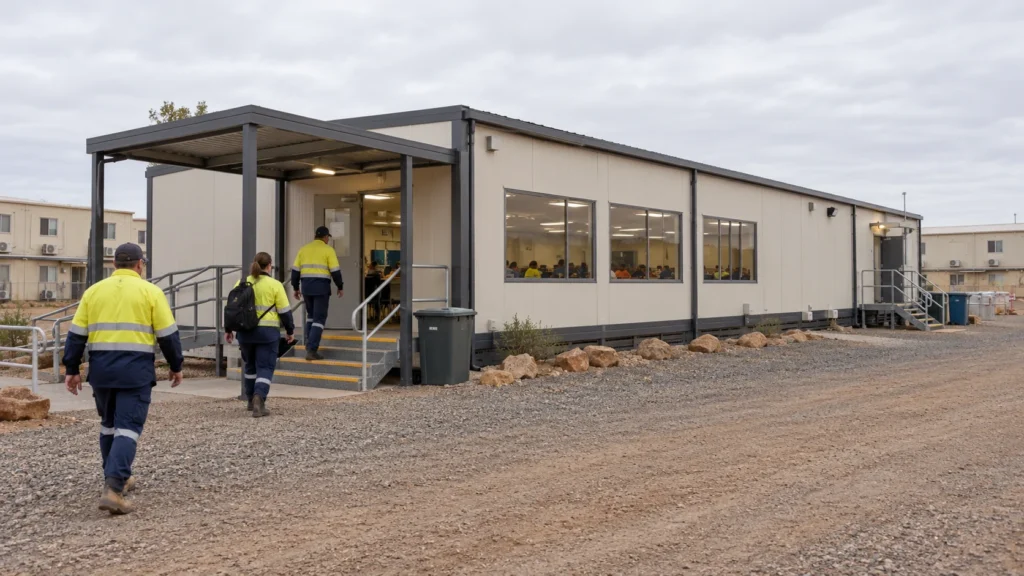
A modular hotel housekeeping plan should connect usable clean linen, the complete working cart, rooms that staff may enter and the person who releases each room. Review that chain before repeating the guest-room layout. A cart that passes through an empty doorway does not prove that staff can replenish it, remove used linen, work around the furniture or hand a finished room back to reception.
The purchasing question is therefore practical: can the proposed building support the hotel’s actual service cycle, including its interruptions? Begin with the operator’s room mix and laundry arrangement, then ask suppliers to demonstrate the agreed interfaces. The photographs here are generated planning illustrations, not photographs of a PQSE customer installation. Use the cited workplace guidance alongside the hotel’s own operating requirements.
Start with a room turnover case the operator can describe
An attractive room rendering shows the end of the process. Housekeeping has to reach that state while guests are leaving, replacement arrivals are approaching and some rooms remain occupied. For a modular hotel room development, the room schedule should describe these different working conditions as well as the finished appearance.
Choose a representative departure room and follow its next service cycle. Establish when access is permitted, which bed and towel items change, where supplies come from, how used items leave and how a defect is reported. Then repeat the discussion for a stayover room and a room held out of service. These cases may use the same building but need different instructions, stock and release decisions.
Separate work time from waiting time
During an operational trial, record active room work separately from waiting for permission, clean linen, a working lift or a supervisor. Otherwise, a slow room can be blamed on its layout when the immediate cause is elsewhere. Conversely, averaging all delays into one room-cleaning time can hide a doorway or restocking problem that procurement could resolve.
No universal minutes-per-room or rooms-per-attendant target is assumed here. The operator must establish a service standard and evaluate actual conditions. The purpose of the trial is to identify the missing input or interface, with a named decision owner. It should not become a demonstration in which staff quietly improvise around the design while the project records a pass.
When comparing container house building systems, attach this operating case to the room drawings. Construction format alone cannot tell a buyer whether housekeeping storage, service openings and final furniture placement form a workable route.
Establish which rooms can enter the work list
A departure forecast is not permission to enter every room on that forecast. The hotel needs its own procedure for checkout confirmation, privacy requests, maintenance holds and access authorization. The housekeeping assignment should identify the current permitted task, rather than leave the employee to infer it from an apparently empty room.
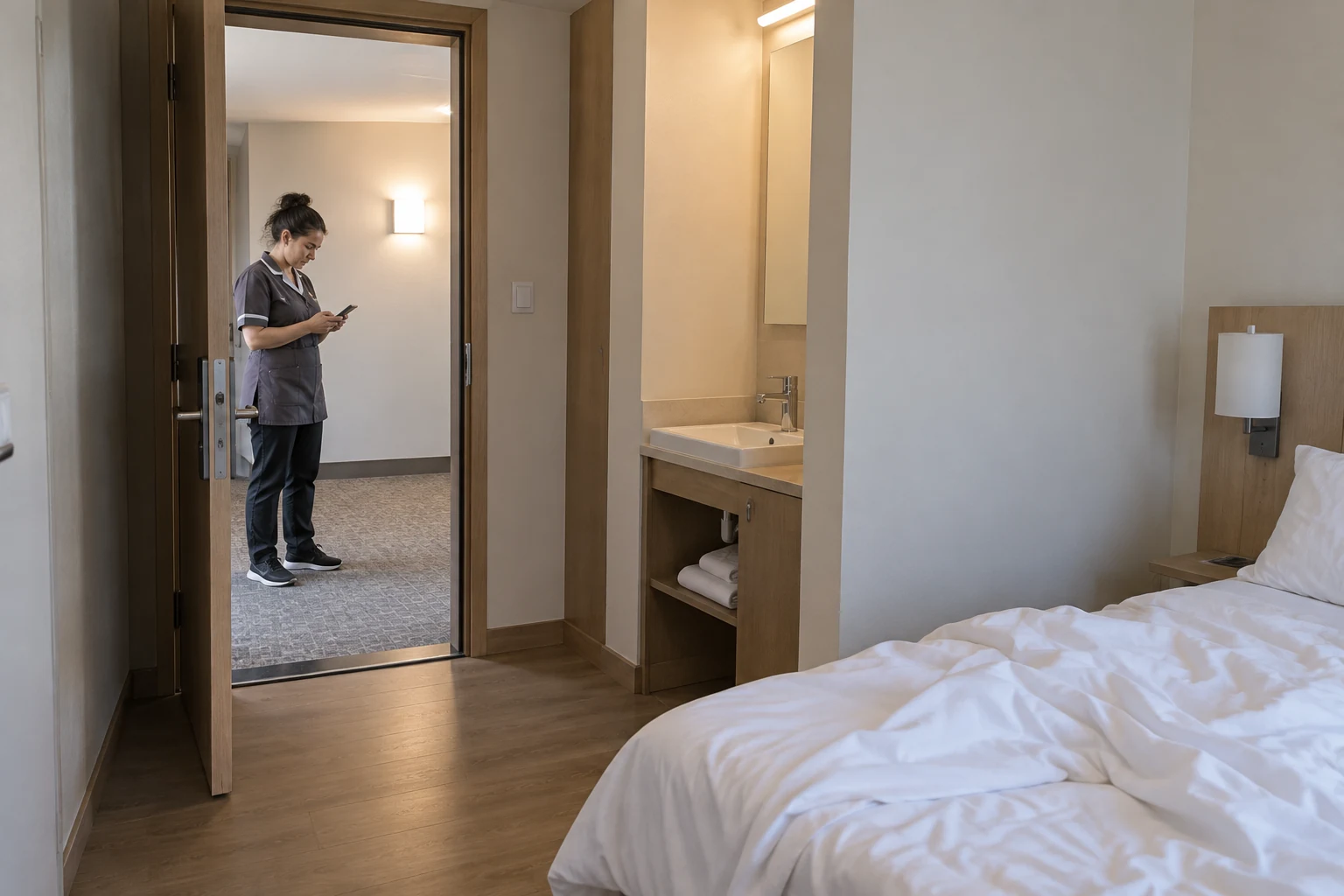
Use the project walkthrough to ask what an employee does when a room is unavailable. Where can the cart wait while the next assignment is confirmed? Can supplies be returned without blocking guest movement? A drawn route that ends at an occupied room needs an operating alternative, even if every planned doorway is wide enough for the selected cart.
Make exceptions visible to the next person
Agree a simple exception record containing the room identifier, time, reason for the hold and next responsible person. A supervisor should be able to distinguish “not yet accessible” from “cleaning in progress” and “cleaned but awaiting a repair.” Those descriptions are proposed coordination terms, not a claim that every property-management system uses the same labels.
This is also a layout question. Staff need a practical place to pause and communicate without leaving tools unattended in a guest route. Identify that place during planning, and have the hotel operator and project reviewers confirm its suitability. Adding a room-number list after installation will not create the missing waiting space.
Include a change of assignment in the demonstration. The employee may have already loaded items for one room type when reception redirects them to another. Follow that change back to the supply point and forward to the new room, checking what must be exchanged and where the cart pauses. This avoids judging the route only under a perfectly ordered departure list. The operator should define the permitted response; the building proposal should show the spaces that make that response practical.
Treat linen stock as a time-dependent input
Count usable items by type and by the time they will be needed. Total ownership is a poor substitute for this information: sheets already on beds, items at an external laundry and towels held for review cannot all replenish the working cart at the same moment. Double, twin and family rooms may also consume different sets.
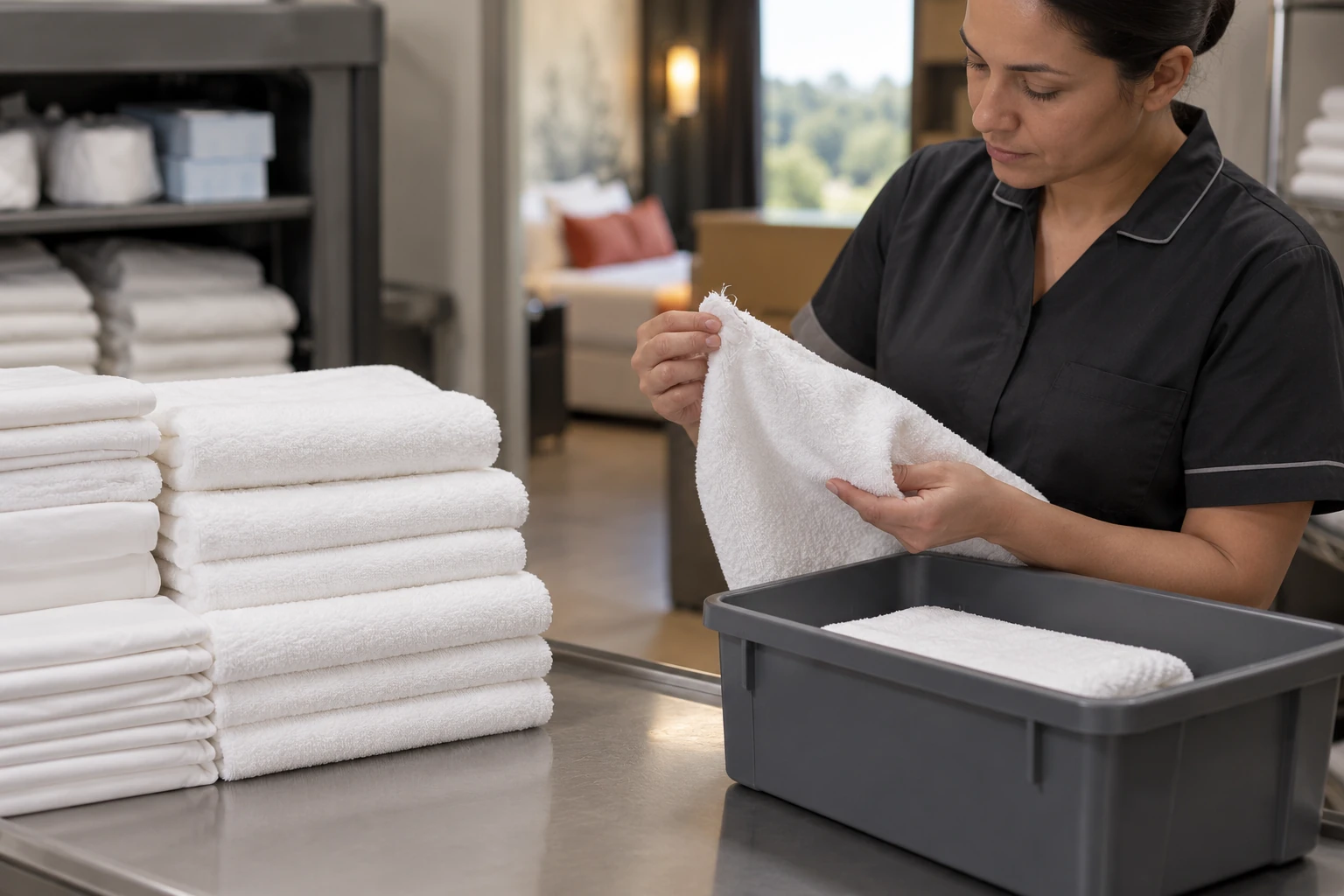
The starting record should separate clean usable stock from items that need a decision before reuse. Describe who checks a doubtful item and where it remains pending that decision. Do not add it to available stock simply because it is physically present. This is inventory planning; the photograph does not establish a hygiene classification or laundry quality result.
Build the linen input sheet around the next return
The following worksheet links room demand to the laundry cycle. Fill it with the hotel’s own service policy and confirmed delivery arrangements. It deliberately supplies no standard linen “par,” because a stock multiple without a timing basis can conceal the period when clean items run out.
| Input | Record for this property | Decision it supports |
|---|---|---|
| Room mix and bed types | Room count by type; items in each agreed set | Separate demand for sheets, covers and towels |
| Service policy | Departure and stayover changes; requested extras | Which items the work list actually consumes |
| Usable clean opening stock | Checked quantity by item at the issue point | What can be loaded now |
| Laundry return | Confirmed arrival window and accepted quantities | When replenishment becomes available |
| Held or unavailable items | Items at laundry, in use or awaiting a decision | What must be excluded from usable stock |
| Contingency and ownership | Operator’s provision for delay; authorized approver | Who responds if the next return is late |
Use the period up to the next confirmed replenishment to compare usable supply with the planned item demand. When that comparison shows a gap, record the gap openly: the answer may be an earlier return, revised delivery scope, extra usable stock or a changed service sequence. Larger storage is useful only if it solves an identified part of that problem.
For a phased opening, check the cycle again when another room block enters service. A receiving and issue point designed around the first block may have enough shelves yet lack room for the later delivery and return movements. Treat the phase change as a new operating condition.
Distinguish a forecast return from a confirmed usable return. The laundry provider may deliver on time while the accepted quantity differs from the order. Ask how a partial delivery changes the issue decision and who authorizes an alternative. Conversely, holding more stock cannot compensate for an issue point staff cannot reach during the service window. Review stock and movement together, but keep their individual causes visible when deciding what to change.
Give clean supply a defined receiving and issue point
Clean linen needs somewhere to be received, checked and issued without becoming mixed with the return task. Specify the work surface, stock location and responsible role in the operating brief. The receiving check should confirm the usable quantity that is actually available, rather than simply match a vehicle arrival to the timetable.
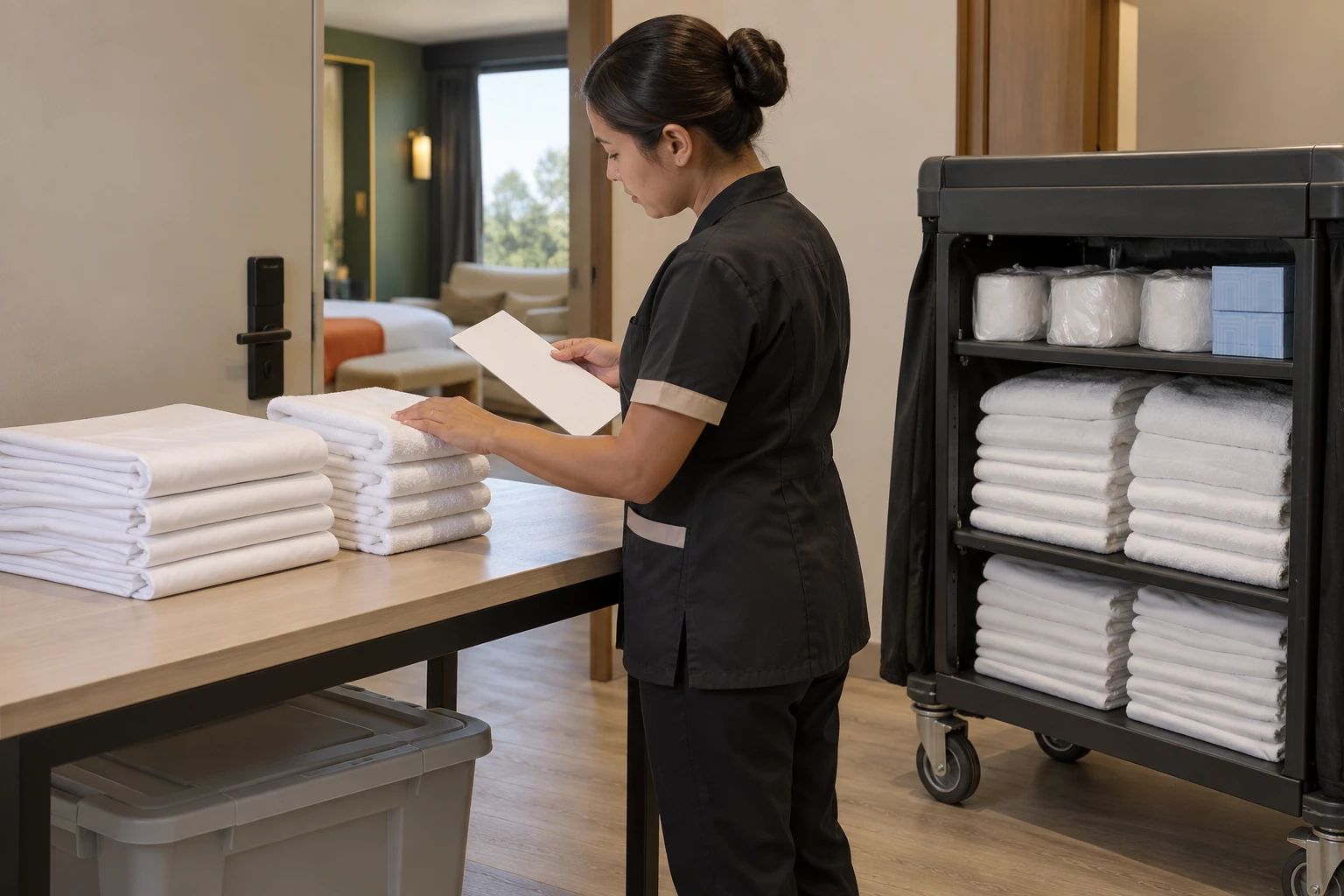
A delivery shortfall belongs in the receiving record, before carts are loaded. This gives the operator time to adjust the work list and contact the laundry provider. It also separates a supply problem from a building problem: a route cannot replenish missing sheets, but an inaccessible issue point can delay the sheets that are available.
Include the transfer from cart to room
Agree where clean items are placed while the bed is prepared. The choice must fit the operator’s cleaning procedure and actual furniture arrangement. Avoid a trial that succeeds only because extra shelves, a temporary table or removed guest furniture create space absent from the proposed room.
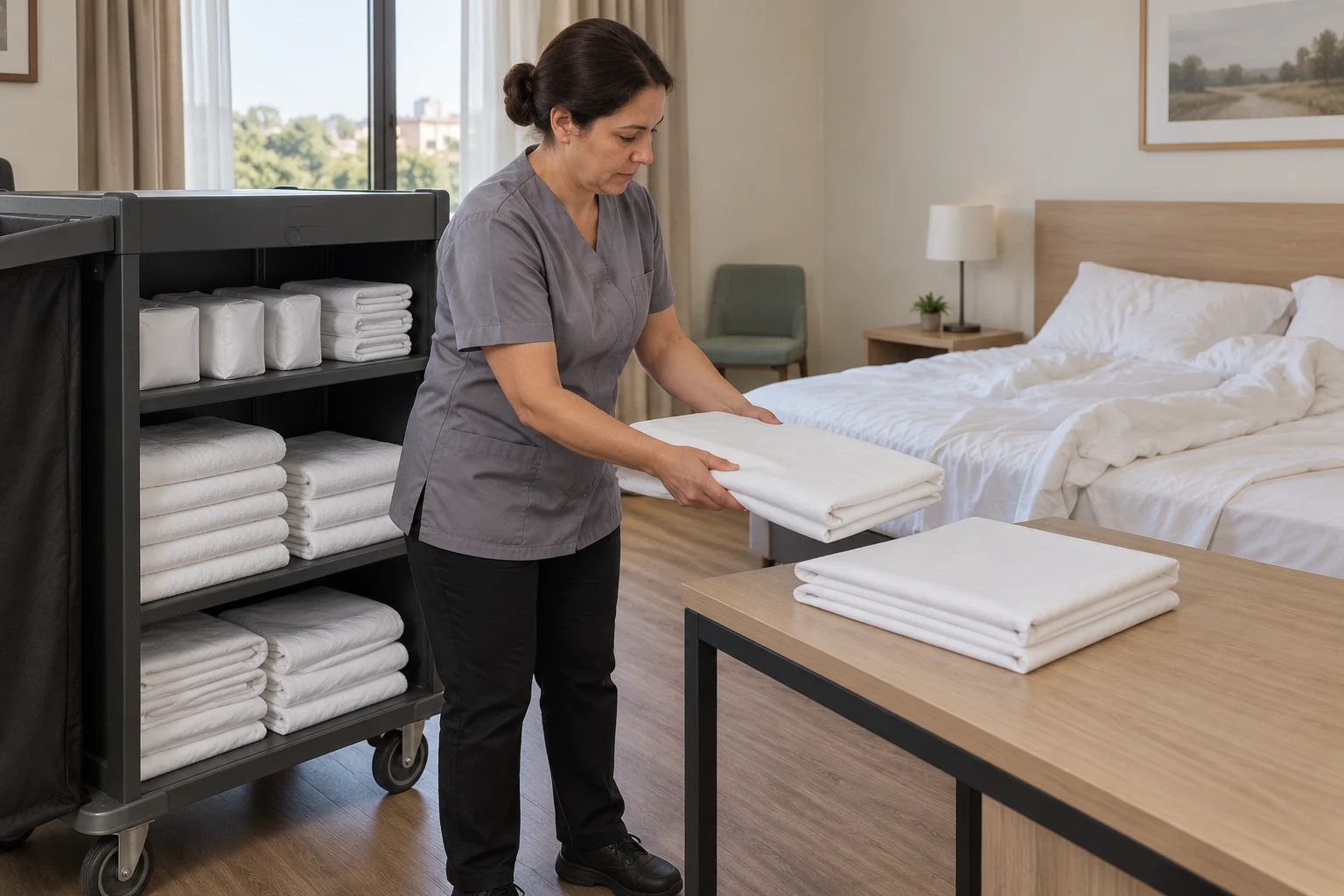
Show the transfer during the room trial, including the employee’s working position and the open door. This reveals whether the route ends in a useful position or merely admits the cart. The broader room layout discussion should include housekeeping reach alongside beds, luggage storage and guest circulation.
Plan the used-linen return as its own task
Used linen grows as rooms are serviced, while clean stock is consumed. A cart and storage arrangement that looks orderly at the start may be awkward later in the route. Ask where used items are contained, how the filled container leaves the working area and how it reaches the agreed laundry collection point.
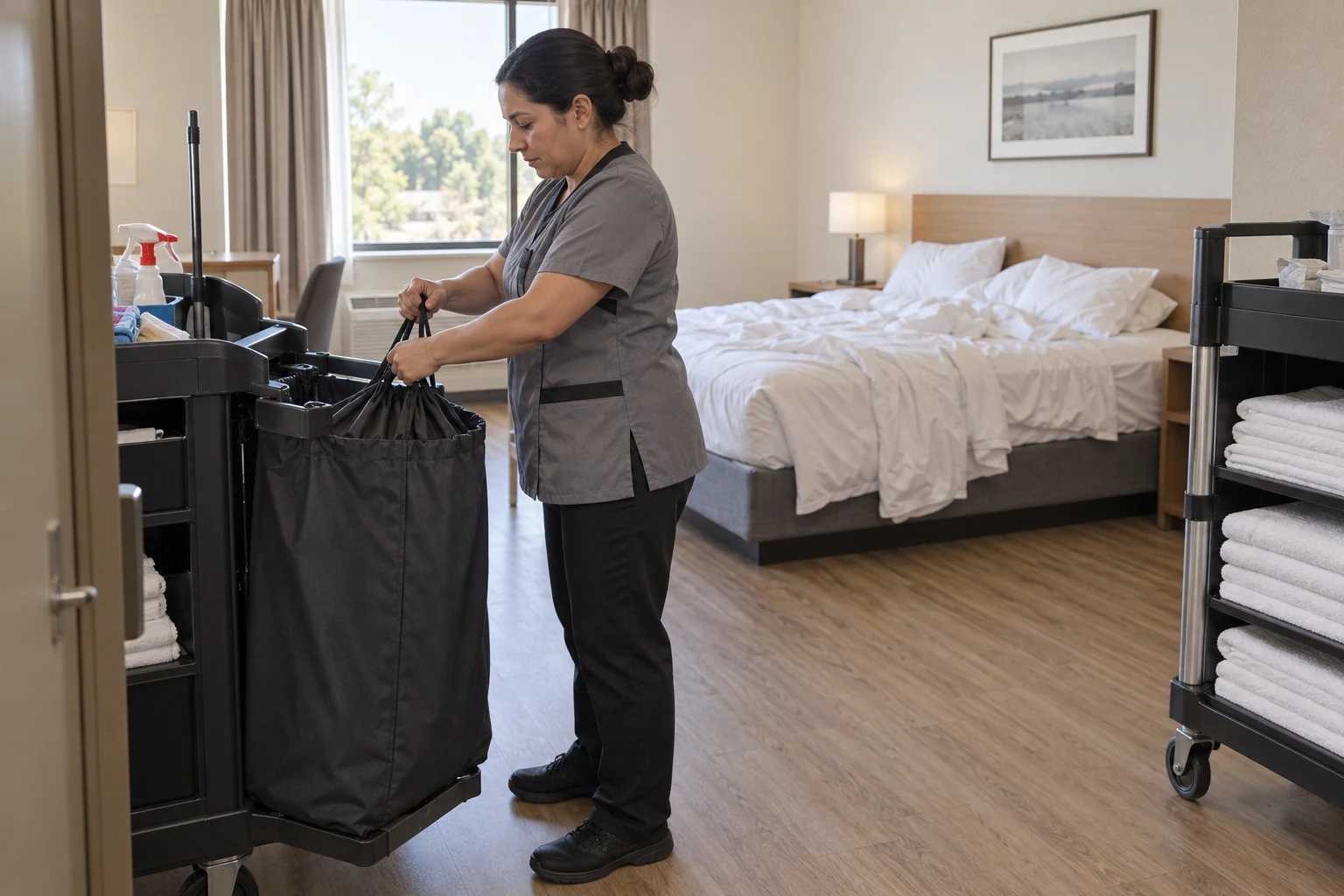
The operational brief should assign containment and collection, rather than treat a bag hook as a complete return system. Check a later-stage working condition with a plausible filled container. Do not let the demonstration move used items onto the clean issue surface to create temporary space. The hotel and laundry provider must agree their handling procedure.
Record who owns the return point, when collection occurs and what happens if it is unavailable. These details affect the space that must remain usable during service. A return left awaiting collection can become the obstacle that changes an otherwise successful route.
A room drawing does not establish infection-control performance or prove a certified clean/dirty barrier. Review the proposed separation against the hotel’s actual cleaning and laundry procedures. Applicable hygiene requirements for the destination and operation need appropriate local review; a bag arrangement alone does not establish that those requirements are met.
Review cart access with doors and furniture in use
Select the working cart configuration before agreeing the service route. Request the manufacturer’s current assembled drawing and accessory list. Confirm how handles, side bags, tool holders and trays are represented; packed dimensions and a basic frame footprint answer different questions from a loaded cart in operation.
Check the complete loaded cart
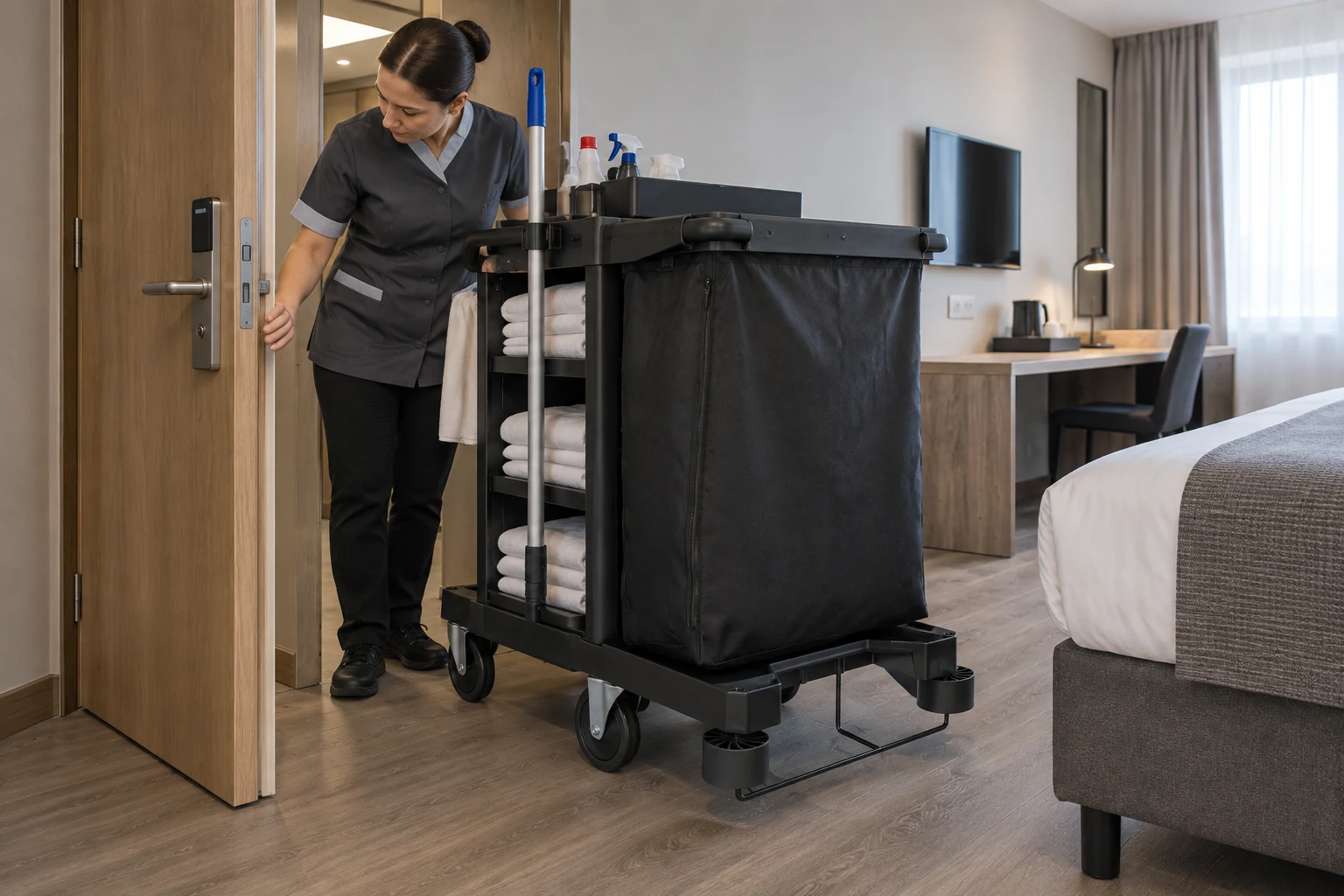
Mark the outer working envelope on the reviewed drawing, then compare it with the installed opening and nearby furniture. Include the configuration staff will use, with accessories in their normal positions. A small protruding holder can matter at a turn even when the main frame passes easily. Do not substitute a different cart for the acceptance trial without recording the change.
Describe both passage and turning. The employee needs a place to stand and operate the handle, not just a rectangle through which the cart can be pushed. Check the selected room entrance with its actual door leaf, hardware and permitted opening position, then repeat the movement out of the room.
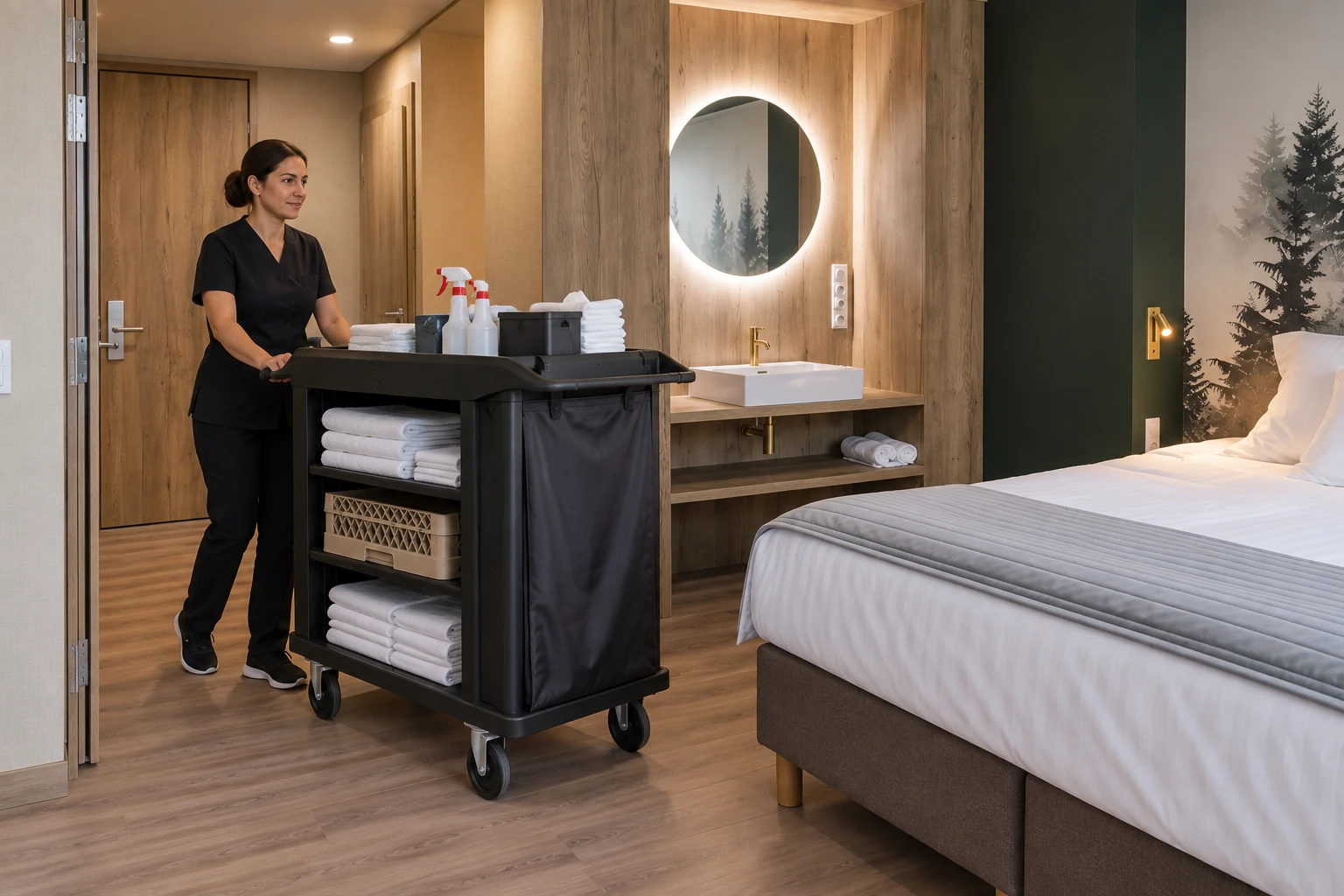
Record contact, reversing and temporary repositioning during the turn. A successful straight passage does not resolve a tight change of direction just inside the room. Likewise, removing the side bag to enter every room is an operating change that the hotel must knowingly accept, rather than an unrecorded workaround.
Include working access after the door opens
Continue the trial to the basin, replenishment shelf and bed. The cleaner may need to open a drawer or reach a fixture while the entry remains in use. Check those working positions with the selected fittings and furniture, including a route for leaving the room without moving supplies onto the bed.
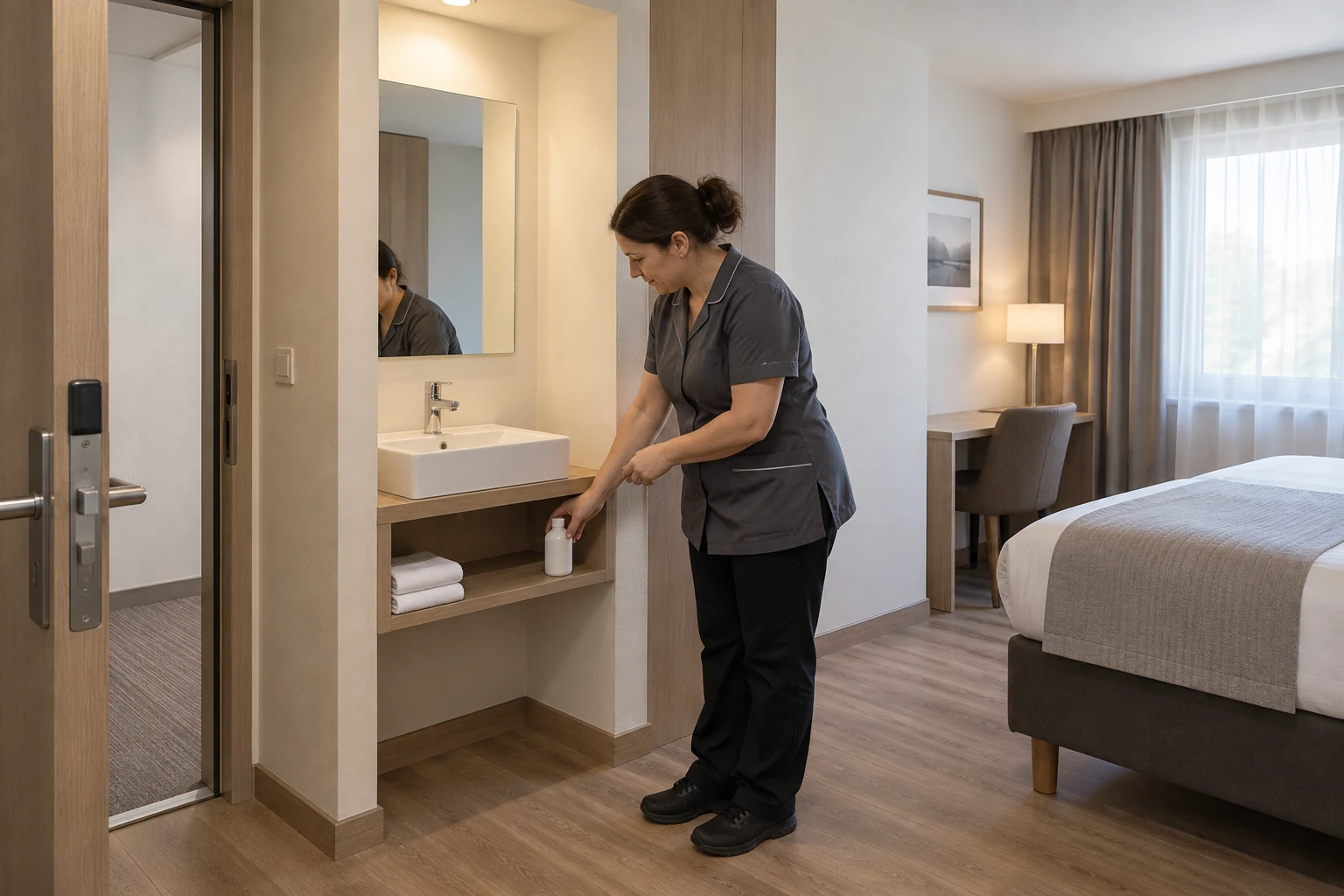
A flat pack room proposal should record the chosen fit-out and openings together. If a detachable building package is being compared, apply the same operating case to its finished layout. The service task stays the same even when the construction and assembly scope differ.
Trial the route with the working load
A route trial should describe its conditions closely enough to repeat. Record the cart and accessories, the loading arrangement, route endpoints, finished floor and door positions. Invite staff who will do the work to identify difficult movements. An empty cart on an unfinished floor is useful for a preliminary check but does not close the acceptance question.
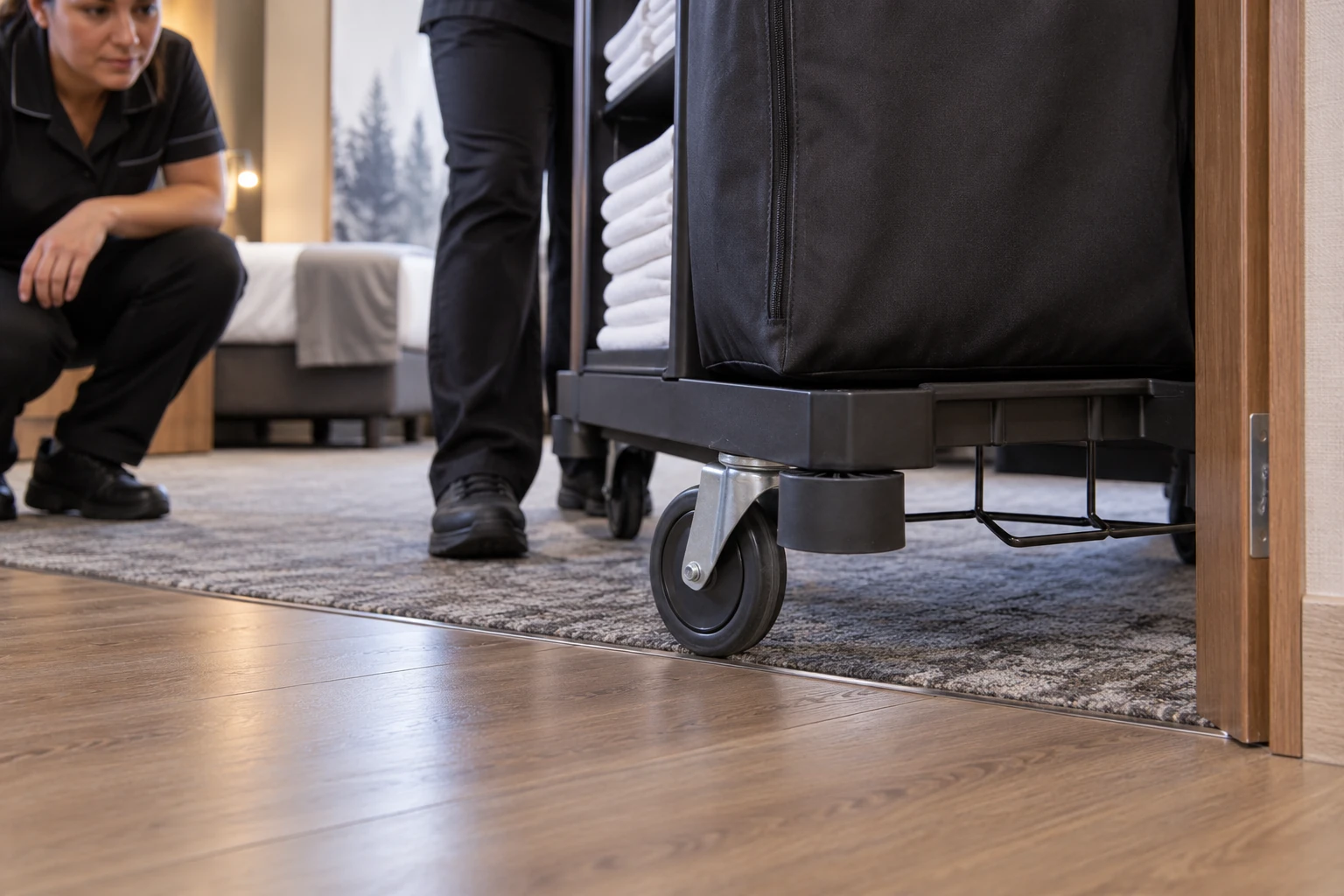
Watch transitions and turns as well as long straight travel. A floor interface can change the movement at one point without changing the overall route length. Document the location and condition rather than conclude that the entire room system is unsuitable from a single difficult movement.
| Check | Evidence to retain | Unresolved condition |
|---|---|---|
| Working configuration | Cart identity, accessories and recorded loading arrangement | Trial uses a different cart or removes normal equipment |
| Passage and turning | Installed opening reference; observed inward and outward movement | Contact, awkward reversing or unapproved repositioning |
| Room working positions | Furniture and door positions during replenishment and cleaning | Task depends on furniture absent from the agreed layout |
| Floor and wheel condition | Specific joint, transition and caster observations | Difficulty attributed to the route without checking the equipment |
| Waiting and return | Approved pause location and used-linen collection arrangement | Cart or return container occupies required circulation |
Use force guidance with its original limitations
The UK Health and Safety Executive provides the following approximate push/pull force figures for risk assessment. Its source labels are retained. These are force-screening guidance, not cart weight limits or an individual worker’s approval. The relevant HSE assessment guidance explains measurement and factors affecting effort.
| Action | Men — source label | Women — source label | Interpretation limit |
|---|---|---|---|
| Starting or stopping a load | 200 N | 150 N | Screening guidance; not a permitted cart mass |
| Keeping a load in motion | 100 N | 70 N | Screening guidance; not proof that the whole task is safe |
Do not convert these figures into kilograms of linen. Wheel alignment, equipment condition, gradients and floor surfaces affect the required force. Where measurement is needed, use an appropriate assessment and instrument; the photographs here show no measured result. HSE’s RAPP overview also explains limitations, including how floor variations can affect small-wheeled equipment. Review the whole task and the actual site conditions.
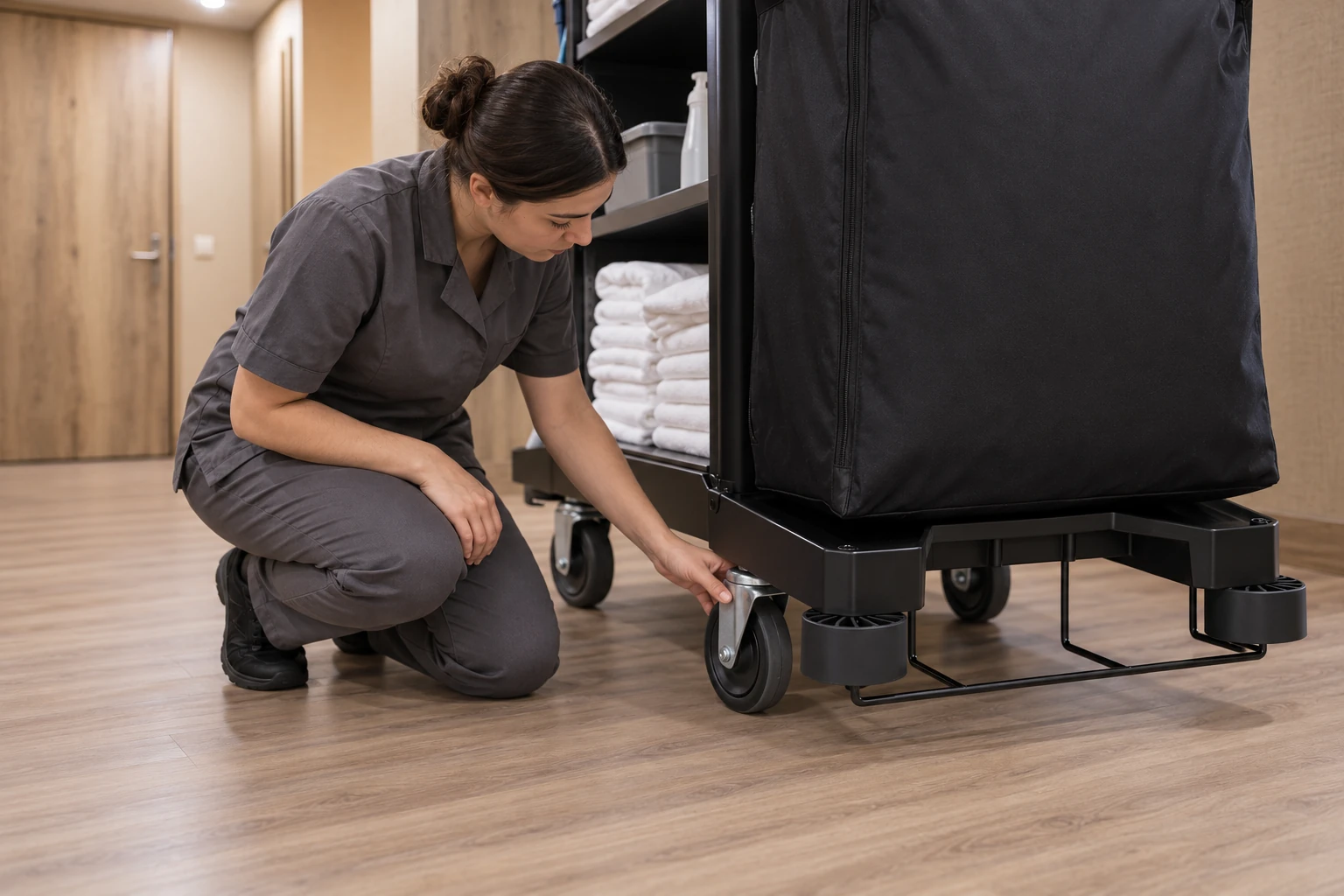
Keep the accepted operating condition in use after opening. Record equipment changes and route defects through the hotel’s maintenance process. A wheel problem should be investigated rather than concealed by taking more running space. Routine observation does not authorize staff to dismantle a caster or improvise a repair.
Cart waiting positions need a separate circulation review. For US workplaces covered by the standard, OSHA 29 CFR 1910.37(a)(3) requires exit routes to remain free and unobstructed, including temporary materials and equipment. This does not supply a universal hotel corridor width. The project’s local fire and accessibility reviewers must establish applicable requirements.
Separate cleaning, inspection and room release
Treat cleaning completion and permission to release the room as separate decisions under the hotel’s procedure. Define who checks completion, who handles a defect and who changes the room’s available status. Keep those handoffs visible in the opening plan, with the hotel’s own system and authorized roles.
| Stage | Record | Next decision | Possible hold |
|---|---|---|---|
| Access permitted | Room, authorized task and confirmation time | Housekeeping accepts the assignment | Occupancy or privacy instruction unresolved |
| Cleaning completed | Completion entry and reported exceptions | Inspection under the operator’s procedure | Missing supplies or unfinished task |
| Inspection completed | Result and any unresolved defect | Authorized release or continued hold | Repair or recheck still required |
| Released for use | Authorized status change and time | Reception may use the room as permitted | New exception requires reassessment |
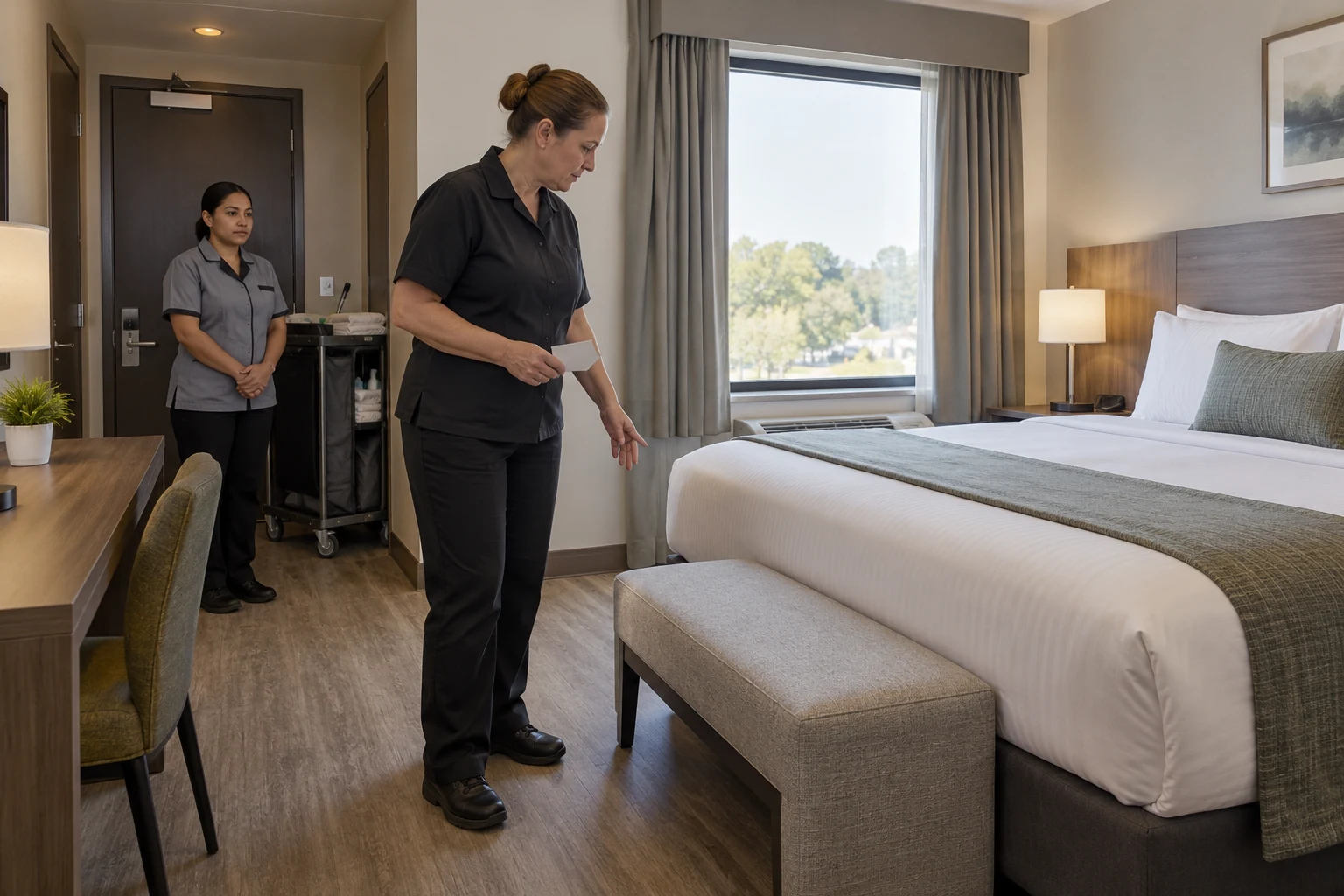
A made bed is visible; a release decision often is not. Demonstrate the information handoff during the trial, particularly when a room looks complete but a defect remains open. Reception should receive a usable status, while the maintenance owner receives enough detail to act. An ambiguous “done” message serves neither purpose.
The operator can then investigate delays by stage. A room waiting for inspection needs a different response from one waiting for linen. This distinction makes the commissioning discussion more useful than a single elapsed-time claim, and prevents a construction completion record from being mistaken for an operating release.
Put the operating interfaces in the quotation
Submit the room mix, service cases, selected cart drawing, linen-cycle inputs and proposed service spaces with the enquiry. Identify what the building supplier provides and what the operator, laundry provider or local contractor supplies. A workstation shown in a concept image should not silently become either an included fitting or an excluded necessity.
Keep the comparison consistent if a prefab K house arrangement is another option for the accommodation layout. Ask each supplier to address the same finished openings, furniture, floor interfaces and service tasks. A different structural system may change the construction scope without removing the need for those operational decisions.
Use the project cost comparison to identify unpriced support items and destination work. No price or cost saving is assumed in this article. Record the proposed item, responsible party, evidence needed and decision date, then resolve it against the actual quotation.
The acceptance record should also identify the drawing revision and the items present during the demonstration. If furniture is moved, a fitting changes or a cart accessory is added afterward, compare that change with the accepted condition before repeating it throughout the property. Keep the request focused on the affected movement or task. A full redesign may be unnecessary, but an undocumented substitution leaves the operator unable to tell which version was actually reviewed.
Before repeating the design, close the route and room trial with an agreed record of what worked, what changed and what remains open. Do not treat an open item as accepted because installation is approaching. This record gives the buyer a specific follow-up request and gives the supplier a defined issue to answer.
Housekeeping route questions
Can one cart check approve every room?
Only if the project can show that the relevant operating conditions are equivalent. Different entrances, furniture layouts, floor transitions or room types may need separate checks. Record the scope of a representative trial and identify the exceptions; do not assume repeated modules mean identical finished access.
How much linen storage is needed?
Start with usable item quantities, room-service policy and the timing of laundry returns. Then plan receiving, issue, held items and collection space. A generic stock multiple or a total number of beds cannot establish the complete storage and movement requirement for every hotel.
Does a passing force check complete acceptance?
No. Force guidance addresses one part of the task. Turning, reach, containment, permitted access, waiting and room-release communication still need review. The appropriate workplace assessment and local project requirements remain separate from a procurement demonstration.
What should the buyer send first?
Send a room schedule, a representative turnover case, the current cart configuration and the laundry arrangement. Add a site plan showing proposed service spaces and guest routes. Where an input is unknown, name the person who will confirm it instead of inserting an assumed dimension or service rate.