A shared fridge in worker accommodation needs an agreed personal-food allocation, a cleaning owner and an access arrangement that works across shifts. Choose the appliance only after describing those tasks. A large advertised capacity does not establish how many residents can store their actual containers, and an assigned shelf does not tell anyone who cleans the door seal or removes abandoned food.
The practical complaint is familiar: someone returns from work and finds their space occupied, cannot identify a container, or discovers that the common parts remain dirty although everybody has cleaned their own shelf. The purchase question is therefore broader than litres. It concerns a small shared service that must remain usable when shopping, work, cleaning and resident departures happen at different times.
This guide focuses on residents' personal food in a shared kitchenette. It complements the wider worker camp accommodation brief, while keeping catered stock and professional meal service separate. It provides procurement and operating questions, with clearly identified official guidance examples. It does not determine a site's food approvals, select a refrigeration capacity or certify a particular PQSE building or appliance.
Decide whose food the fridge is intended to hold
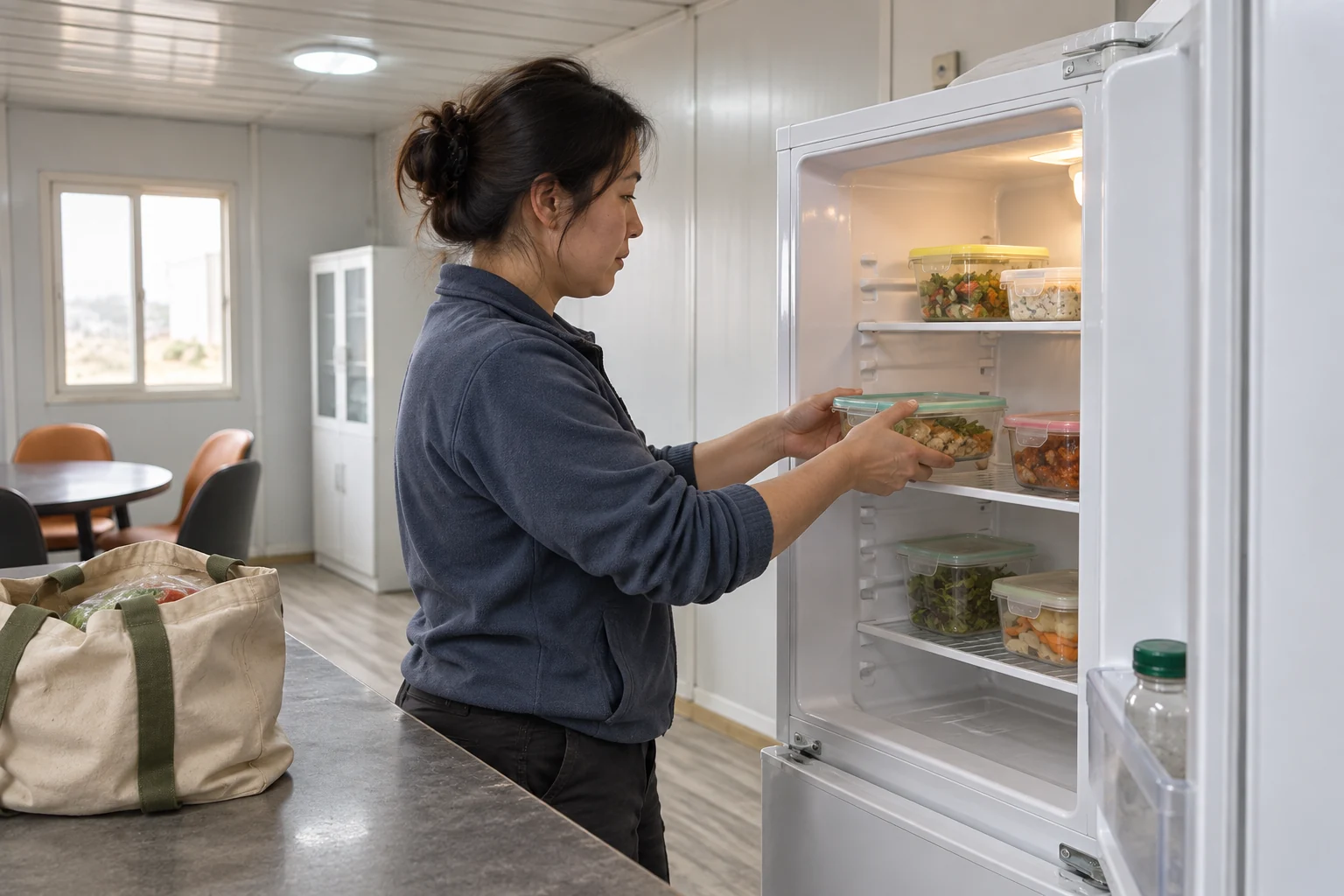
Begin with the people and food categories, rather than a fridge drawn beside a kitchen counter. A resident storing a sealed lunchbox needs a different arrangement from a caterer storing ingredients for the camp. Describe which activity this appliance supports and who is responsible for the food entering it.
A September 2026 shared-household discussion illustrates one gap. The poster described cleaning the fridge but leaving a roommate's allocated drawers untouched. The account and comments were read as individual, unverified household experiences, not evidence about camps or a medical diagnosis. The useful question is whether allocating private space has accidentally left common cleaning responsibilities unresolved.
Ask the operator whether residents bring groceries, receive packed meals, or normally eat in a catered facility. Identify any intended mixed arrangement explicitly. A personal fridge should not silently become overflow for the catering team because its shelves happen to be available at handover. That change brings different ownership, handling and operating questions which the responsible food team must resolve.
Include the intended kitchenette function when discussing worker camp accommodation layouts. The building enquiry should describe the service to be supported, including the planned operator. A product image cannot determine whether an appliance is included, which use it is suitable for, or who accepts the finished arrangement.
Allocate usable space before counting nominal capacity
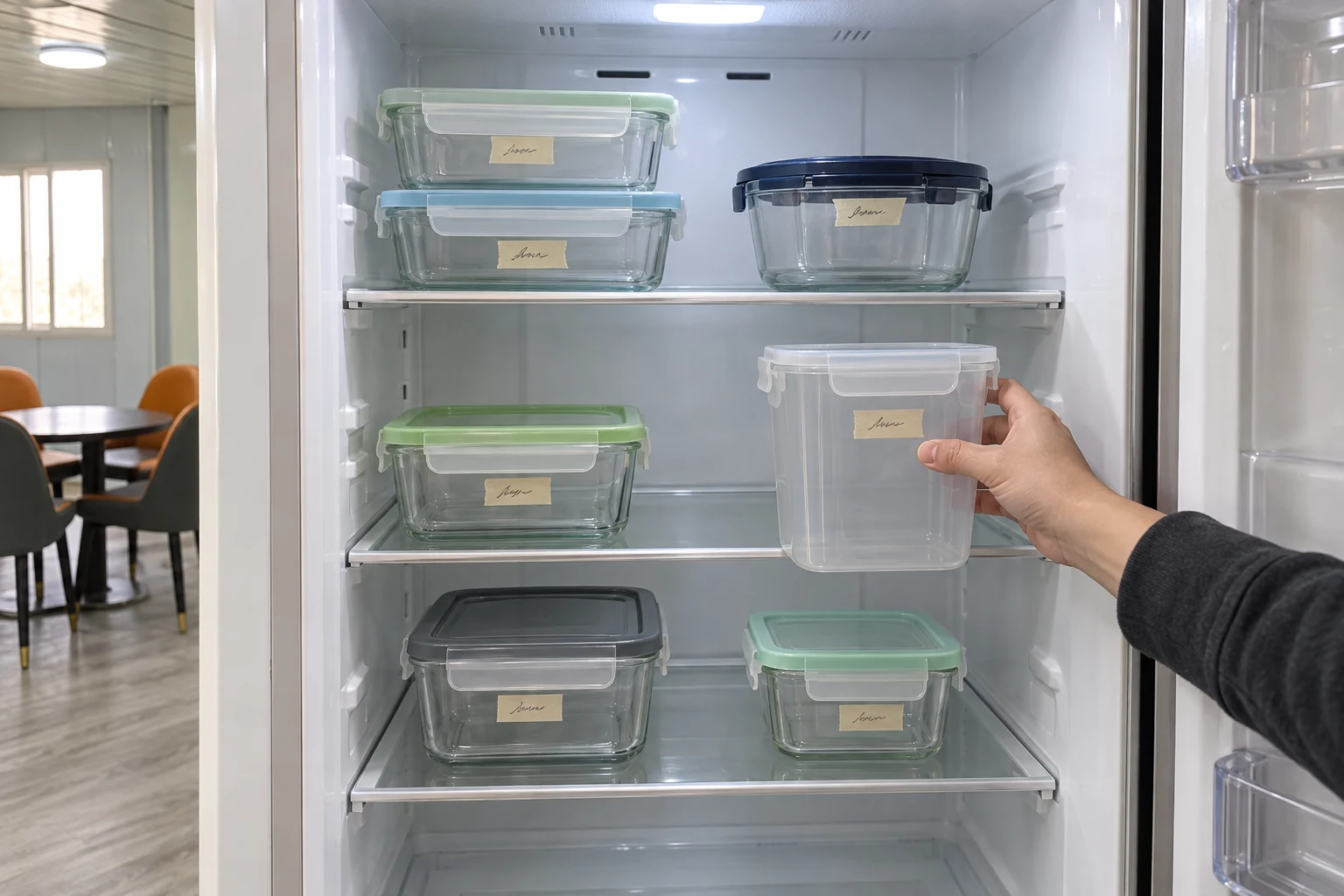
Bring representative empty containers to the allocation review. Check their height, lids and access within the proposed appliance rather than converting a brochure's litre figure into a resident entitlement. People need to retrieve their own food without first moving another person's containers or hiding items behind an unreachable stack.
Test the proposed sharing arrangement
Use a small inventory of actual container types and expected purchasing habits. Distinguish a worker bringing one daily meal from someone shopping between infrequent supply trips. These are demand scenarios to discuss, not a universal food volume per resident. Keep seasonal arrivals and roster changes visible, because an allocation that fits the opening population may become disputed after a later group moves in.
Ask whether the door compartments, drawers and main shelves can support the proposed categories. Do not assume every resident receives an identical shelf when food separation or appliance geometry requires another arrangement. Agree how a temporarily unused allocation is handled. Informal borrowing can become permanent crowding unless residents know when extra items must be removed and whom to contact about an unresolved shortage.
Record the chosen arrangement on the occupied-room review, not solely in a procurement spreadsheet. A fridge door and a person collecting a box occupy floor space outside the cabinet. The container-house layout review should include those movements alongside nearby seating and cupboards. Usable storage and workable access are related checks, but neither proves cooling performance.
| Use | Information to establish | Decision owner |
|---|---|---|
| Residents' personal groceries | Likely container types, allocation and resident access | Accommodation operator with residents' practical input |
| Issued packed meals | Handover time, ownership after issue and applicable food controls | Responsible food operator and accommodation team |
| Catering ingredients | Professional receiving, storage and preparation process | Catering team under applicable local requirements |
| Temporary extra demand | Who authorizes additional use and where approved capacity comes from | Named operator; do not assume an empty shelf is unrestricted |
Make ownership visible without inventing a food-safety label
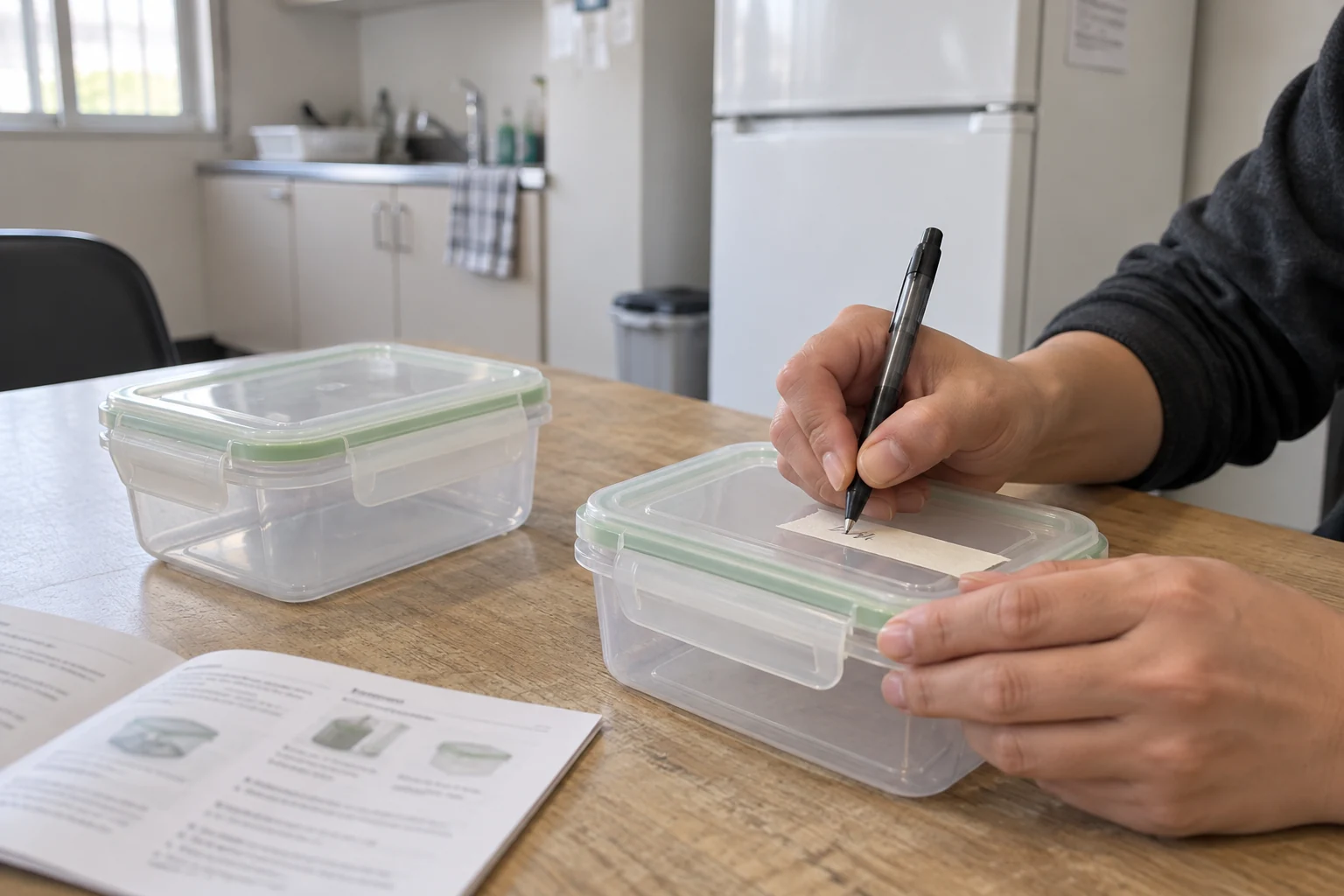
A practical ownership mark helps someone return a container to the correct place and contact its owner. It should remain distinct from the food's original storage instructions and use-by information. A handwritten room identifier establishes whose box it is; it cannot establish whether its contents are safe to eat.
Choose a marking method residents can use with the actual containers and languages involved. A name, agreed identifier or allocation reference may be sufficient for ownership, subject to the camp's privacy practices. Avoid a complicated scheme that only the manager can interpret. The person returning from a late shift should be able to identify their own box without opening several lids.
Explain what residents may do when an item is unmarked, leaks or occupies someone else's allocation. They need a reporting route and an accountable response; they should not be expected to make a food-safety judgment about a stranger's meal. Make any disposal procedure, notice and authority explicit. An ownership dispute and a potentially unsafe item may require different responses even when both concern the same shelf.
During induction, use a clean empty example container to demonstrate the arrangement. Ask a new resident to find its agreed location and explain how they would report a problem. This tests communication rather than memorization. Keep the instruction available near the facility without turning the appliance door into an unreadable collection of notices that conceals operating information.
Give temperature observation an owner and a response

A coldness dial, an illuminated control panel and a clean-looking fridge do not all provide the same information. Establish how the selected appliance's temperature will actually be observed, who checks it and what happens when a concern is reported. Keep the correct model instructions available to the person carrying out the task.
The US FDA's consumer refrigerator guidance recommends 40°F or below and explains the role of an appliance thermometer. It also advises avoiding overpacking, covering food and cleaning spills. These are US consumer recommendations, not a capacity certification for a shared camp appliance. Shelf allocation must leave the selected appliance's intended operation possible.
The FSA's guidance for England, Northern Ireland and Wales gives a separate consumer example of 0–5°C and recommends using a thermometer and consulting the manufacturer. It also distinguishes raw-food storage from other food. Do not combine regional examples into an invented worldwide legal limit; have the responsible local operator establish the applicable procedure.
The FSA's 2026 research synthesis reports Kitchen Life 2 averages from monitored households. The table retains that sample and fieldwork basis. These observations do not measure camps or PQSE appliances; they support asking how actual temperature is checked.
| Reported observation | Original value | Interpretation boundary |
|---|---|---|
| Households with a fridge/freezer thermometer installed | 65 households | Measurement sample; not all participants or camp residents |
| Households with average fridge temperature above 5°C | 34 of those 65 | Average during fieldwork, not the number of individual readings above a limit |
| Households with average fridge temperature above 8°C | 8 of those 65 | Subset of the same sample; not an additional independent group |
| Average across the monitored households | 5.3°C | Sample average; not a recommended setting or acceptable camp result |
Follow a container through a complete shift change
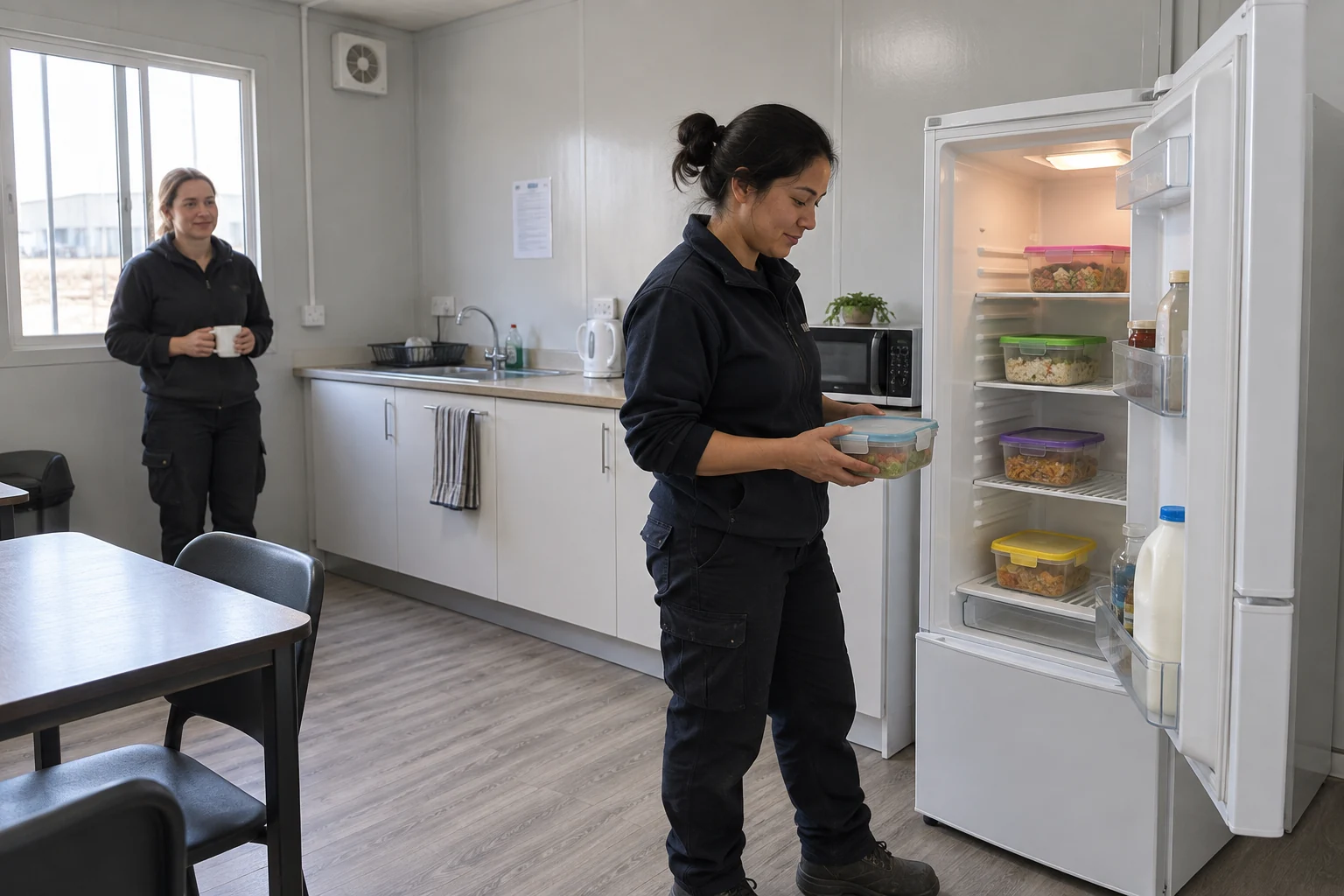
Walk through the moment one resident collects a meal while another stores groceries and staff need access to the kitchenette. This short overlap can reveal a problem that a daily headcount misses. Check where people wait and place their belongings, and whether collection requires moving someone else's food.
Describe the sequence with the operator: arrival, handwashing where relevant, collection, any agreed preparation activity and departure. Note which steps require the same counter or doorway. A busy appliance can create an awkward waiting position even when its interior allocation is adequate. Have the responsible team assess the proposed movements with the furnished layout instead of treating an empty floor-plan aisle as the complete test.
Avoid designing the whole service around an average weekday. Ask about a grocery delivery arriving near shift release, a delayed bus or an appliance temporarily unavailable for cleaning. These are scenario checks, not claims about measured camp performance. Decide how residents obtain an agreed alternative when their normal storage location cannot be used; leaving food on a table is not a storage plan.
If the camp issues meals, coordinate the personal-food arrangement with the caterer's actual operation. The mining camp meal-service review concerns arrival and service bursts. It should not be used to convert a dining-line calculation into fridge capacity. Keep the two services coordinated while retaining their different equipment, handling and staffing responsibilities.
Confirm the appliance and its maintenance interface
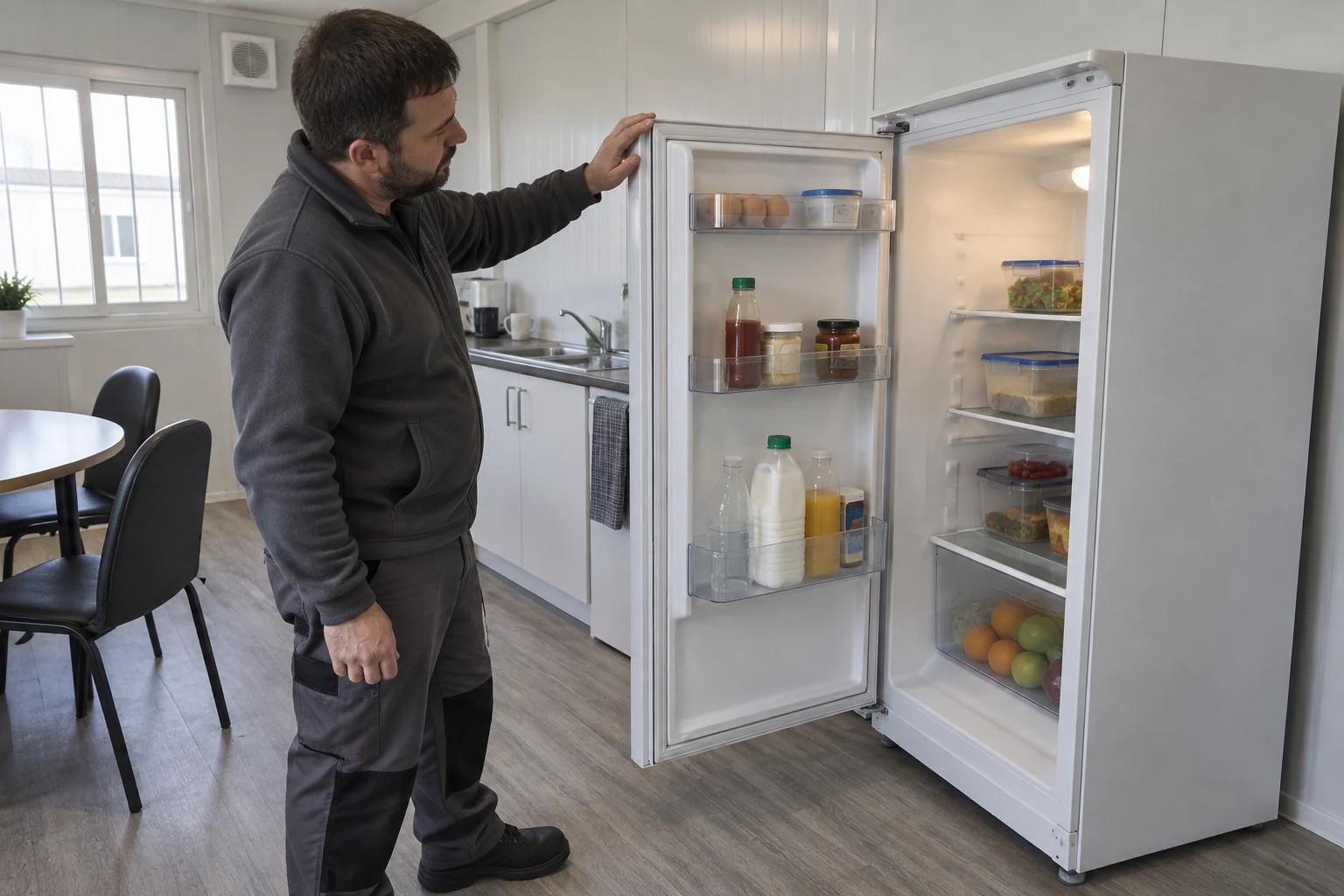
Ask for the exact proposed appliance identification and its current installation and care documents. The required service access belongs on the furnished drawing alongside the fridge, nearby counter and door. A substitute model should return to this review instead of being accepted solely because its advertised storage volume is similar.
A replacement can change the room interface
Confirm who supplies, positions and connects the appliance, and who retains its operating information. Ask the responsible installer to identify the actual ventilation, electrical and access requirements from the selected equipment documents. This guide provides no installation clearances or circuit design: those depend on the model and project. A space drawn for a generic cabinet cannot settle the interface of a later substitution.
Look beyond the space needed for normal collection. Ask how the relevant parts will be inspected, who obtains replacements and whether maintenance can proceed without dismantling unrelated furniture. Make the reporting route useful to an evening resident as well as the daytime supervisor. A fault that is noticed outside office hours still needs an agreed response and food-handling decision by the appropriate operator.
Discuss the kitchenette when selecting the prefab K-house configuration or another building family. Establish the actual room arrangement and supplier scope for the order. Naming a building product does not prove a fridge is included, establish the wall's suitability for added equipment, or authorize changes to building services.
Assign the common parts, not just individual shelves

Allocate cleaning of the shared door, handles, drawers and other relevant common parts explicitly. Personal shelf ownership leaves these tasks unanswered unless someone is responsible for the whole appliance. Agree how cleaning is carried out without residents losing access to appropriate food storage or being asked to judge unidentified contents.
The IFC/EBRD workers' accommodation benchmark discusses clean shared cooking facilities and management responsibility even where individual users clean their own areas. It is a 2009 benchmark, not universal camp legislation or recognition of PQSE. For the procurement brief, identify who is accountable when the resident's task ends and the common facility still needs attention.
A cleaning schedule should identify availability as well as tasks. Coordinate with the responsible food operator how contents are protected while the appliance is cleaned or unavailable, and what residents are told beforehand. Do not improvise a universal time allowance for food sitting outside. The appropriate handling procedure depends on the food, appliance and governing requirements; the accommodation team must obtain it from the responsible person.
Inspect the result in the places that ownership labels do not cover. A signed checklist alone cannot show that a leaking container was addressed or that an inaccessible common area has been cleaned. Record the specific unresolved item and the person who will act. The aim is a complete response, not a competition between residents over whose shelf looked cleanest.
Check access while other residents are resting

Follow the late-shift route from the entrance to personal food and back without relying on access through someone else's sleeping space. Check lighting, door movement and where a resident waits. The kitchenette should remain an agreed shared facility, rather than becoming available only to people on the manager's daytime schedule.
A locked room can prevent unauthorized use but also exclude residents whose collection times were not considered. Identify who needs access, how it is provided and who responds when access fails. Record any restrictions alongside the meal arrangement so that a resident is not left choosing between disturbing a colleague and missing an agreed service. Review the actual arrangement with the operator before treating a lock as the complete solution.
The accommodation benchmark separates individual cooking from sleeping areas. That distinction does not by itself resolve the route between them. Coordinate the approach with worker camp daytime-rest and shared-facility planning. A kitchen placed outside a bedroom can still create repeated disturbance if the waiting point or access door sits beside a resting group.
Check the ordinary journey under the lighting actually proposed for that time. Include the person carrying a container, their clothing and any relevant access needs. Keep emergency routes subject to the project's proper review; this walkthrough does not establish an approved exit width or accessible design. It helps the buyer ask where competing uses must be resolved in the furnished plan.
Keep the rest of the kitchenette in the operating brief
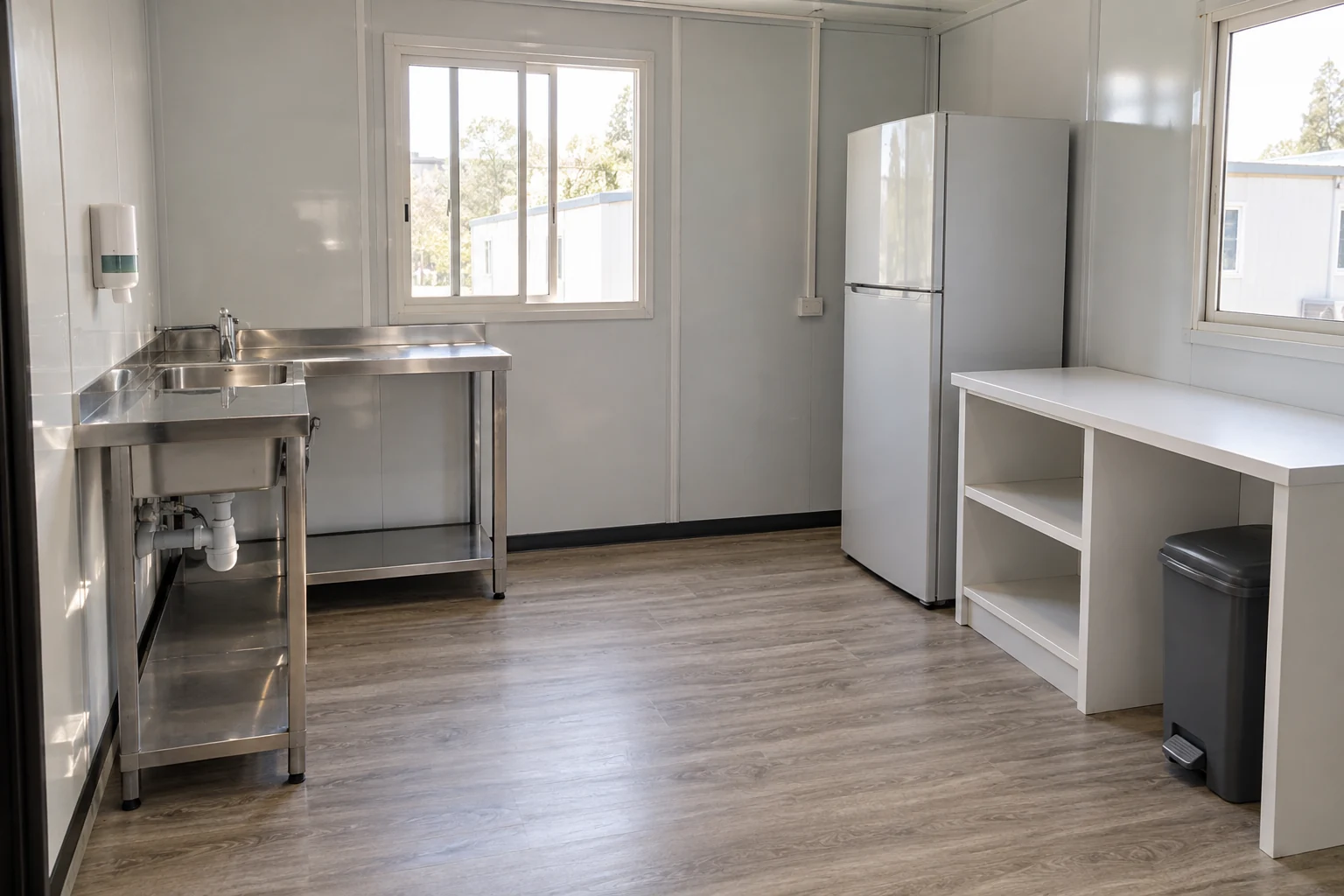
Personal-food storage works within a room that also needs the relevant washing, waste and cleaning arrangements. Identify those functions and their responsible operators without assuming that the fridge solves them. Keep cleaning materials separate from food storage and make their actual accommodation part of the room review.
Describe where residents place a container during normal use, where packaging goes and how a spill is reported. Check that waste collection does not occupy the space people need to open the appliance. Keep the task review grounded in the proposed service: a personal-food kitchenette, a reheating area and a professional kitchen may have different requirements, so a single generic kitchen note can conceal important differences.
Ask the local responsible team to establish the necessary hygiene facilities for the actual use. Do not infer approval from the presence of a sink or translate a commercial food-kitchen rule into every residential kitchenette. The order should identify the agreed requirements and who checks the finished arrangement. This keeps the building supplier, equipment supplier and operator working from the same intended function.
Review cleaning tools and waste routes with the room furnished. A convenient cupboard can become inaccessible behind an open fridge door, while a trolley can obstruct collection if parked in the only useful approach. Record the practical conflict and revise the arrangement through the responsible team. Adding another notice will not make an unsuitable parking location disappear.
Close the allocation when a resident leaves
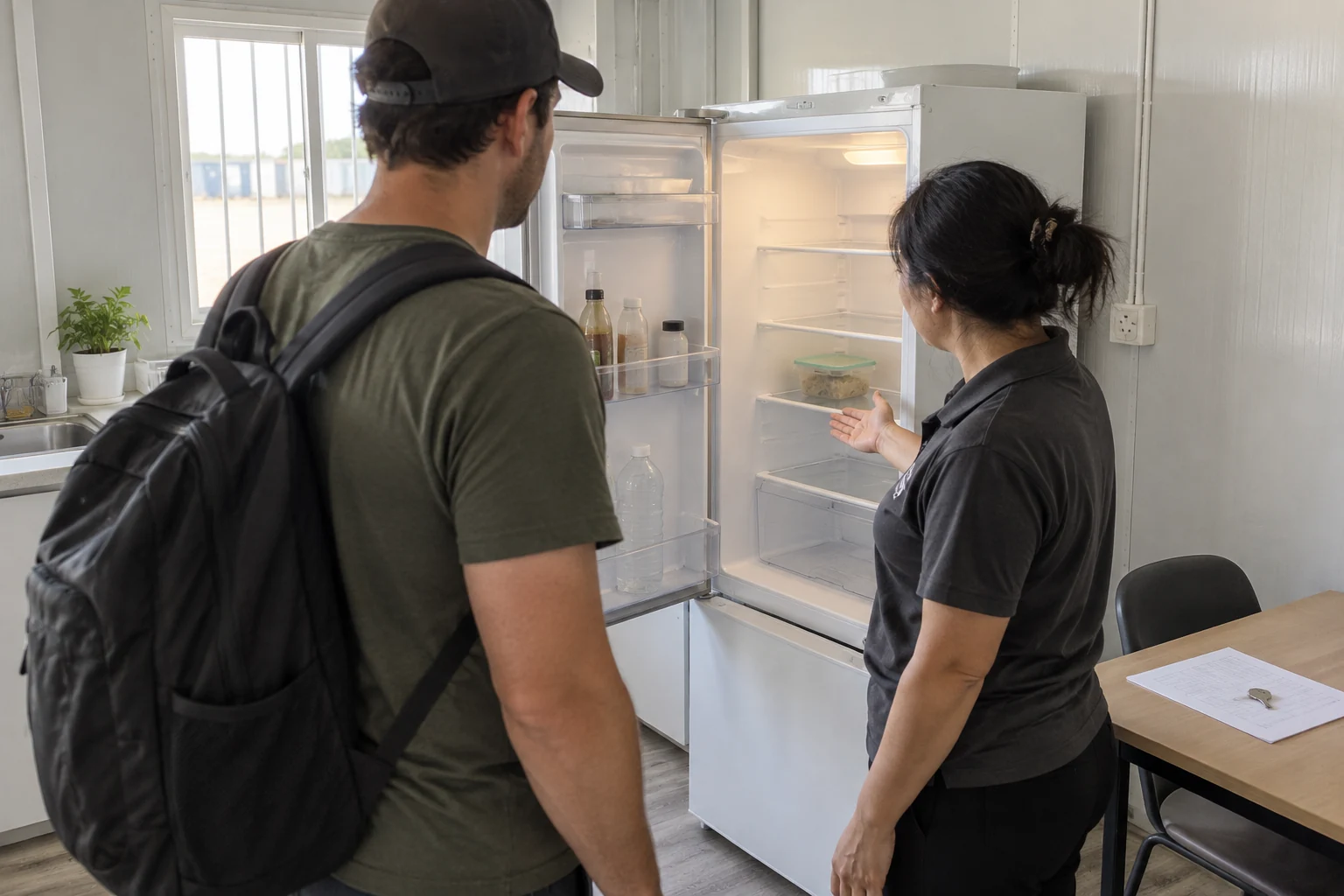
A shelf assignment should have a clear start and end. Include personal-food storage in departure and arrival checks, so abandoned items do not quietly consume the next resident's space. An empty bed is not proof that the former occupant's containers have been identified, removed appropriately or included in the cleaning handover.
Agree who confirms departure, who contacts the owner if necessary and who has authority under the operator's procedure to deal with remaining items. Keep this process separate from an informal decision by another resident. An ownership label can support contact, but it does not replace the food-handling procedure or determine a lawful disposal policy for the destination.
Before allocating the location again, confirm the relevant cleaning and access information is available. A new resident needs to know their own arrangement, the common responsibilities and the reporting route. Ask them to demonstrate where their food belongs and how they will obtain help outside ordinary office hours. That brief practical exchange may reveal an assumption which a printed induction sheet leaves unclear.
Retain the small records that make continuity possible: appliance identifier, allocation arrangement, responsible contact and any open maintenance issue. Do not collect unnecessary private information about residents' diets or photograph their personal food for a general marketing case. The operational record should support the task, while a published article should remain within its actual evidence and permission.
Put the agreed service into the purchase and handover records
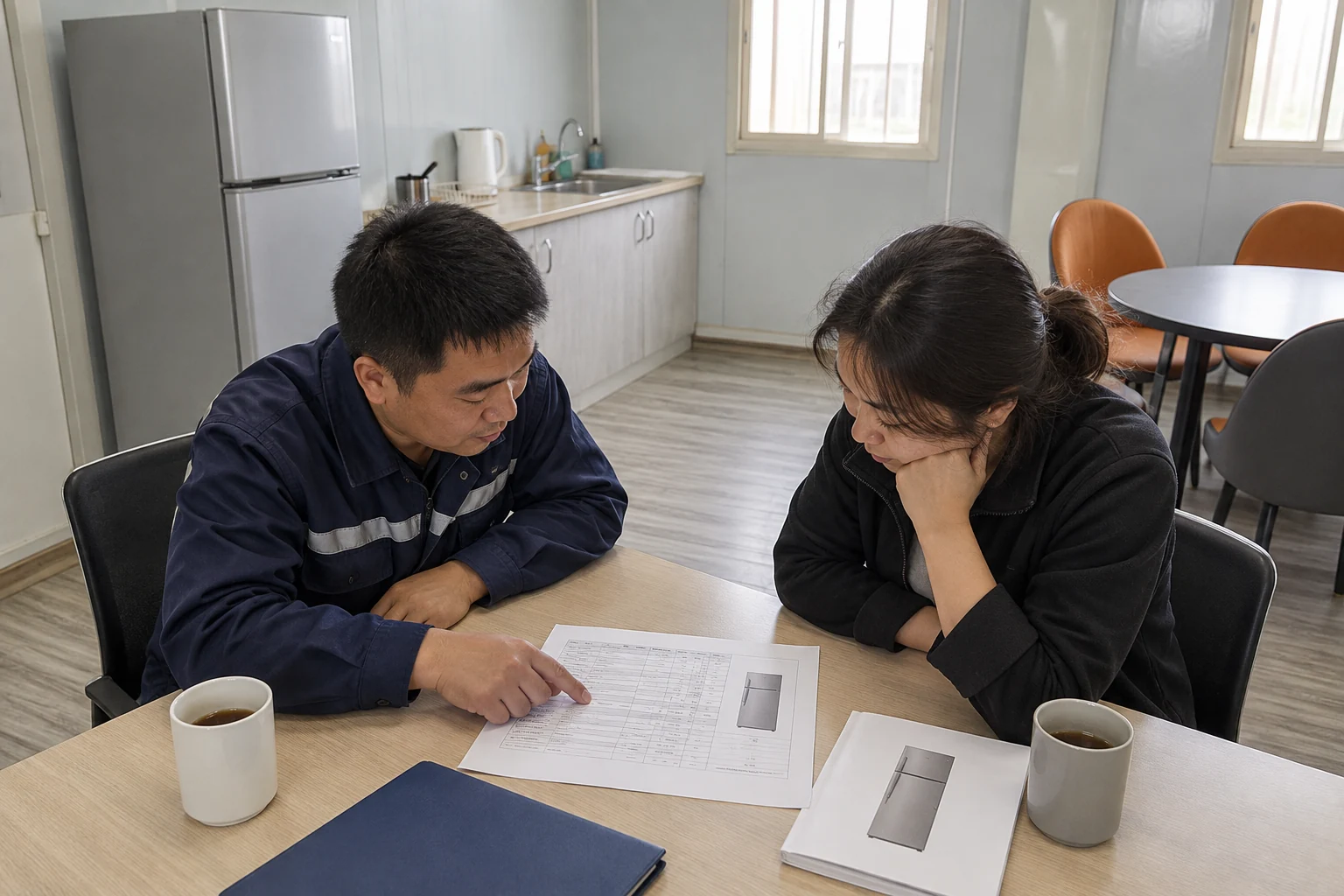
Send the building and appliance teams the same description of the personal-food service. Ask each party to identify its inclusions and unresolved interfaces. The useful handover is an identified appliance in a reviewed room with an accountable operation, rather than a supplied cabinet followed by a separate argument about who cleans it.
Resolve omissions before accepting substitutions
Compare the quotation with the container-house supply-scope checklist. Confirm whether the appliance, its installation, instructions and relevant room interfaces are included or arranged separately. Treat a blank field as an open question. A photograph showing a fridge in a furnished room is not an order document and should not silently enlarge the contracted supply scope.
At handover, review the actual model and arrangement against the agreed records. Resolve a changed appliance, altered cupboard or different operator before calling the service complete. Keep unresolved items visible with an owner and a next action. This is a practical acceptance record for procurement coordination, not a food-safety inspection or a substitute for the approvals required at the destination.
After residents move in, use specific complaints to improve the arrangement. Ask whether the problem was inadequate allocation, unclear ownership, unavailable cleaning or a failed appliance response. Different causes require different changes. Purchasing more equipment without identifying the task can leave the same common responsibilities unassigned in two fridges instead of one.
| Record | What it should identify | Open question to resolve |
|---|---|---|
| Service brief | Personal food, resident groups and access pattern | Does this include issued meals or professional catering stock? |
| Equipment schedule | Exact proposed appliance and applicable documents | Who accepts a model change and reviews its room interface? |
| Room arrangement | Actual appliance position, approach and maintenance access | Has the responsible team checked the furnished arrangement? |
| Operating allocation | Ownership, common cleaning and reporting responsibilities | Who responds during a late shift or resident departure? |
| Handover exceptions | Outstanding item, responsible person and next action | What remains unavailable until that action is completed? |
Buyer questions
Can a litre rating be converted into a fixed number of residents?
A nominal capacity alone does not establish usable allocation for the actual containers, food categories or access pattern. Review representative demand and the selected appliance with the operator. This guide supplies no universal litres-per-resident ratio and makes no guarantee about an unidentified model.
Does assigning each resident a shelf settle cleaning responsibility?
It settles only the agreed personal allocation. Common parts, abandoned items and fault responses still need named responsibilities and a workable procedure. Confirm who is accountable when an individual has cleaned their own space but a shared part or unresolved report remains.
Are the FSA household observations a forecast for a worker camp?
No. They describe averages in the original household sample. They neither measure PQSE appliances nor predict camp outcomes or establish illness causation.
What should accompany a shared-kitchenette enquiry?
Provide the resident groups, personal-food arrangement, shifts, representative storage needs, proposed room plan, destination and intended operator. Identify the appliance if selected and any unresolved installation or management responsibility. The relevant suppliers and local responsible team can then state their scope and the information still required.
Sources and scope
- FDA refrigerator thermometer guidance. US consumer advice; not a camp appliance certification.
- FSA chilling guidance. England, Northern Ireland and Wales consumer example.
- FSA consumer-practices research synthesis, 2026. Kitchen Life 2 household observations; original sample boundaries retained.
- IFC/EBRD workers' accommodation guide, 2009. Accommodation benchmark; not universal legislation or PQSE endorsement.
Prepared for PQSE House as an AI-assisted researched planning guide. The photographs are independently created illustrations using real photographic geometry references; they are not camp inspection or temperature-test records. Project requirements, appliance documents and responsible local review remain necessary. No first-hand PQSE fridge performance, professional signoff or independent brand endorsement is asserted.