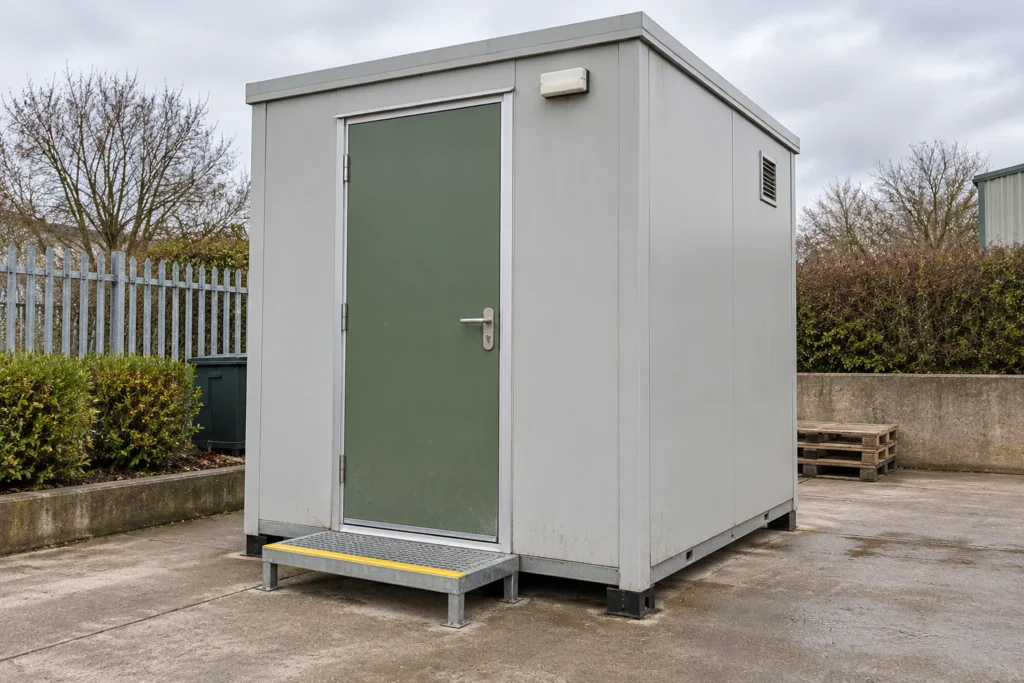
A portable toilet tank alarm needs a defined response before it needs a convenient reset. Identify the tank and the observed signal, confirm what the installed equipment actually controls, and pass the event to a named person.
A quieter alarm does not, by itself, establish that the tank has been emptied or the facility can return to use.
The difficult purchase decision is often between packages that look similar on a quotation. One includes an indicator, another mentions an optional valve, and a service contract deals with collection. Those descriptions leave an important question unanswered: who connects the warning to a decision about the affected toilets? This guide follows that decision from the first observation through service and handover. Named manufacturer examples illustrate different functions; none establishes a standard PQSE alarm configuration. Newly generated photographs illustrate planning situations and are not photographs of a PQSE customer installation.
Start with the signal somebody actually observed

At a shared toilet entrance, the first useful report is specific: which facility, which visible indicator, and whether a sound was heard. A message saying only that the toilets have an alarm leaves the next person to reconstruct the event. Give the responder enough information to find the correct equipment without entering a tank or opening a panel.
Use the facility's existing identification rather than an informal description that changes between shifts. A row of similar cabins can make the last toilet a different asset to different people. Link the cabin or block to the tank record and the alarm's model information. If those relationships are not documented, mark them as unconfirmed instead of assuming the nearest visible tank serves every unit.
Distinguish an observation from a diagnosis. A staff member can report a flashing light, an audible warning, or a message already displayed by the installed equipment. That report should not become a claim that a float is stuck, a pipe is blocked, or a collection vehicle failed to attend. The purpose is to preserve what was seen while the responsible provider determines what it means.
For a new order, begin with the portable toilet cabin and site-service scope. Put the alarm, tank and service responsibility into the same enquiry, even when different parties supply them. The buyer can then identify the missing interface before a warning occurs during operation.
Identify what enters the monitored tank
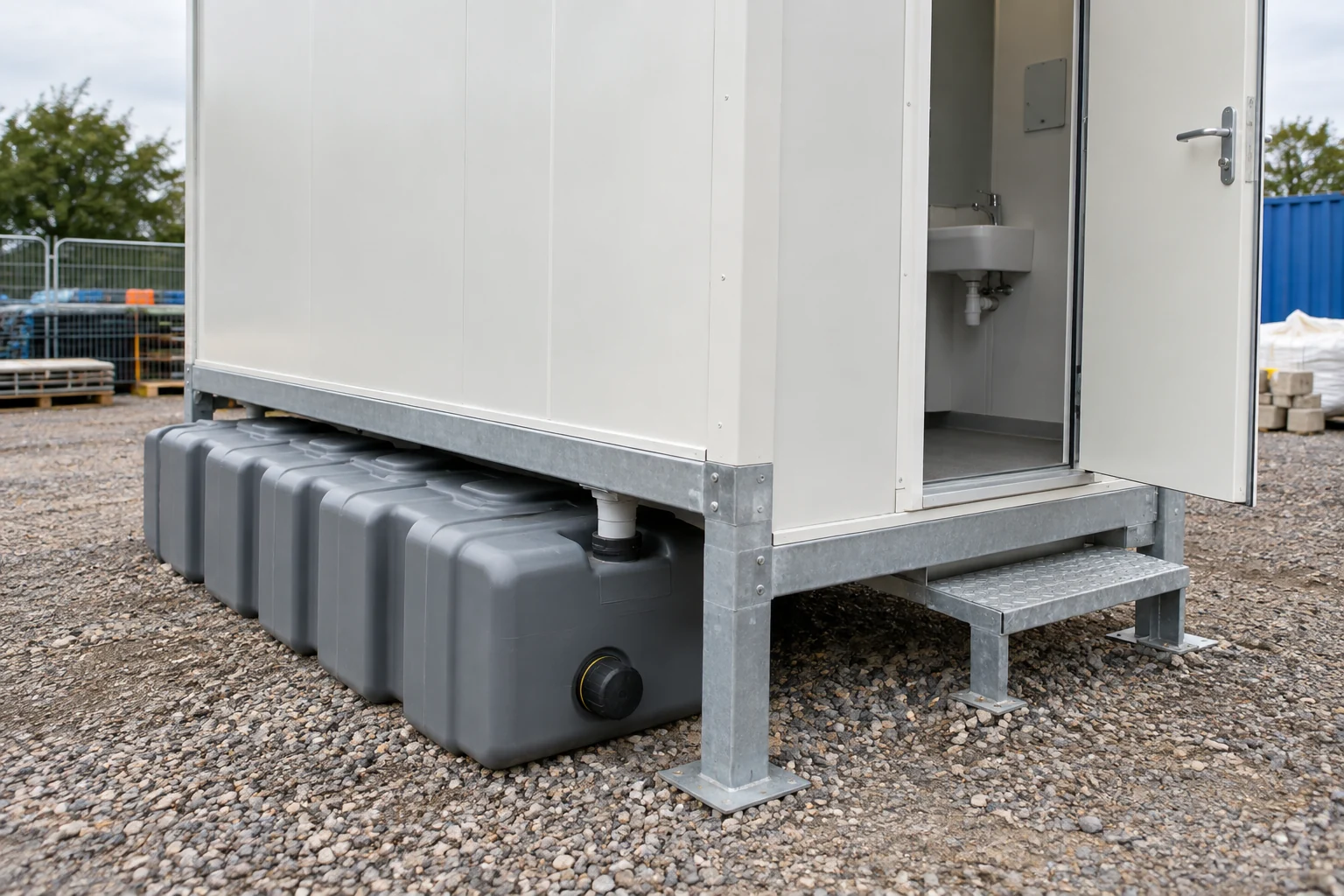
A closed tank beside a toilet block is an asset to identify, not a capacity reading. Establish which fixtures discharge to it and which connections belong to another system. The external appearance of the cabin, tank or alarm cannot show whether a washbasin, shower or separate neighbouring unit shares the same collection boundary.
Ask for a current connection description from the responsible supplier or installer. It should identify the monitored tank and the functions associated with it. For a combined portable bathroom, specify the actual arrangement rather than carrying over an assumption from a toilet-only sketch. A drawing that describes the building may still leave external collection equipment outside its scope.
Treat uncertain connections as unresolved information. The operator does not need to prove the route by opening the tank, lifting access covers or experimenting with fixtures. The practical procurement action is to request the accepted system description and identify who is responsible for confirming it. Keep a revised record when a facility is moved or its external service arrangement changes.
This boundary also determines which questions a supplier can answer. A cabin supplier can describe its agreed delivery; the tank provider can identify the selected vessel; the service provider can explain its collection task. Comparing sanitation functions and site services helps assemble the enquiry. It does not establish that one contractor has accepted every part of the installation.
Three documented values answer three different questions

Numbers on an alarm page can describe a sensor position, a sound pattern or an equipment check. They are not interchangeable measures of how long a site can continue using its toilets. Read each value beside its model and meaning before adding it to a procurement brief or operating instruction for the selected installation.
The Dometic DTM04 manual places Full within 51 mm (2 in.) of the tank top. That position belongs to this named monitor's documented arrangement.
A distance below the top does not describe the volume represented by that distance. The relevant tank shape, usable limits and incoming flow are separate information. Without them, a buyer cannot turn the display into remaining litres, remaining users or an available service window. Even a vessel's nominal volume does not answer how an installed signal relates to the operating arrangement.
Use the table to prevent category mistakes rather than to rank the products. Its values come from different equipment documents and concern different actions. Wider toilet capacity and waste-collection planning remains a separate task. An alarm indication should be interpreted under the selected instructions, not used to justify an invented period of continued use.
| Named document | Documented value | Limit of the comparison |
|---|---|---|
| Dometic DTM04, Revision A | Full: within 51 mm (2 in.) of tank top | Signal position; no remaining-volume or time forecast |
| Merlin Interceptor | Unmuted buzzer changes to chirp after 5 minutes | Sound pattern; no permitted response delay |
| SJE-Rhombus Tank Alert I | Alarm test: weekly | Equipment check; no pump-out interval |
Silencing a warning leaves a decision outstanding

Acknowledgement tells the next person that somebody has noticed the event. It should leave a clear record of what remains unresolved. A closed alarm panel and a quiet room are not enough to explain whether service has attended, whether a restriction still applies, or who now owns the next action for that facility.
Tank Alert I retains its warning light after horn silencing until the condition is remedied. Merlin's Interceptor retains its flashing LED and auxiliary output until its alarm condition ends.
That distinction matters at handover. Record the acknowledgement separately from the reported condition and the actual notification. An entry such as alarm acknowledged describes an action by the operator; it does not describe a service finding. A subsequent note should identify the contacted person and the instruction received, including any unresolved question about the affected facilities.
Avoid a local habit in which the word reset covers every stage. It may mean somebody silenced a horn, somebody observed a different indication, or somebody authorised a return to use. Use ordinary, specific verbs in the event log instead. The next shift should be able to tell what happened without reconstructing the previous operator's intentions or pressing controls to investigate.
Make the warning reach a person who can act
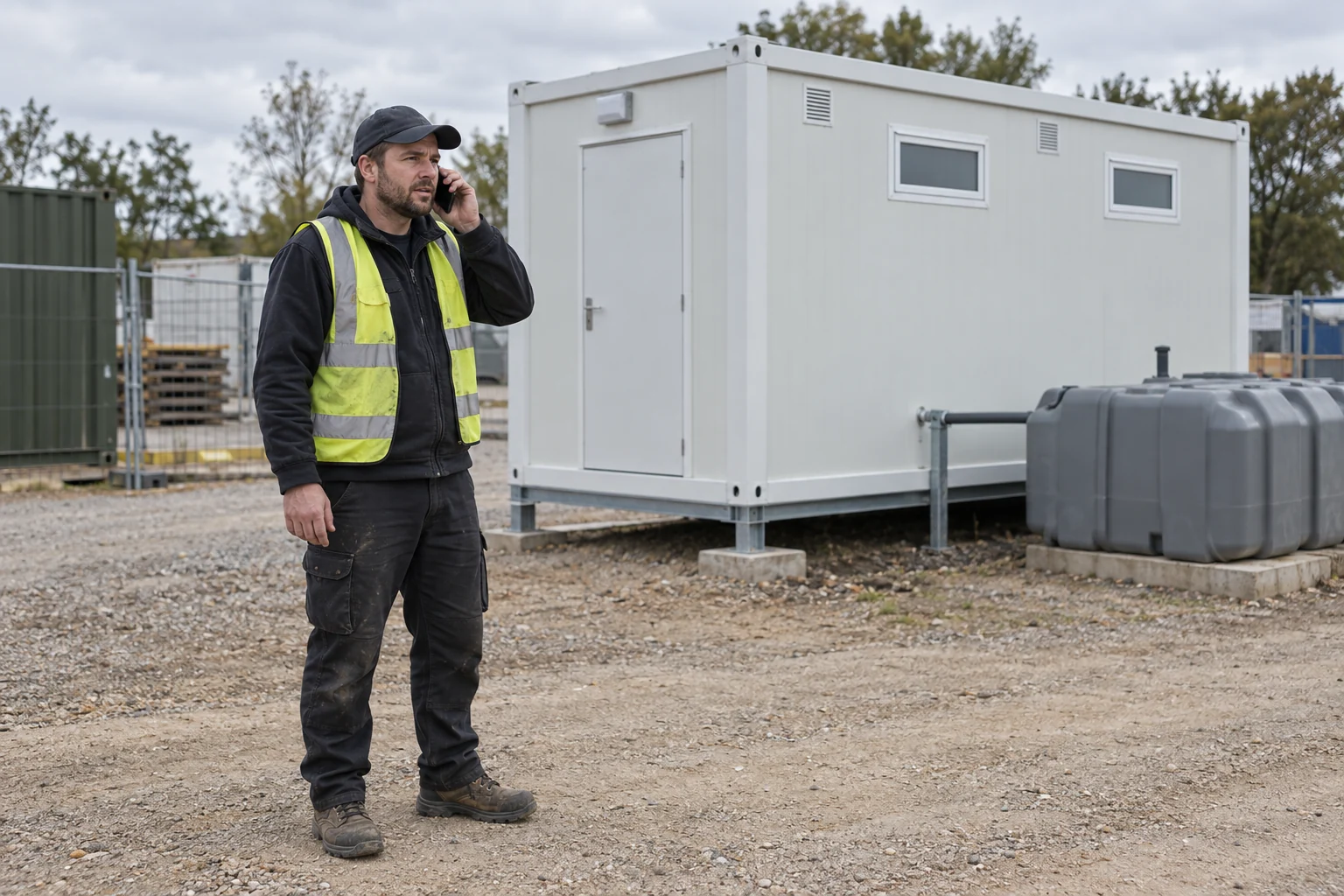
The person standing beside the alarm may not be the person who can arrange collection or restrict facility use. Give the event a reachable owner and a way to confirm that the message arrived. A phone call, message or shift record is useful only when it identifies the facility and results in an understood next action.
Walk through the ordinary working arrangement before buying additional notification features. Who observes the alarm during occupied hours? Who receives an event when the usual supervisor is away? Who can contact the service provider? These are staffing and communication questions. They do not establish that the selected alarm has remote reporting, automatic escalation or a backup communication channel.
For shared washrooms across camp shifts, put the response arrangement where incoming staff can find it. An outgoing operator should not leave a phone number without explaining whether contact was made. Record the recipient, the reply and the responsibility that was accepted. Where nobody has responded, keep that uncertainty visible and use the site's agreed escalation arrangement.
Agree any response expectation with the actual operator and service provider. A product description cannot supply the site's travel time, contractor availability or alternative facilities. Describe what users should be told under the responsible operator's instructions if a unit is restricted. Clear communication can prevent a completed phone call from being mistaken for a completed collection or repair.
Trace an optional control to the interface it affects
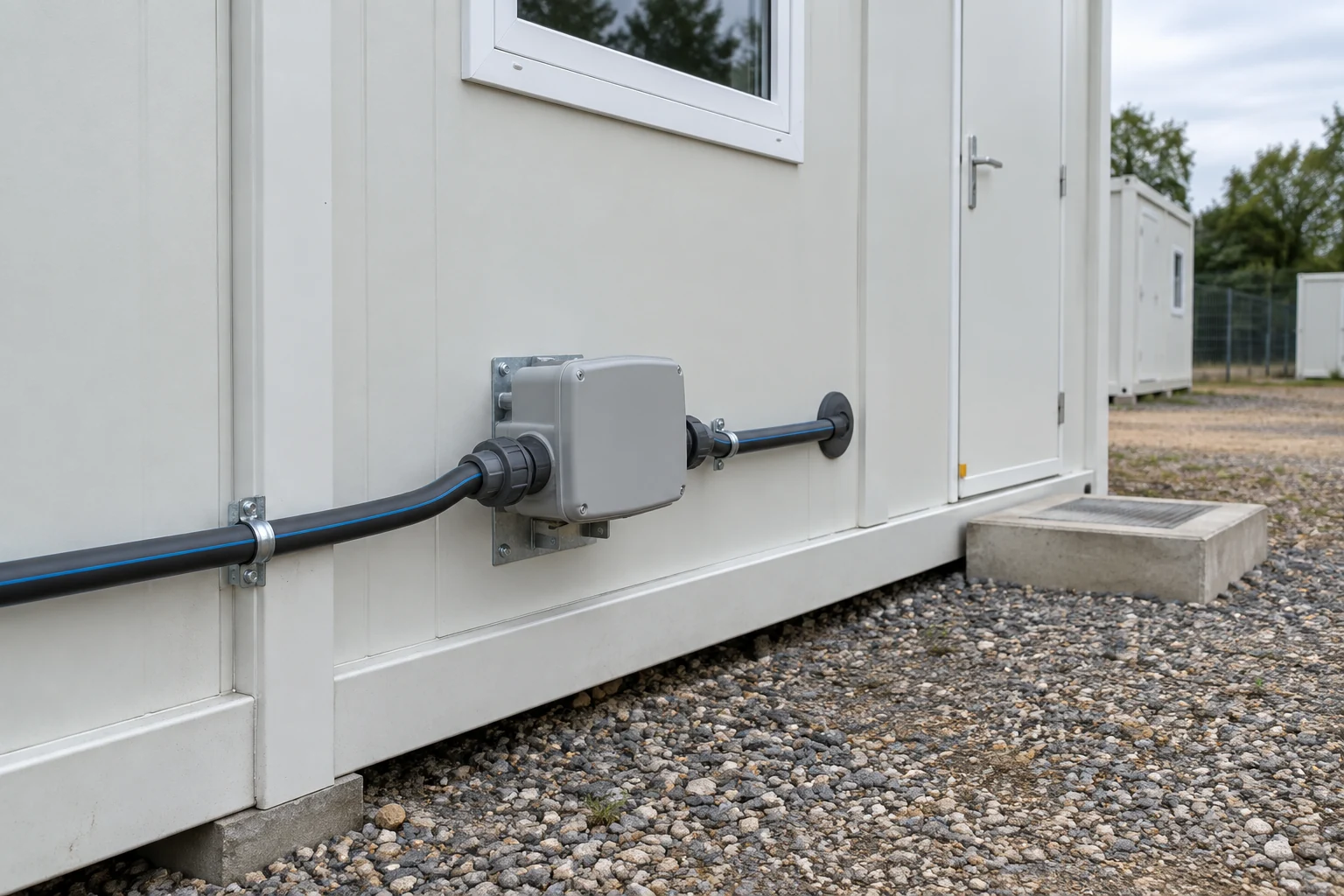
A quotation that mentions automatic shutoff needs a more precise question: shutoff of what? Identify the optional component, the equipment or supply it controls, and the accepted description of its installed action. A closed external enclosure can illustrate the discussion, but its appearance does not prove that a particular valve or interlock has been supplied.
Dometic's separately available DTM04 relay interrupts electric-toilet power at Full. Merlin offers an optional Interceptor solenoid for the connected water supply. These are different control interfaces, not a combined PQSE specification.
For the proposed facility, ask the supplier to mark the controlled item on the agreed system description. Identify any other contributing fixtures separately. A statement about one controlled supply should not be expanded into a claim that every possible input stops. Where the proposed action is unclear, obtain clarification from the responsible designer or installer before accepting the description in the purchase order.
Request a record identifying the configuration that was checked and the scope of that check. The acceptance question is whether the installed arrangement matches the agreed function. This article does not specify electrical connections, valve installation, float adjustment or an overflow test. Those matters belong to the selected equipment documentation and the appropriately qualified provider, with the applicable site requirements.
| Named equipment example | Documented function | Question for the actual order |
|---|---|---|
| DTM04 optional relay | Separately supplied; cuts electric-toilet power at Full | Is this option included, and which toilet is controlled? |
| Tank Alert I | Horn silencing leaves the warning light active | How is an acknowledged event kept visible to staff? |
| Interceptor optional solenoid | Acts on the connected water supply during an alarm | Which supply is affected, and what remains outside it? |
Send the provider an event, not just a collection request
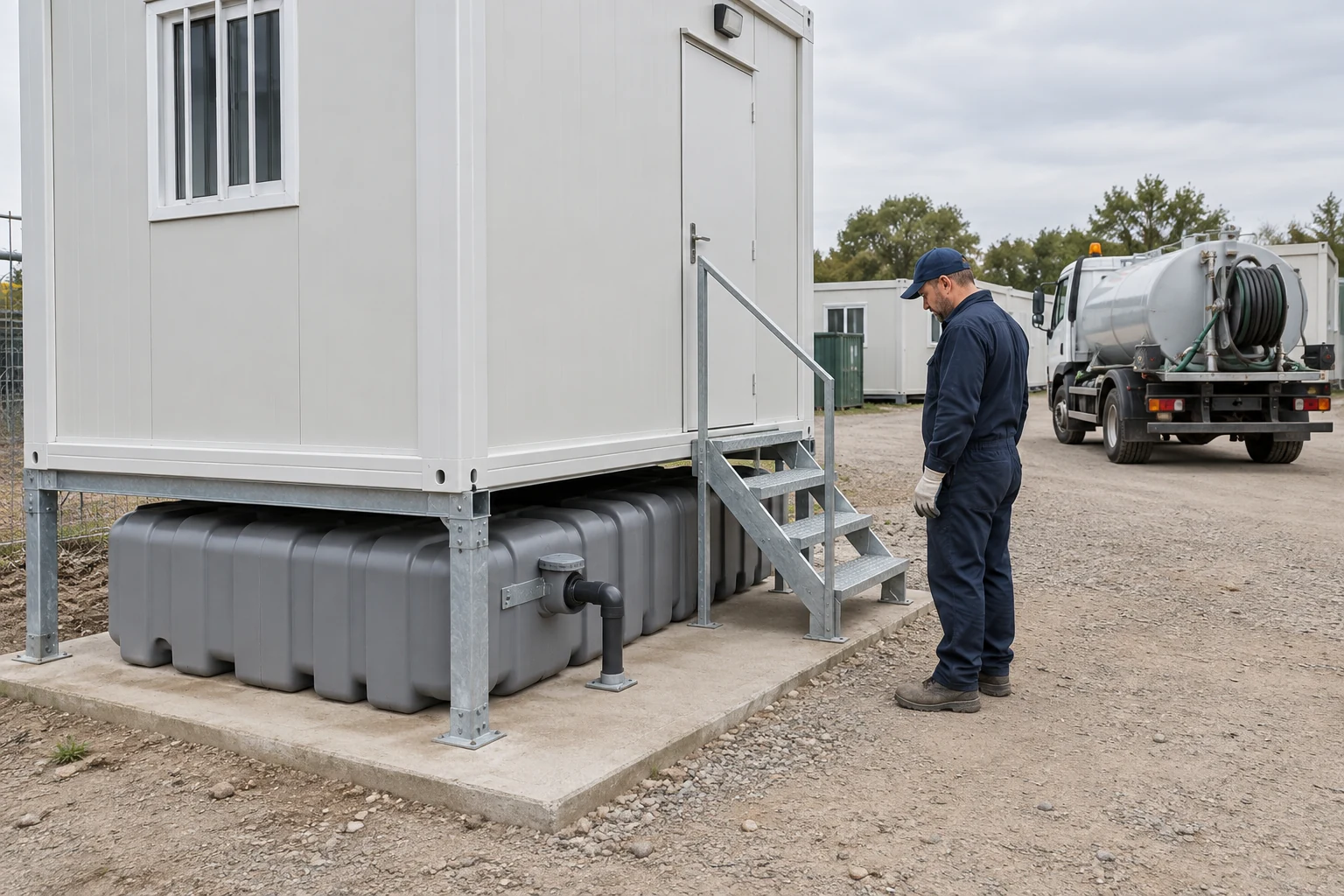
The service provider needs to know what prompted the call and which facility is affected. A closed tank, accessible service area and identified vehicle can illustrate the handover, but they do not show that liquid has been removed or a fault corrected. Keep the observed warning attached to the task that is actually being requested.
State whether the request concerns scheduled collection, an alarm event, an unexplained indication or a combination requiring separate responsibilities. A provider attending to remove waste may not have accepted a diagnostic or electrical task. Ask who handles any unresolved equipment issue so that completion of one task does not silently close another. Record the provider's actual finding without adding an explanation it did not give.
A toilet service and downtime plan can establish the routine contract. The event record should identify the particular restriction or question that sits outside that routine. Give the provider the accepted asset information and site contact. Keep closed equipment closed; the log does not need a photograph of tank contents to explain which service was requested.
At a remote camp with external services, confirm the practical attendance arrangement and communication route for this case. Do not turn a product's audible timing into a promise that a contractor can arrive within that period. A booking, an arrival and a completed task are different events, and the handover should preserve those distinctions.
Keep a power indication within its documented meaning

During a handover beside closed equipment, staff may point to a power light as reassurance. The useful question is what the selected manual says that light represents. Separate a known display state from an unverified sensor, control or notification condition. A confident description should come from the actual configuration, not from the colour of an indicator alone.
Tank Alert I's instructions identify its green light as panel-power indication, an unsupervised float circuit and a Type 1 indoor enclosure. These are properties of that named alarm, not every tank-monitoring system.
For a selected installation, ask which loss or failure conditions are documented and which are not monitored. The answer may reveal a question requiring the provider's explanation; it should not lead an operator to inspect wiring or simulate a fault. Preserve the distinction between the indication observed and the wider function somebody hopes it confirms.
This is especially useful when replacing equipment or changing suppliers. Similar-looking panels can have different intended meanings. Retain the correct manual with the asset record and remove obsolete local instructions from the operator's current reference set. A handover can then state the actual indication and identify the relevant documentation without treating a familiar light as evidence that every part of the facility is ready.
Order the configuration that will be handed over

Before an order is accepted, compare the proposed model documents with the scope of supply. The enquiry should identify the monitoring device, any separately supplied control, the installer and the service owner. Reviewing a closed sample enclosure and unfilled project documents illustrates this task; it does not establish a tested package or a default product option.
An alarm included line is too broad when the buyer expects several different outcomes. Ask the quotation to name the item and describe its intended function in the proposed installation. Where an option is excluded or supplied by another party, say so in the agreed scope. Keep unresolved items open rather than relying on a catalogue photograph to fill the gap.
Include the operating information that staff will receive: the relevant manual, the identified asset, the notification arrangement and the accepted provider contacts. Agree who updates those records after a move, replacement or alteration. Documentation should follow the configuration actually handed over, not an earlier proposal that used a different tank or omitted a control component.
A useful comparison between offers therefore asks what each party is committing to deliver and demonstrate. It need not claim that one alarm is universally safer or better. If two proposals describe different functions, resolve that difference before comparing the commercial terms. The selected configuration should answer the site's question in writing, including the limits of the supplier's responsibility.
Give checks a defined purpose and a qualified owner

A planned review can take place beside closed equipment while the responsible technician and operator compare records. Be clear about the question it is meant to answer: a documented alarm check, a configuration review or an unresolved service event. The photograph cannot show an internal test, successful repair or approved installation, and should not be read as one.
Keep the selected equipment's required checks distinct from tank collection and general cleaning. The provider should identify the applicable instructions, who performs the work and what result will be recorded. A routine visit should not be labelled a complete system test merely because somebody observed the panel or found the surrounding area tidy.
Ask what the check covered and what it left outside its scope. A record might identify the equipment and observed response while leaving another interface for a different contractor. Preserve those limits. An unresolved question about a sensor, control or connection needs the appropriately qualified provider's attention rather than an operator's improvised experiment with the tank or electrical enclosure.
Keep records of missed checks and outstanding actions available to the next responsible person. An old completed entry cannot establish the present condition of replaced equipment. Equally, the absence of a record does not identify a particular defect. It identifies an evidence gap to resolve. The buyer's role is to arrange an appropriate review and obtain a clear account of its result.
Separate equipment return state from facility release

At the facility entrance, the final handover concerns what people may use and who has confirmed that decision. An equipment indication belongs in the record, together with completed service and any outstanding restriction. A newly quiet panel, a departing vehicle or a conversation at the door should not replace the agreed return-to-use information for that installation.
For the DTM04 relay option, toilet power returns when Full goes out during pump-out. Its monitor-only instructions say the toilet should not be used at Full until pump-out. These describe that equipment's documented operation.
The site's release decision should also account for the task that was requested and any issue the provider left unresolved. If collection was completed but investigation remains open, preserve both facts. Ask the responsible operator to identify the permitted facility status under the selected instructions and provider advice. Do not invent a general reset sequence or treat an automatic equipment change as an answer to every outstanding question.
Use the handover fields below as a concise editorial aid. They connect the original observation to a named responsibility and a current decision; they are not a mandatory form or a universal response timetable. The incoming shift should be able to find the latest accepted status, the remaining action and the person to contact without reopening the investigation from memory.
| Record field | Information to preserve | Confirmation owner |
|---|---|---|
| Asset and observation | Facility, tank, equipment identity and actual signal | Reporting operator |
| Acknowledgement | What was acknowledged, when and by whom | Acknowledging staff member |
| Notification | Actual recipient, reply and accepted next action | Sender and receiving responder |
| Current facility status | Affected use and unresolved restriction | Responsible site operator |
| Service finding | Completed task, provider's finding and remaining issue | Assigned provider |
| Release and next shift | Confirmed status, outstanding action and reachable owner | Release owner and incoming operator |
Buyer questions
Can an alarm be specified before the tank supplier is selected?
You can describe the monitoring need, but keep the equipment choice and interface unresolved until the actual tank and collection arrangement are identified. Ask the relevant suppliers to confirm the proposed combination and responsibilities. A model name on an early quotation does not settle who supplies, installs or checks the complete arrangement.
Does a quiet alarm mean the tank has been emptied?
No. A quieter sound is not a service-completion record. Keep the acknowledgement, current indication and actual provider finding separate. The incoming operator should be able to see what remains unresolved and who is dealing with it, using the instructions for the installed equipment.
Should collection and an equipment investigation be one service request?
Describe both needs if both exist, then confirm who has accepted each task. One contractor may collect waste while another handles the alarm or control equipment. The event record should preserve the separate findings and any outstanding action rather than treating attendance by one provider as completion of every requested service.
What should the next shift receive after an alarm event?
Give it the identified facility, latest accepted status, actual service finding, remaining restriction and reachable owner of the next action. Use the handover to explain the present decision, not merely to list calls made. Where status is still uncertain, preserve that uncertainty and the responsible person's agreed next step.
Sources and scope
- Dometic DTM04 installation and operating manual. Revision A, August 2017, English sections 3.1, 3.2 and 7. Named monitor and optional relay; no PQSE configuration or independent performance claim.
- SJE-Rhombus Tank Alert I instructions. PN1011978J, September 2016, English pages 1–2. Named indoor alarm; equipment instructions, not a general sanitation service interval.
- Merlin Interceptor Liquid Level Alarm. Australian supplier; publication date unstated. Optional water control; no PQSE supply or measured performance established.
The tables distinguish documented functions and unlike quantities; they do not rank equipment performance. The event worksheet and procurement questions are editorial planning aids. The actual installation, its applicable requirements and the responsible provider's instructions determine the operating response. No wiring, tank-opening or self-repair procedure is provided.