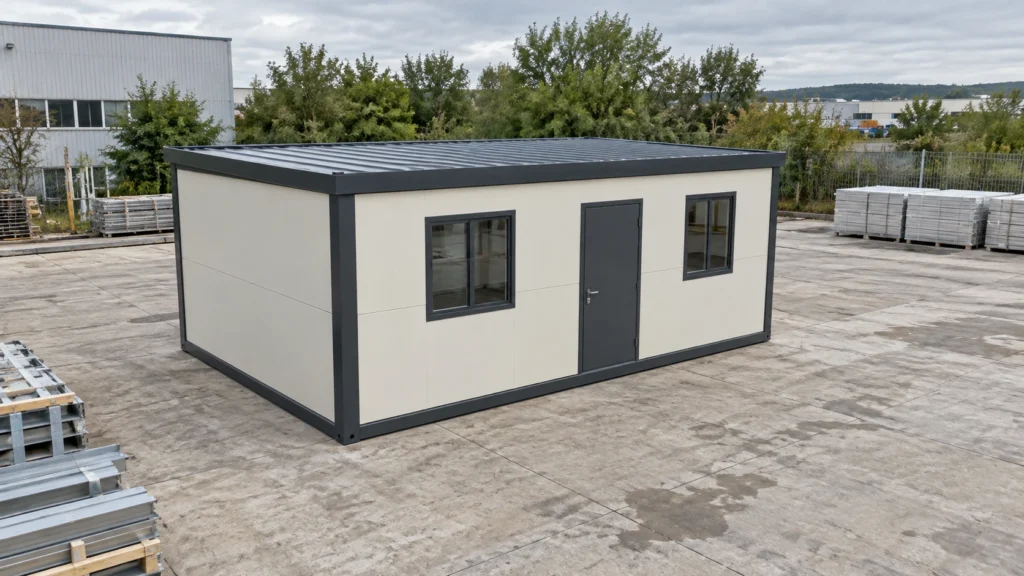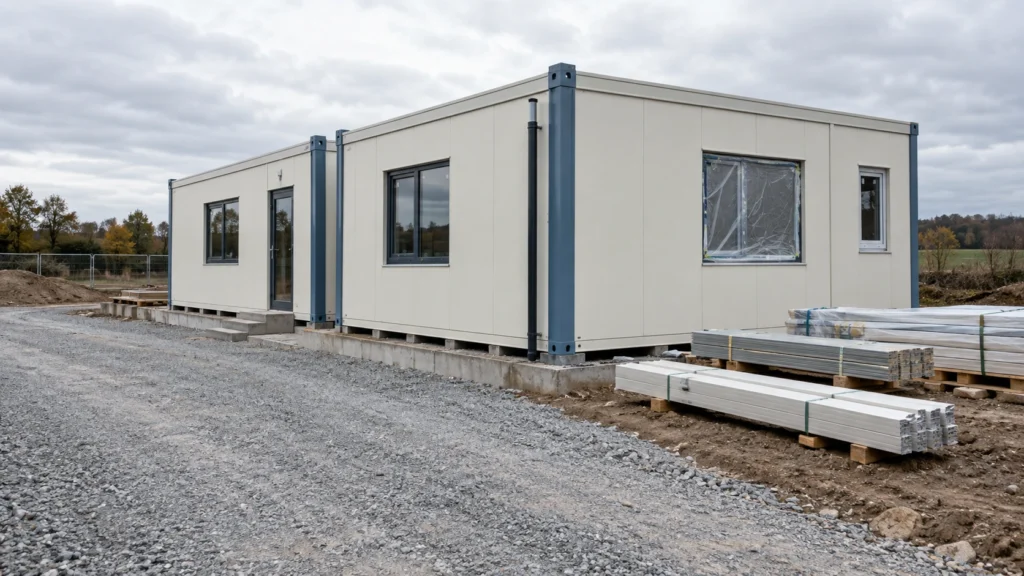
Before booking container house freight, confirm the final package list, packed dimensions and gross weights, loading plan, delivery scope and site receiving arrangements. These determine what can travel and what your local team must prepare.
A flat-packed building, folded unit and fitted room create different cargo. Use the shipping condition of your selected model; a room-size label or photograph cannot establish a loading quantity.
This guide connects factory packing with site receipt. The appointed transport and handling teams need the actual cargo and equipment information to prepare the loading, securing and lifting arrangements.
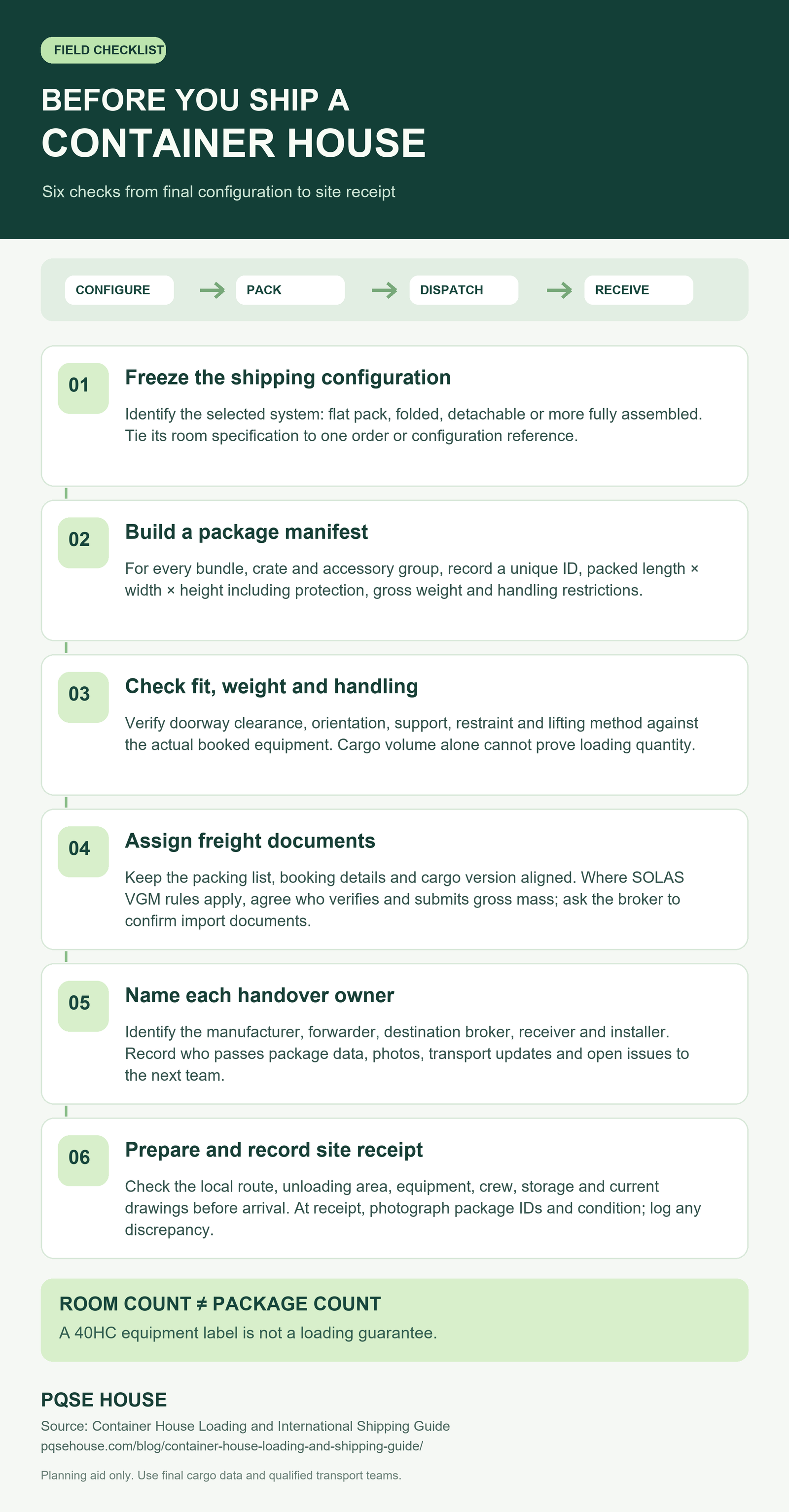
Container House Shipping Checklist
Use this one-page visual to check the handoffs before dispatch. Confirm the final details with the factory, forwarder and receiving team for your specific configuration and route.
What Information Do You Need for a Freight Quote?
Provide package dimensions and gross weights in shipping condition, including protection and external additions. Keep finished-room dimensions in the layout file so they are not substituted for cargo dimensions.
Use a cargo data sheet with one version reference
Keep the room specification and cargo data connected by an order or configuration reference. The cargo sheet should identify each package, its shipping condition, the date of measurement and any items still provisional. Send the same version to the factory, forwarder and receiver.
When a layout or accessory changes, mark the affected packages and reissue the sheet. This avoids a common coordination gap: the buyer discussing a revised room while the transport team is still planning around earlier dimensions. A preliminary estimate remains useful if its assumptions are visible and it is not mistaken for final booking information.

Match the transport form to the selected system
| Supply form | Information needed before freight planning | Destination implication to discuss |
|---|---|---|
| Flat pack assemblies | Bundle dimensions, package weights, separate panels and accessory groups | Unpacking space, component organization and the assembly sequence |
| Folded unit | Folded envelope, protected openings, loose items and handling instructions | Space and equipment for the approved opening and finishing process |
| Detachable component package | Complete package list, longest pieces and the location of small parts | Storage, identification and assembly labor |
| More fully assembled room | Finished shipping envelope, gross weight and any external additions | Delivery route, handling method and final site connections |
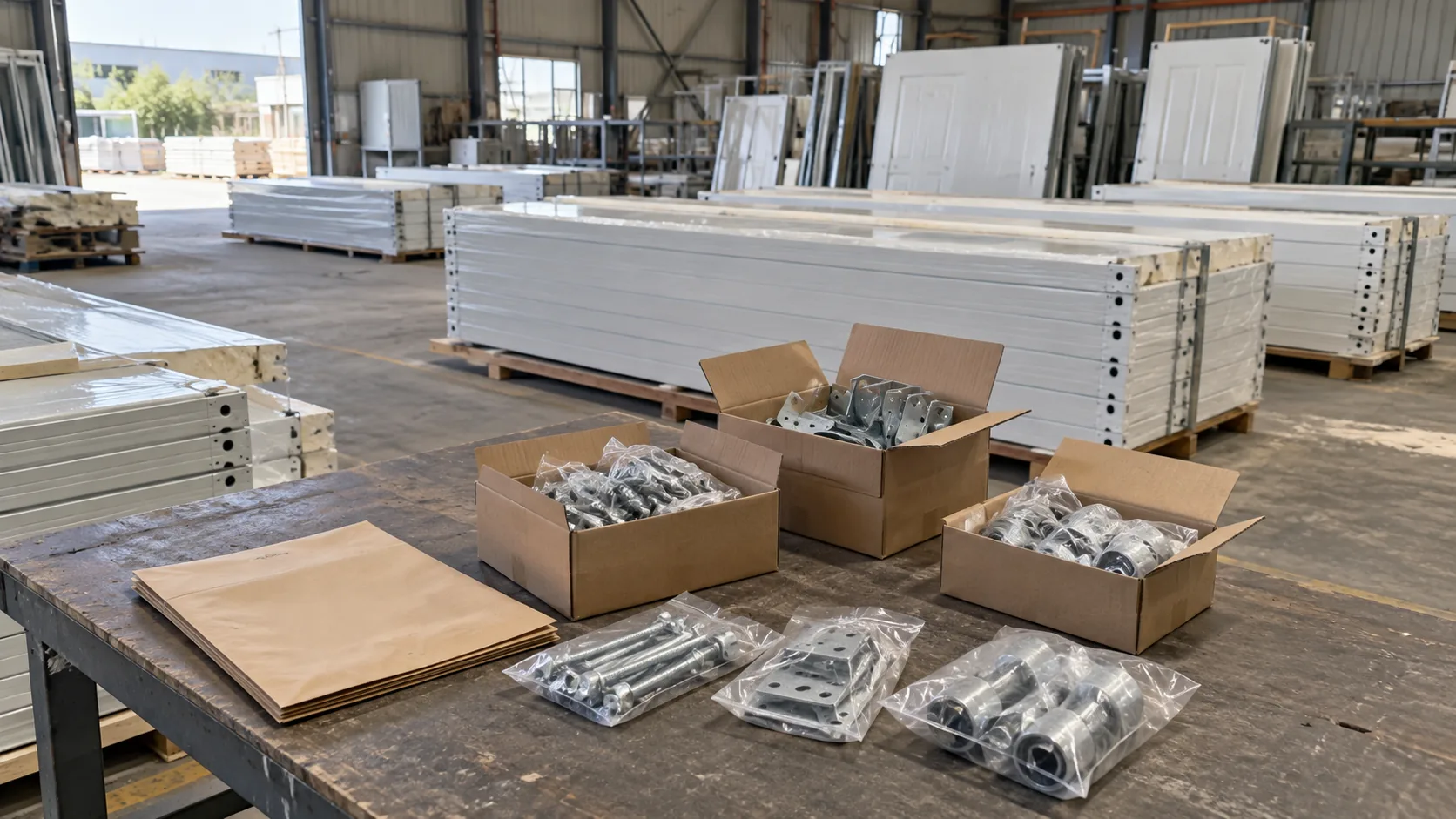
For flat pack container houses, confirm whether the proposed package includes only the main room components or also partitions, bathroom fittings, electrical items and external additions. A configuration change can alter the shipment even when the number of rooms stays the same.
Separate product labels from shipping-container types
20GP and 40HC describe freight equipment, not the dimensions or loading quantity of a prefab building. Match the booked equipment specification to the final package list.
Request a revised packing plan when the configuration changes. Added windows, sanitary equipment or separately packed stairs can affect the package arrangement and the receiving sequence.
Distinguish a room count from a package count
An order for several rooms can include frame bundles, panels, fittings and separate equipment. Record both the room references and the packages needed to complete them. Some shared items may serve more than one room, so the receiving list needs to show that relationship rather than forcing every carton into a simple one-room grouping.
Ask how the first installation stage will locate its components. The answer should come from the packing list and loading plan, not from opening every package at the destination. Any proposed receiving sequence still needs to fit the loading and securing constraints determined by the responsible teams.

Prepare a Packing Plan That Protects the Order
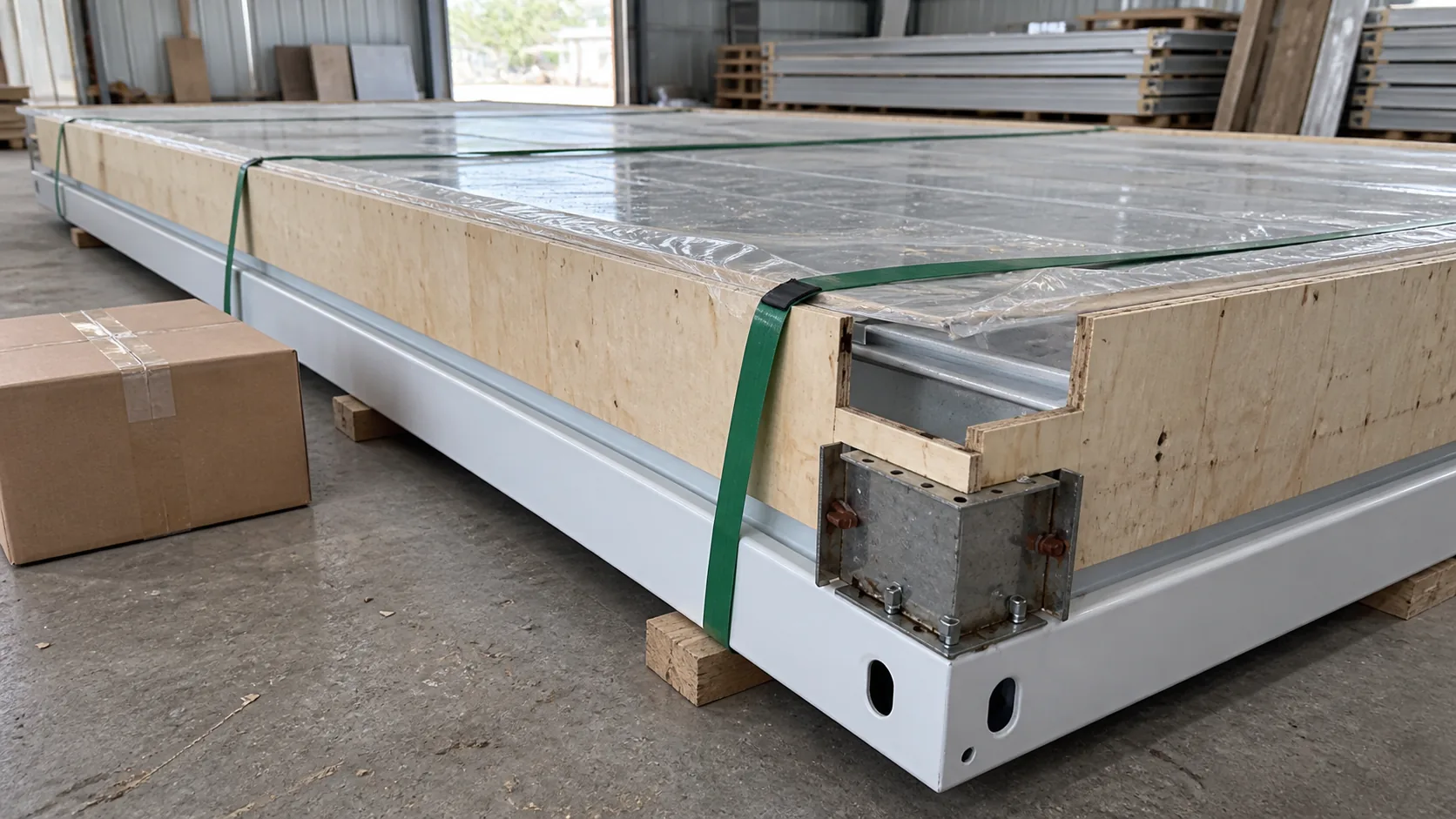
Packing should address the actual components and the planned journey. Review the vulnerable edges, finished surfaces, openings and loose accessories, then identify how they will be supported, protected and located when the order arrives.
Ask for photographs of the proposed packing method alongside the written package list. Check whether the images relate to the same type of product and protection method. A photograph of one package does not establish that every accessory has been included.
Describe the protection and the condition being handed over
For each package type, record the vulnerable surfaces, the proposed protection and the handling or storage information supplied with it. Photographs are most useful when they identify the package and show its overall condition as well as a relevant detail. Keep the package reference visible in the record even when labels cannot be read in a wide image.
A later receiving team can then compare the delivered condition with a specific dispatch record. This is more useful than an attractive photograph of unrelated packing, and it supports a precise discussion if protection is missing or damaged on arrival.
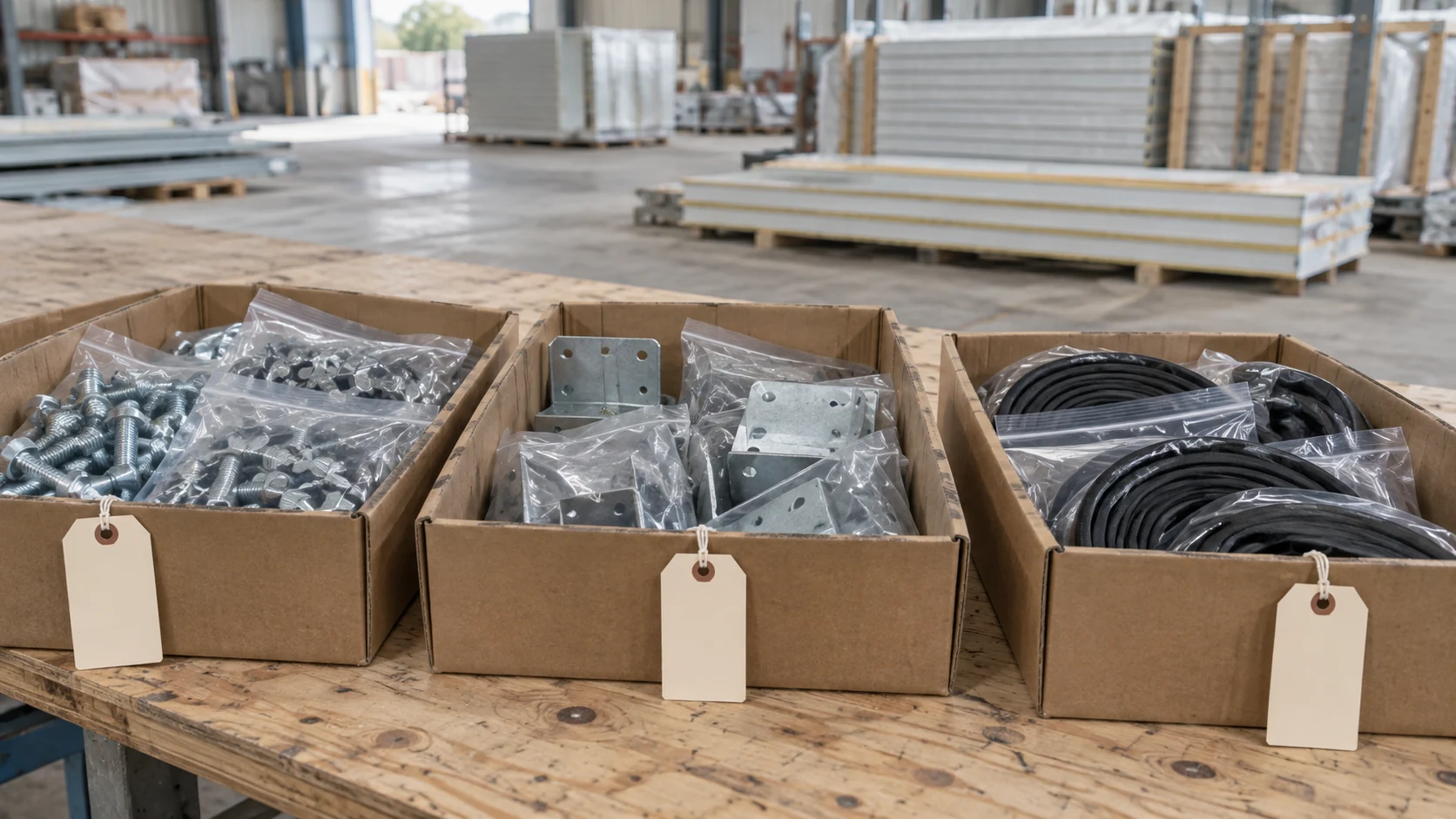
Keep small parts connected to the building package
Make small parts identifiable by unit or assembly stage. A total carton count cannot tell the installer where the brackets or seals for the first room are packed. Link each accessory group to a package reference and the relevant assembly information.
For example, a hypothetical packing list might identify “Unit A / base-frame hardware / carton A-01.” Agree how the receiving team will locate the first-stage items without unpacking unrelated rooms. The loading team must still account for support, weight distribution and restraint.
Review the journey and storage conditions
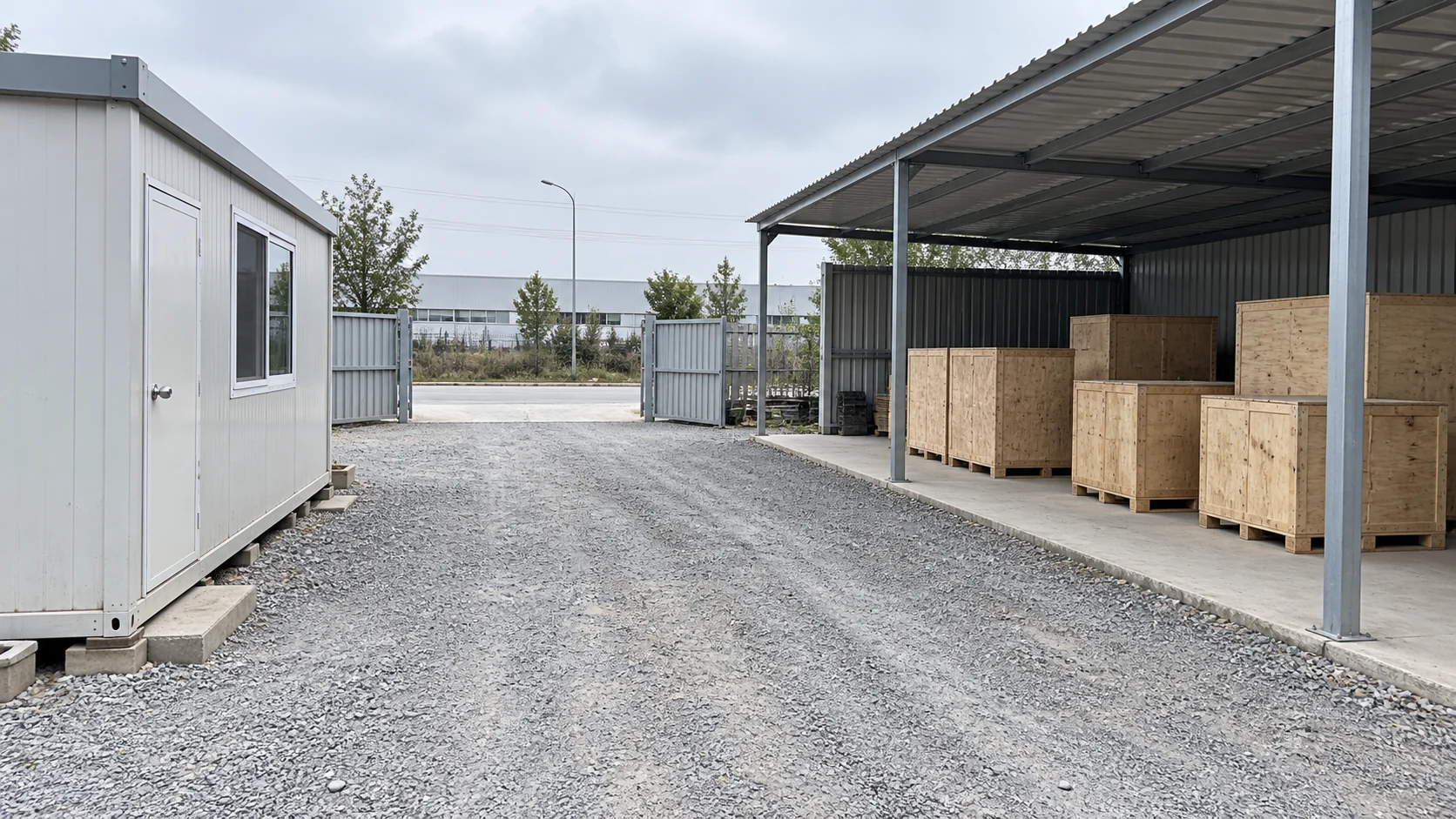
Explain whether the packages will travel directly to site, pass through intermediate storage or remain outdoors before assembly. Ask the supplier what storage conditions and protection arrangements the specified components require. Tell the receiving team before dispatch if covered space or particular handling equipment is needed.
The IMO/ILO/UNECE CTU Code provides international guidance for packing cargo transport units. Use it as a reference for discussion with competent packing and transport personnel; a generic article or image cannot determine the securing arrangement for your particular load.
Keep protection, support and restraint as separate questions
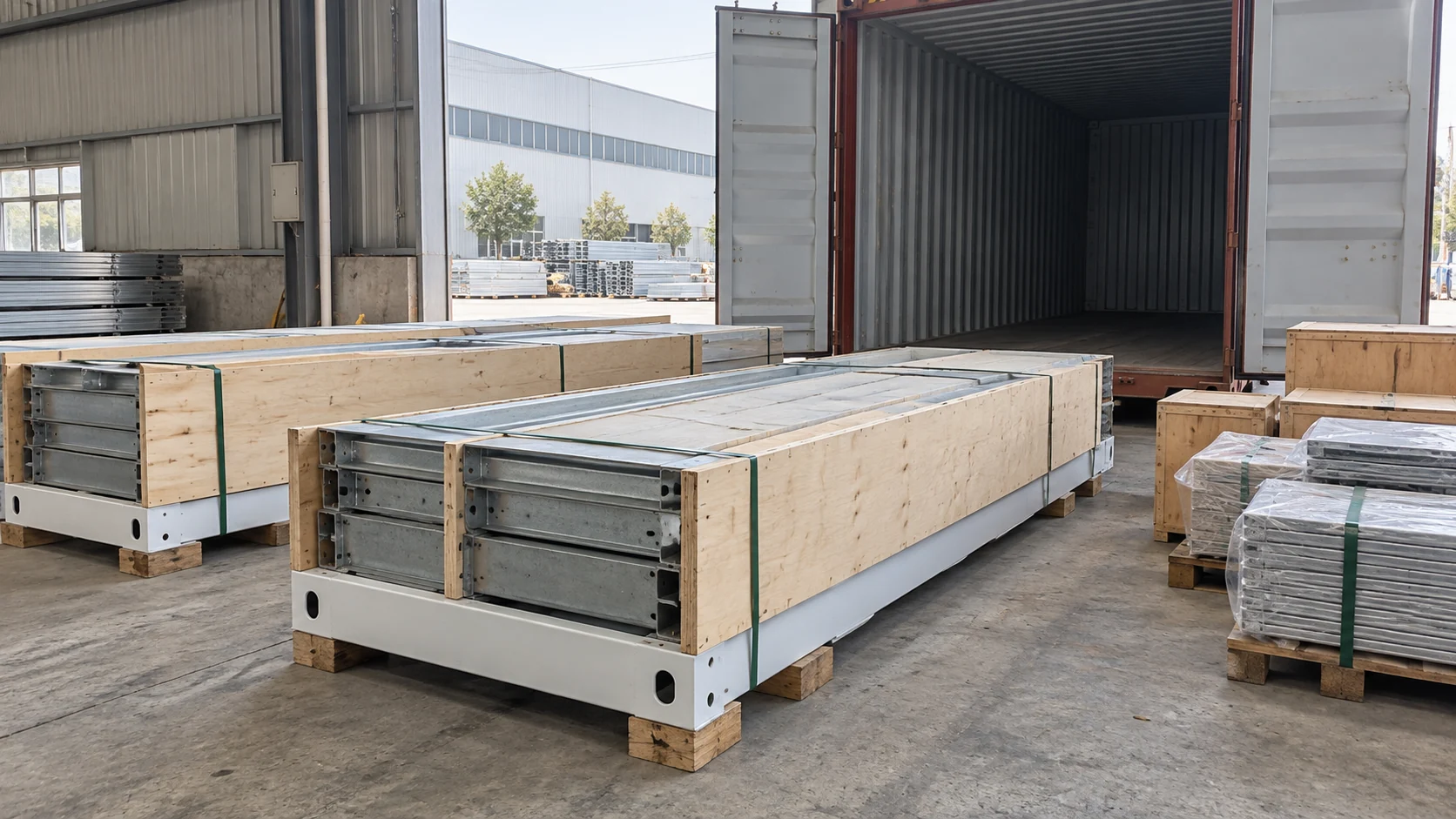
Protection limits exposure of surfaces and edges; support carries the package in its planned orientation; restraint addresses movement in transport. Discuss all three with the competent packing and transport teams. One visible strap or a wrapped bundle does not demonstrate that the complete arrangement has been assessed.
Use the current package weights, equipment information and handling restrictions for that discussion. If packing changes after the plan is prepared, ask the responsible team whether the loading information also needs revision. The final record should describe the cargo that actually leaves the factory.

Why Is Total Cargo Volume Not Enough to Confirm Loading Quantity?
Cubic volume does not establish whether a package can pass through the door, sit in the planned position or stay within weight limits. Confirm the arrangement against the actual freight equipment and handling method.
| Input | What to provide or confirm | Why it matters |
|---|---|---|
| Package identification | A unique reference for each bundle, crate and accessory group | Connects the physical cargo to the packing list |
| Packed dimensions | Length, width and height, including protective materials and protrusions | Establishes clearance and arrangement |
| Gross weight | Weight of each package and the complete planned load | Supports equipment and load-limit checks |
| Support and handling information | Approved handling points, orientation and any restrictions | Helps the team select the handling method |
| Freight equipment | Actual container or other equipment type and relevant limits | Confirms the plan against the booked equipment |
| Separate additions | Stairs, canopies, service equipment and loose materials | Prevents omitted cargo and last-minute repacking |
| Loading and receiving order | Items needed at each stage and access constraints | Connects dispatch planning with site operations |
For example, a package can fit within the container’s internal dimensions yet fail the doorway-clearance check. Include wrapping, edge guards and protrusions in the measurements. Ask for a plan based on the final configuration before relying on a “units per container” claim.
Review fit, weight and operations together
A loading proposal has to address the package envelope, entry route, available support and the equipment used to place it. Review the complete sequence with the responsible team rather than treating an empty container as a simple volume box.
A hypothetical package might clear the internal space but require a different orientation to enter. Whether that orientation is permitted depends on the product and handling instructions. The example explains why a dimension comparison is only one check; it does not recommend a particular loading maneuver.

Confirm verified gross mass responsibilities
VGM concerns the mass of the packed freight container, including its tare mass. Where the SOLAS rules apply, the shipper must provide verified gross mass in time for stowage planning. The IMO’s VGM guidance describes weighing the packed container or using an approved method to total cargo, pallets, dunnage and securing materials plus container tare.
Package weights alone are not a completed VGM submission. Agree who obtains and submits it, the approved method to be used and the deadline for the actual booking.

Track booking data separately from the product paperwork
Keep the carrier or forwarder’s booking requirements with the cargo version used to prepare them. Record the person supplying each submission and the milestone by which it is needed. Product drawings support the cargo description, but they do not replace booking and transport records.
If the planned cargo changes, notify the relevant booking contact and confirm which submissions need updating. Keep the receiver informed of the final package information as well. This connects the administrative handover with the physical shipment instead of assuming that an updated drawing automatically reaches every party.
Align Documents and Responsibilities at Each Handover
Name the manufacturer, forwarder, destination broker, receiver and installer, plus any export coordinator. Assign a contact for document queries and a person authorized to approve delivery changes.
Match descriptions, package references and quantities across the packing list and transport documents. Have the destination broker confirm the import document requirements before dispatch.
Use a handover record
| Handover | Questions to settle | Information to pass forward |
|---|---|---|
| Production to packing | Has the agreed inspection been reviewed and are outstanding items resolved? | Release status, product identifiers and approved component list |
| Packing to loading | Do all packages match the list and the loading plan? | Package photographs, dimensions, weights and handling information |
| Export dispatch | Are booking details and required submissions complete? | Relevant transport documents, contacts and dispatch update |
| Destination arrival | Who handles document queries, collection and local transport? | Arrival information, required import records and receiving arrangements |
| Site receipt | Who checks package identity and condition, and where will cargo be stored? | Receiving record, photographs and any discrepancy report |
This table is a coordination tool. The commercial agreement and the responsibilities accepted by each party govern the actual scope. Write the named delivery point clearly and identify who arranges each remaining leg to the site.
Use named locations and named contacts
Write the destination point precisely enough for the parties to understand the remaining transport and handling work. A port name alone may not describe the final collection or site delivery arrangement. Identify the party responsible for each stage and where the current documents can be found.
Keep the contact list usable at the handover: the person handling a document query may differ from the person receiving the truck or supervising installation. The International Trade Administration’s Incoterms overview also explains that trade terms do not settle every sale condition. Maintain the agreed building scope and project responsibilities alongside the transport arrangements.

Our manufacturer, builder and contractor guide can help if responsibility is split between a factory and a local project team.
Keep documentation specific to the destination
The required document set may include invoices, packing information, transport documents, origin information and route-specific records. Have the broker confirm the set for this shipment rather than carrying over assumptions from another country.
If the design or accessories change, ask whether the package list and relevant shipment descriptions need updating. Keep the final versions together and make them available to the receiver before arrival.
Prepare the Destination Before the Shipment Arrives
Confirm the site can receive and handle the actual packages before dispatch. Review the local route, unloading area, storage and installation sequence while you can still adjust the delivery plan.
Give the local team the actual package sizes and weights. Ask them to confirm vehicle access, overhead restrictions, unloading space and the equipment and personnel required. Any lifting or handling operation should follow the approved method for those packages and site conditions.
Check readiness as a group
Before dispatch, confirm these points with the receiver and installer:
- The destination contact and delivery location are correct and reachable.
- The local route and receiving area have been assessed for the planned vehicles and cargo.
- Suitable handling equipment and competent personnel can be available for the agreed arrival window.
- Temporary storage meets the requirements of the supplied components.
- The installation team has the current drawings, component list and manufacturer’s relevant instructions.
- Site works and service interfaces are coordinated with the approved installation program.
Track vessel arrival, cargo availability, site delivery and installation start separately. Name the person who updates the downstream plan when a milestone changes.
Keep arrival, availability and site readiness distinct
A vessel arrival update is not a confirmation that cargo can be collected or that the site is ready. Track the information needed for the next stage: cargo release, local transport, receiving resources and the installation program. Ask the responsible party to confirm its own milestone rather than treating one estimated date as a promise for all stages.
When a milestone moves, review downstream storage and receiving arrangements. The useful question is which resource or decision needs updating, not simply whether the shipment is early or late. Keep that update with the same package and order references used elsewhere.

Include waiting and storage costs in the discussion
Charges can arise when equipment or terminal space is used beyond the agreed period. Maersk’s explanation of detention and demurrage illustrates the distinction between equipment use outside and inside the terminal. Confirm the terminology, free time and rates for your actual booking.
The container house cost guide provides a place to record these transport and destination items alongside the building package. Keep unconfirmed charges visible instead of treating them as zero.
Check the Shipment When It Reaches the Site
Compare the received packages with the packing list before they are dispersed around the site. Photograph package identifiers and visible condition, including any damage to wrapping or edge protection. Record missing or damaged items precisely enough for the supplier and transport parties to identify them.
Use the agreed discrepancy-notification process and keep delivery, photograph and packaging records together. Escalate unsafe handling conditions to the people responsible for site operations.
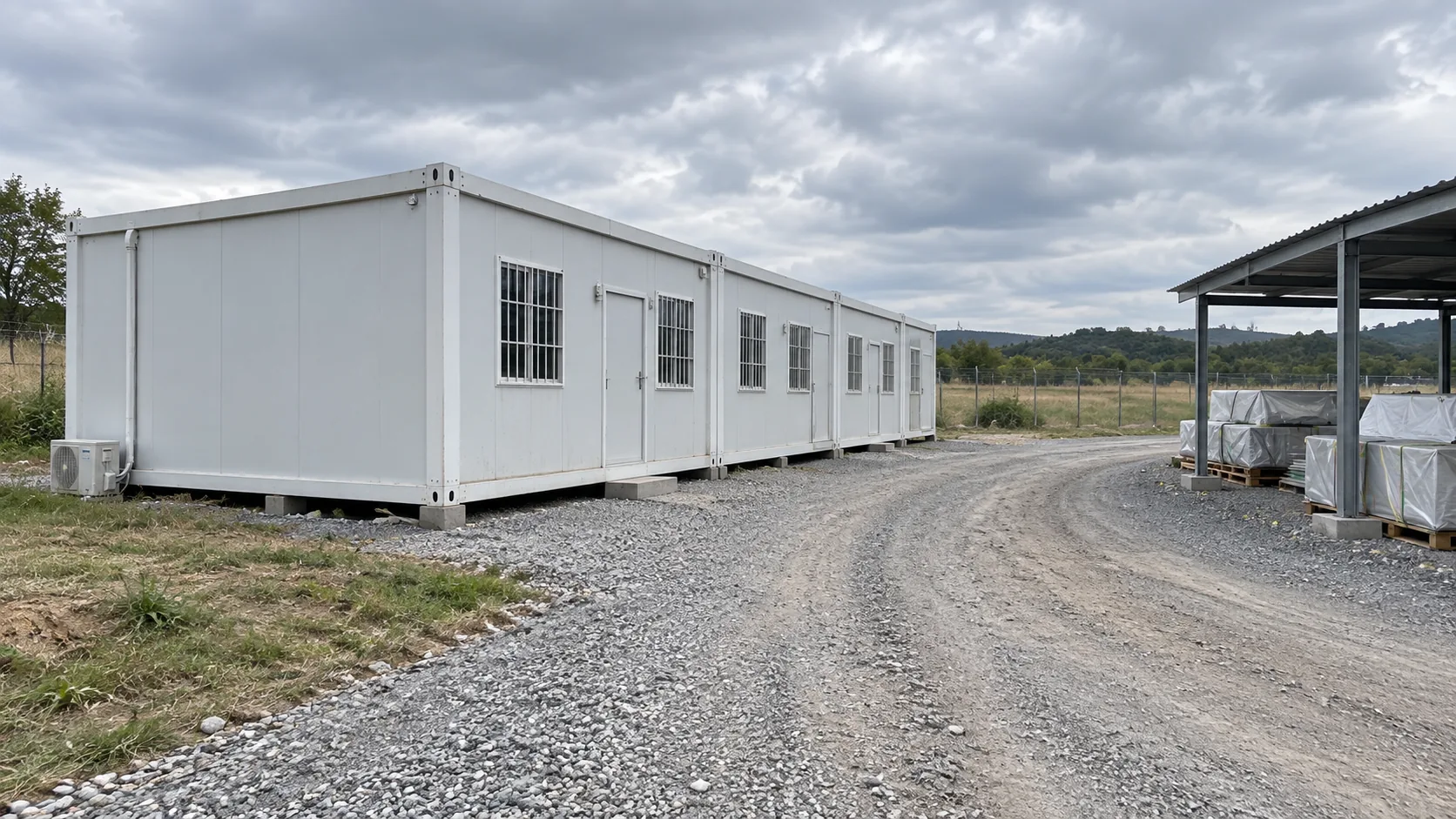
After unpacking, match the main components and accessory groups to the assembly information. Keep installation-critical small parts together. Where an item needs checking or correction, record who is responsible and how it affects the next stage of work.
Make discrepancy reports specific and traceable
A useful receiving record names the order, package, delivery date, location and observed difference. Attach an overall image and a relevant detail, then state whether the package has been moved, opened or set aside. Preserve the supporting delivery and packing information for the agreed review process.
Distinguish an observation from its cause. For example, record a torn wrap or a missing carton without assuming when or where the problem occurred. Ask the responsible supplier and transport contacts to review the evidence and agree the response. Keep any effect on installation visible to the site team so the next stage is not planned around an unavailable component.

Shipping Questions Buyers Often Ask
How many container houses fit in a 40HC container?
The answer depends on the selected model, packed dimensions, gross weights, accessories, protection and loading limits. Request a configuration-specific plan. A count quoted for a different room or packing method may not apply to your order.
Can I book freight before the final layout is approved?
You can discuss preliminary options using clearly marked estimates. Before confirming the booking and loading arrangement, reconcile the cargo details with the approved configuration. Changes to the room, equipment or packing may affect the plan.
Does international shipping include installation?
Only if the accepted scope explicitly includes the relevant site work. Transport, unloading, assembly, service connections and final checks are separate activities to allocate. Confirm the people, equipment and information provided for each one.
Prepare a Useful Shipping Inquiry
Send PQSE House the selected product system, quantity, proposed layout, destination port and site location. Include external additions, the target arrival period and the handling or storage resources available locally.
With those inputs, the discussion can focus on the actual package, loading information and delivery interfaces your project needs.
Cargo information sheet — open the checklist
Copy these headings into your project brief. Add your own information and mark unresolved items for review.
| Record | Information to add |
|---|---|
| Package identity | Package number and linked room or component |
| Shipping dimensions | Packed length, width and height with protection |
| Gross weight | Measured package weight and version/date |
| Receiving plan | Handling information, destination contact and discrepancy record |