Specify bedside power as a guest task, then check that task in the furnished room with the chosen lights switched off. Identify the supply available to each sleeping position, the devices it is intended to support and the commands that affect it. A visible socket, USB symbol or attractive control plate does not establish that the guest can use the arrangement at night. The electrical designer and equipment supplier must confirm the actual installation and control sequence; the buyer's demonstration should establish what happens under the stated room setup.
This guide concerns the interface between bedside furniture, guest charging and room controls in a modular hotel proposal. It does not prescribe wiring, a universal outlet quantity or a charging rate for PQSE rooms. Its checks are editorial procurement suggestions. Newly generated photographs illustrate the tasks, rather than document an installed customer room, an electrical test or accessibility approval. Keep the selected building package and the final hotel fit-out identifiable throughout the discussion.
Give each sleeping position a usable supply
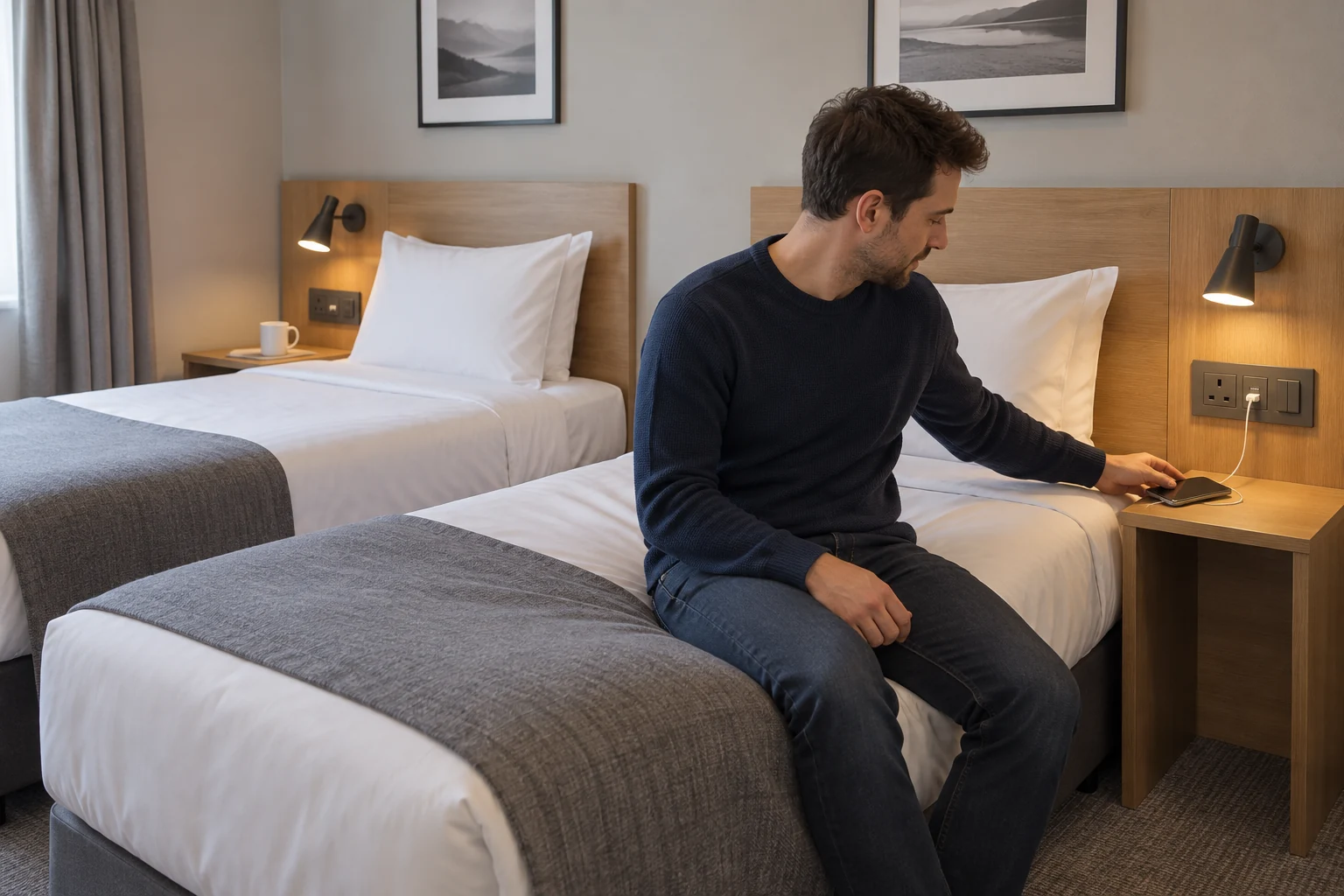
Begin with the positions guests will actually occupy. A double room can look well equipped from one side while the other guest has no convenient place to connect a device. Examine both bedside surfaces, the fitted lamp and any room equipment already using the supply before deciding what the proposed arrangement offers.
In a 4 October 2026 hotel discussion, a guest described bedside sockets occupied by lamps or clocks, with other outlets across the room. Replies included better experiences. This is an individual travel report, not evidence of a hotel-wide trend or a modular-room defect. It identifies a useful question: how much of the visible provision is actually available to the guest?
Define the intended use before counting ports. The operator might want guests to connect their own mains chargers, use built-in USB charging, or choose either. Those are different provisions. A socket permanently assigned to a lamp should not silently count as spare guest supply in a quotation. Equally, the presence of USB ports should not conceal the absence of the mains option the operating brief requires.
For a modular hotel room proposal, describe the bedside task separately for the agreed occupancy and furniture arrangement. Ask the supplier to show where devices will rest and how a guest reaches the available connection. Leave the quantity as a project decision supported by that use case; there is no verified universal number in this guide.
Review the outlet with the furniture in its final position
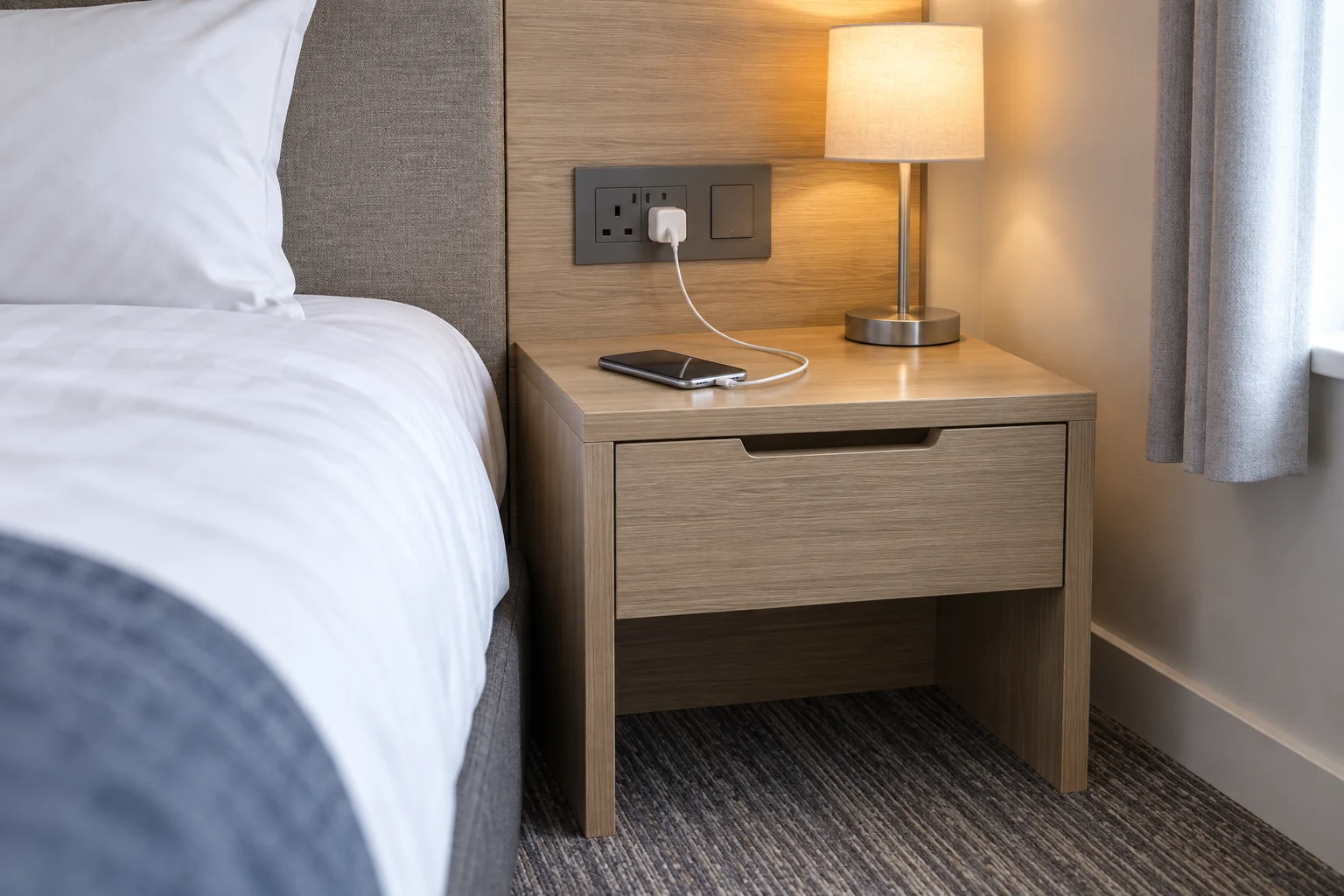
Review the fitted nightstand and headboard together with the proposed supply point. The useful opening is the space left for the actual plug and hand, not an empty wall in a drawing. Keep the lamp base, drawers and ordinary tabletop items present so that the observation represents the room guests will receive.
Use a representative charger and cable without removing furniture to make the demonstration easier. Observe whether the plug can be inserted and removed normally, whether its body conflicts with the furniture, and whether the connected device has a supported resting position. Record the configuration rather than interpret a convenient photograph as evidence that every charger will fit.
The cable route deserves its own look. A connection behind the bed may technically be available while forcing the device to rest somewhere unsuitable for the agreed task. Follow the cable to the intended surface, including how a guest gets out of bed. If a drawer, chair or movable bedside table changes that route, show the movement during the review instead of hiding the interaction with a tidier arrangement.
Clarify which furniture and fit-out items belong to the selected container house package and which are supplied separately for the hotel. A building-system name does not identify the final bedside furniture or the electrical component fitted beside it. An unresolved interface between those packages should remain explicit in the order discussion, even when their finishes appear coordinated.
Name the charging components before comparing them
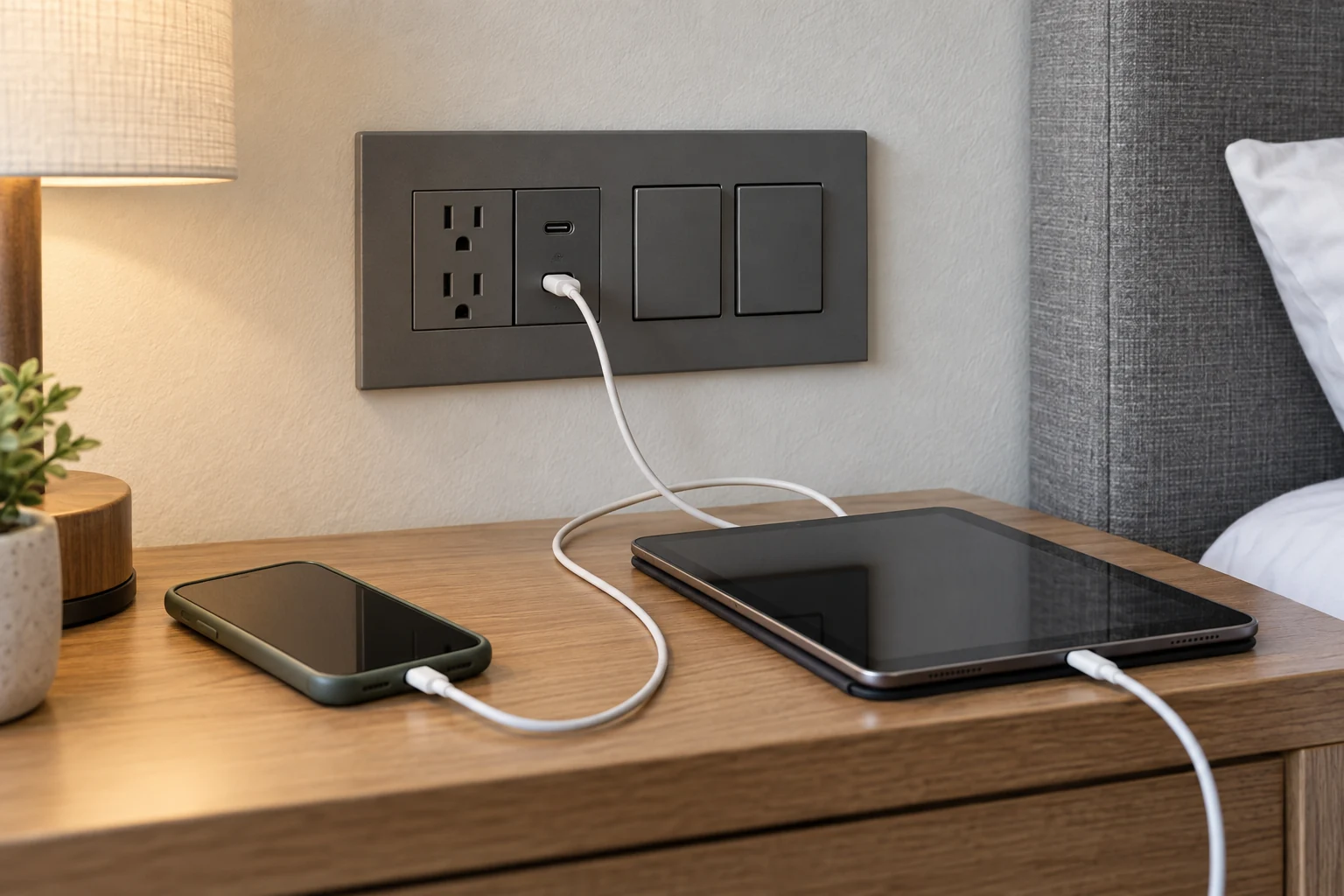
Separate the mains supply, the charging connector and the selected charging component. A panel can combine these with lighting controls, but their functions still need individual descriptions. Ask for identifiable models and the relevant current product instructions, rather than an unspecified promise of a modern bedside charging station.
A manufacturer-published Dream Hollywood case study describes switches, mains outlets and USB ports combined beside the bed. It is an external hotel's arrangement, not a PQSE reference. The combined appearance alone does not answer whether the selected devices charge with a particular lighting command off.
Legrand's September 2024 R26USBPD65/TR20USBPD65 instructions distinguish single-device output from simultaneous use. That named-model distinction is useful when comparing a proposal; it does not establish a PQSE charging specification or the power a particular guest device will receive.
Ask what supports the proposed device and cable combination. Compare documented functions under equivalent use conditions; an advertised maximum is not an achieved guest-device power measurement.
For a flat pack room package, identify the final electrical and furniture completion scope before accepting the charging-component schedule. A factory proposal and the item installed during final fit-out must remain distinguishable. Ask the responsible supplier to confirm the selected installation; the buyer should not investigate the question by opening a fitted electrical device.
| Provision | Describe in the proposal | Useful comparison | Do not assume |
|---|---|---|---|
| Guest mains supply | Outlet type, position and intended guest use | Available with the room equipment connected | Every visible receptacle is spare |
| Built-in USB charging | Named component, connector and supported use | The agreed device/cable combination | Connector shape establishes delivered power |
| Bedside lamp | Selected fixture and its control | Lamp operation independently of guest charging | A combined plate means a common function |
| Room command | Actual action and affected functions | The documented state after that action | A button label describes every connected load |
Try the device set the room is meant to support
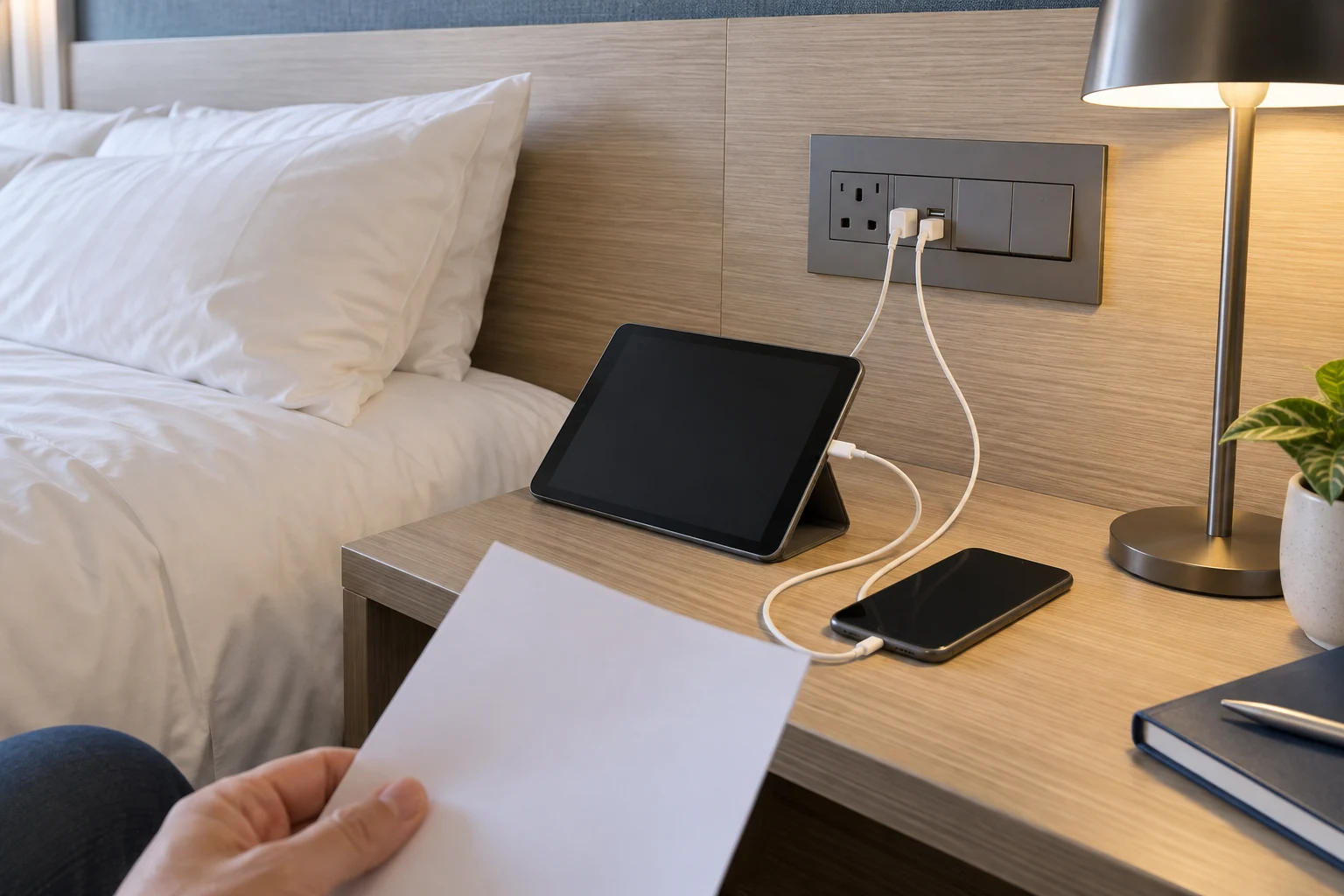
Use the device set agreed for the room, rather than demonstrate one conveniently chosen phone. A second connected item creates another observation to make. Keep the devices, cables, charging positions and control state identifiable, so that the result describes a reproducible guest task instead of an undefined claim that everything charges.
Start by defining what the demonstration is intended to establish. Showing that a phone indicates charging answers a narrower question than measuring a charging rate or confirming support for a laptop. Agree the required evidence with the equipment supplier. Do not convert a charging icon into a power measurement, a complete charge-time prediction or confirmation of compatibility with unexamined devices.
If the hotel brief includes two simultaneous users, observe the agreed simultaneous setup. Note whether connecting the second item changes what the first item visibly reports. Any unexpected interruption should become a specific supplier question, with the component and setup attached. The observation alone does not identify the electrical cause or authorize an on-site workaround.
A useful comparison also records what was not tested. Different cables, adapters, device revisions or charging interfaces can create a different case for review. The point is not to collect every possible guest device. It is to agree a representative scope and make a limitation recognizable when someone later proposes a substitution or expands the advertised room offering.
Describe what each lighting command is supposed to do
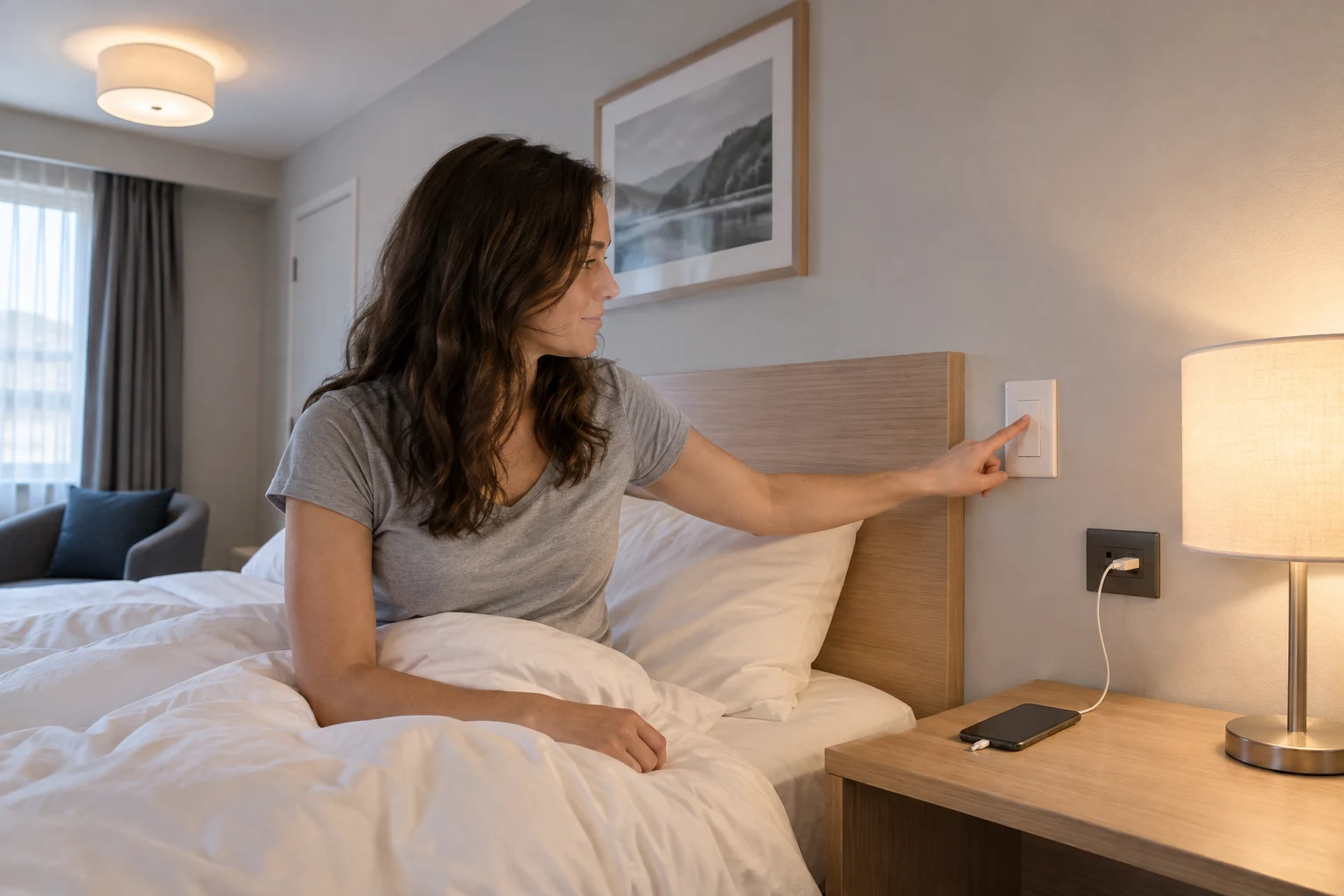
Identify the command a guest will use at bedtime. It may switch a lamp, select a room scene or operate another agreed group of functions. Describe the action and its intended response with the selected controller. Do not treat a master-off label as a complete explanation of the installed room's behavior.
Ask the supplier to distinguish the bedside lamp control from the command for the main room lighting. Then ask whether either action affects guest mains supply, built-in charging, shades or other included equipment. Keep this as a requested description of the actual configuration; a generic room-control brochure cannot decide which functions have been connected in this order.
Discuss ordinary guest sequences in plain language. A guest may enter, turn on the main light, connect a device, use the bedside lamp and then turn that lamp off. Another may operate the room's all-off command from bed. Show both only if both belong to the intended arrangement. An unfamiliar control sequence should not be concealed by a demonstration performed solely by the installer.
The existing hotel room mock-up approval guide explains how an identified configuration can become a production reference. This bedside review adds a particular question to that reference: which command was used, and what happened to the agreed charging function? It should not reopen unrelated finish choices or replace the broader sample approval decision.
Check charging after the chosen lights-off command
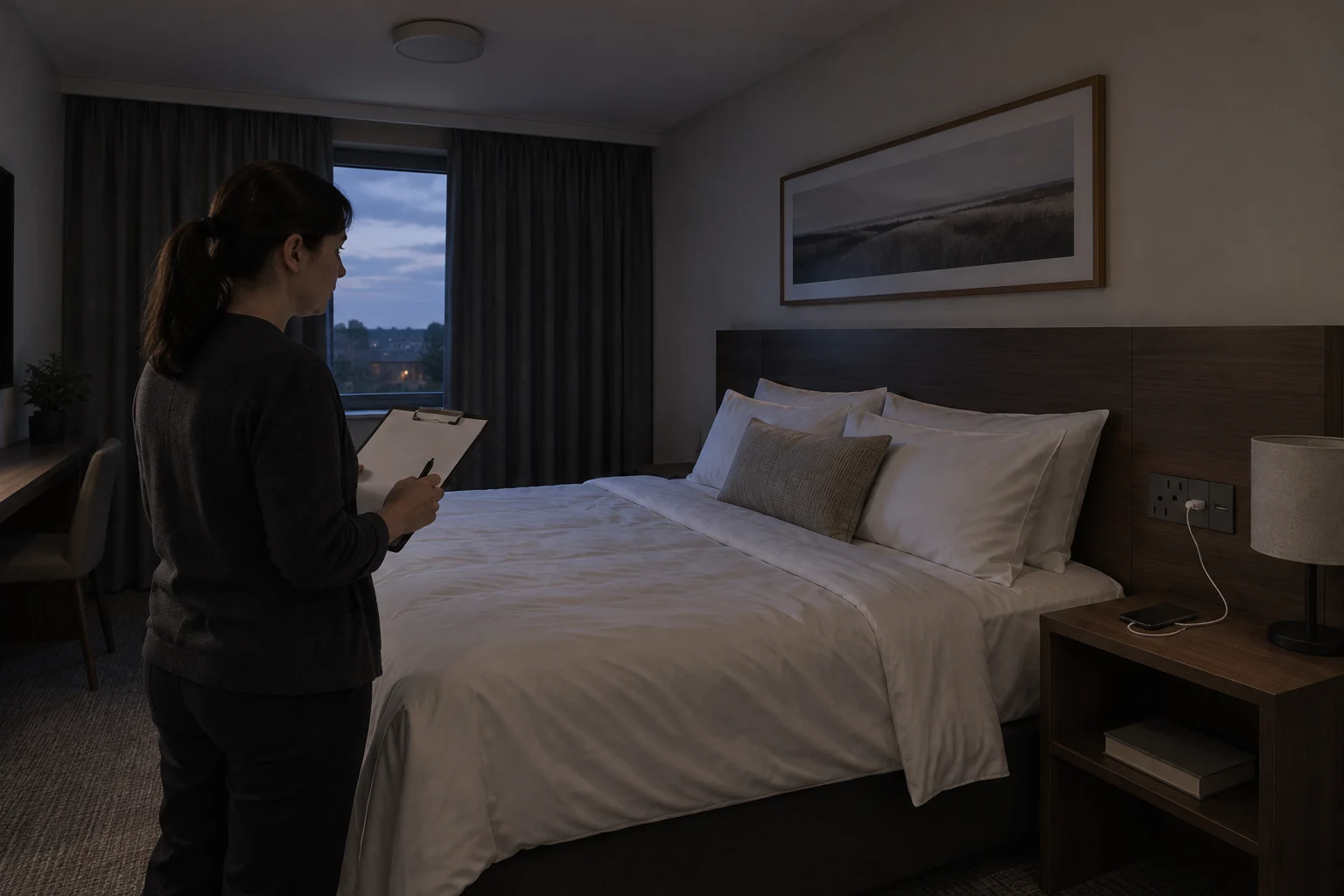
Make the observation in the intended night-use setup, with furniture, devices and the selected controller present. Apply the agreed lighting command, then check the required charging function using the defined method. If a response is delayed, ask the supplier to identify the actual timing and repeat the relevant observation under those conditions.
Lutron's myRoom hospitality brochure separates lights from optional receptacle control in a typical operating sequence. Its occupied-night example keeps the optional third-party-controlled receptacles powered. That does not prove the response to a particular bedside master-off command. The actual system configuration still needs confirmation.
Use a short observation log to prevent different people from testing different questions. Identify the room, controller revision, device setup and initial state before applying the command. Record what actually happened and who will resolve an unexpected result. Avoid filling the expected-response column from memory or from a photograph of another hotel.
Distinguish a guest turning the lights off while staying in the room from a room becoming unoccupied or being checked out. Where those states are included in the system, ask how they are determined and which functions are affected. A review at one moment cannot establish every later state. No universal delay, absence period or energy-saving sequence is specified here.
| Action or condition | Supplier-defined response | What to observe | Open question |
|---|---|---|---|
| Bedside lamp switched off | Enter the agreed lamp and charging response | Lamp, guest mains and chosen USB setup | Does the observed setup match the description? |
| Main room lights switched off | Identify the affected functions | Required charging function after the action | Is any interruption intended or unexplained? |
| Guest remains in the room at night | Identify the actual occupied-night sequence | Required supply and visible indicators | How is the selected state established? |
| Temporary absence, if included | Confirm the configured response and timing | The functions covered by that sequence | Which requirement must remain available? |
| Check-out, if included | Confirm the hotel's agreed response | Only the stated functions and conditions | Who restores and verifies the next-use setup? |
Look at the indicators from the pillow position
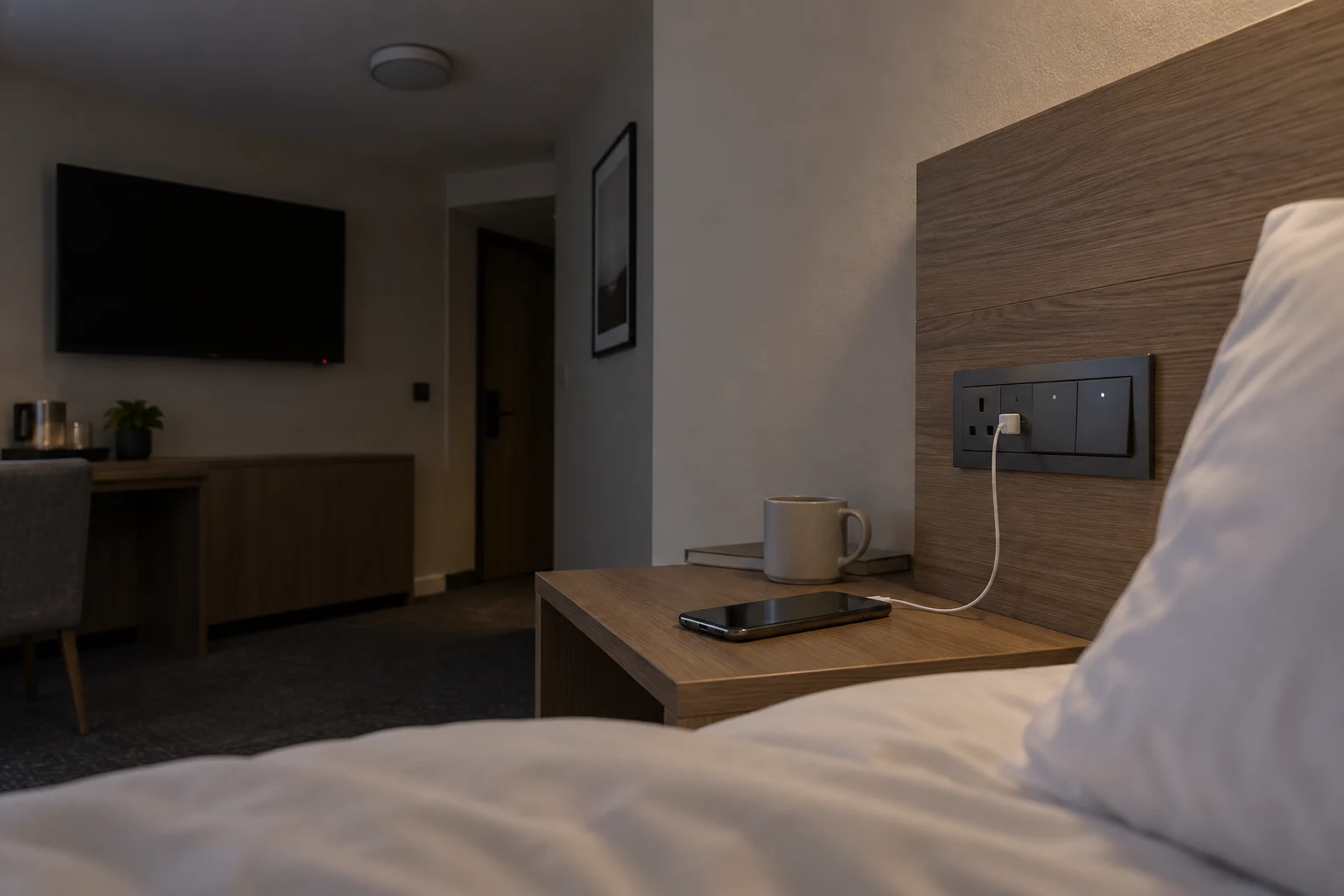
Observe the room from the position where a guest's head will rest. A small indicator beside a television or charging component may face the bed even when the main lights are off. Establish which visible indications belong to ordinary appliances and which belong to safety or other required functions before discussing a response.
A 21 September 2026 hotel discussion describes a guest disturbed by fixed television and air-conditioning indicators after switching the room lights off. Other users report different experiences. This subjective report does not establish a brightness limit, a sleep-health outcome or permission to obscure equipment.
For the same named Legrand charging models, the instructions describe yellow and green status indications and a cable/adapter exception. They do not promise a dark bedside or a user-selectable indicator-off setting. Ask the selected manufacturer what, if any, approved adjustment is available.
Keep the response proportionate to the evidence. If the operator requires a particular night appearance, write that requirement as an observation to resolve with the designer and equipment supplier. Do not invent a measured light level, describe an illustration as a test or offer tape and unplugging as an acceptance method. Safety indicators, ventilation openings and necessary equipment functions must not be treated as decorative inconveniences.
Keep accessibility review tied to the applicable room class
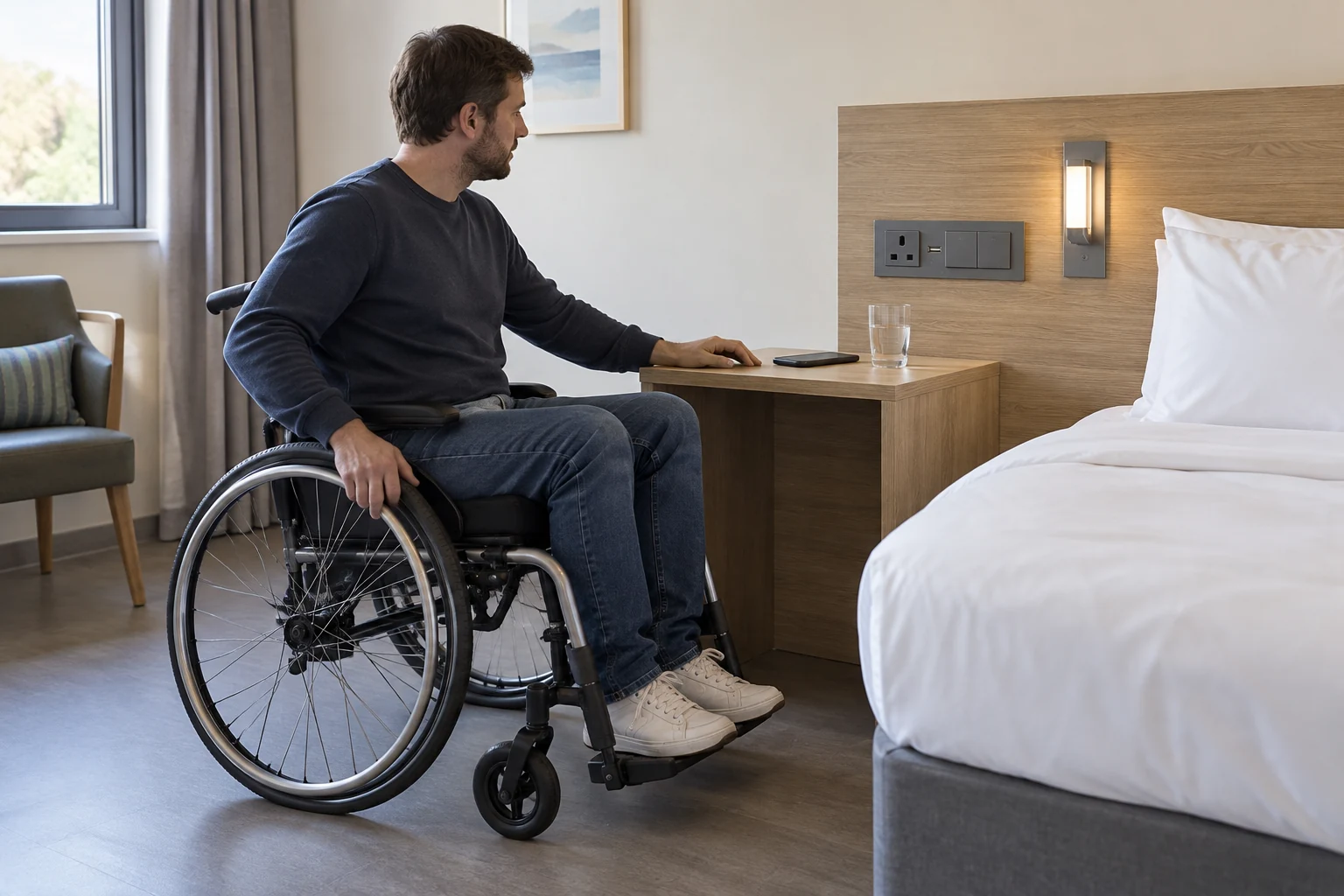
Where the project includes rooms with required accessibility features, review the controls from the applicable approach and in the furnished configuration. A guest comfort observation and a compliance measurement answer different questions. The relevant project team must identify the jurisdiction, room class and provisions before turning a bedside preference into a dimensional requirement.
The U.S. Access Board's ADA Standards scope operable parts on accessible elements, routes and spaces, with stated exceptions. Transient-lodging provisions distinguish required mobility and communication features. Apply the relevant reach and operation criteria where this U.S. standard governs the project; do not turn them into a worldwide mounting-height rule for every hotel outlet.
The Board's operable-parts guide explains why clear approach and obstructions matter. It also distinguishes a useful closed-fist usability check from a mandatory test. Review the actual furniture and operable portion with a qualified accessibility reviewer; a photograph cannot establish the measured reach or required operating force.
The following values illustrate different evidence questions. They are not comparable product performance scores, and the manufacturer values are not accessibility criteria. Keep the selected measurement method and applicability attached to any resulting finding. A room that feels convenient to one observer has not thereby demonstrated that every required feature is compliant.
| Source and subject | Stated value | Boundary to retain |
|---|---|---|
| Legrand R26USBPD65 / TR20USBPD65, single-device USB use | Up to 65 W total | September 2024 instructions; named component, not achieved guest-device power |
| The same Legrand models, two connected devices | Maximum 30 W per port | Simultaneous-use condition; not a PQSE room rating |
| U.S. ADA 308.2.1 / 308.3.1, unobstructed reach | 15–48 in (380–1220 mm) | Applicable accessible operable parts; distinguish forward/side approach and obstructions |
| U.S. ADA 309.4, activation of operable parts | 5 lbf (22.2 N) maximum | Applicable parts; one-hand operation, without tight grasping, pinching or wrist twisting |
Check the arrangement for both guests
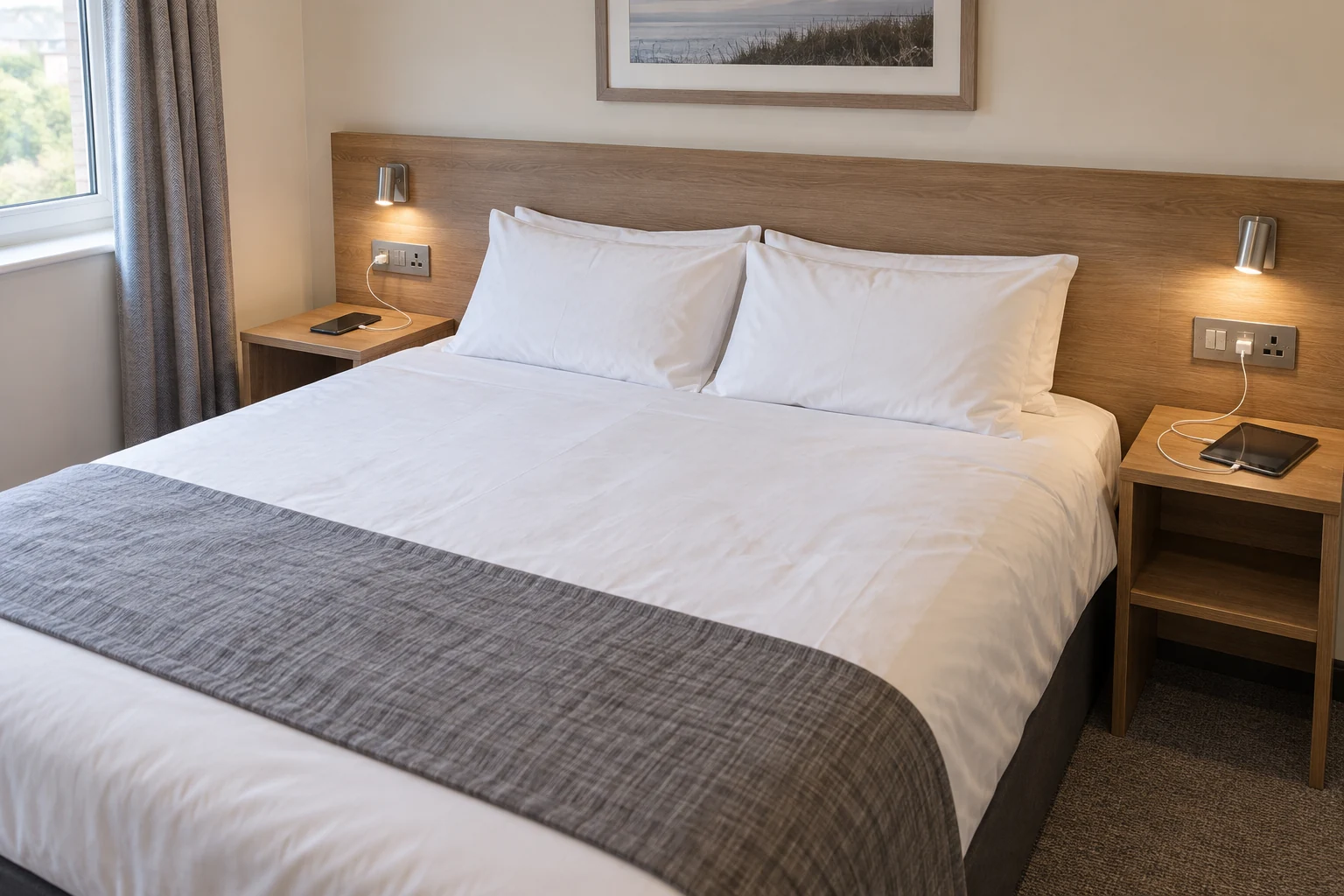
Repeat the ordinary use sequence at the other sleeping position. A tidy charging setup beside one nightstand can conceal a compromise on the opposite side. Examine where each guest places a device, reaches the control and leaves the bed, while retaining the furniture and room equipment specified for that arrangement.
For an illustrative two-person review, the operator could ask each participant to connect the agreed device, use the lamp control and leave the bed without shifting the other person's equipment. This is a proposed task, not a reported PQSE trial. It helps expose which side depends on shared access and whether the arrangement matches the operator's intended offering.
If the room uses different bedside components on each side, identify the difference rather than assume symmetry. One side may be intended to provide a different function, but the buyer should understand that decision before repeating the layout. The review should also make a clear distinction between the provision included in the order and a loose accessory brought in just for the demonstration.
Relate the findings to the guest-room operating brief. Room occupancy, furniture choice and the intended guest experience must agree. Do not use a particular guest's successful setup to promise support for every personal accessory, and do not redesign the rest of the room around an unexamined charging assumption.
Keep replacements connected to the agreed function
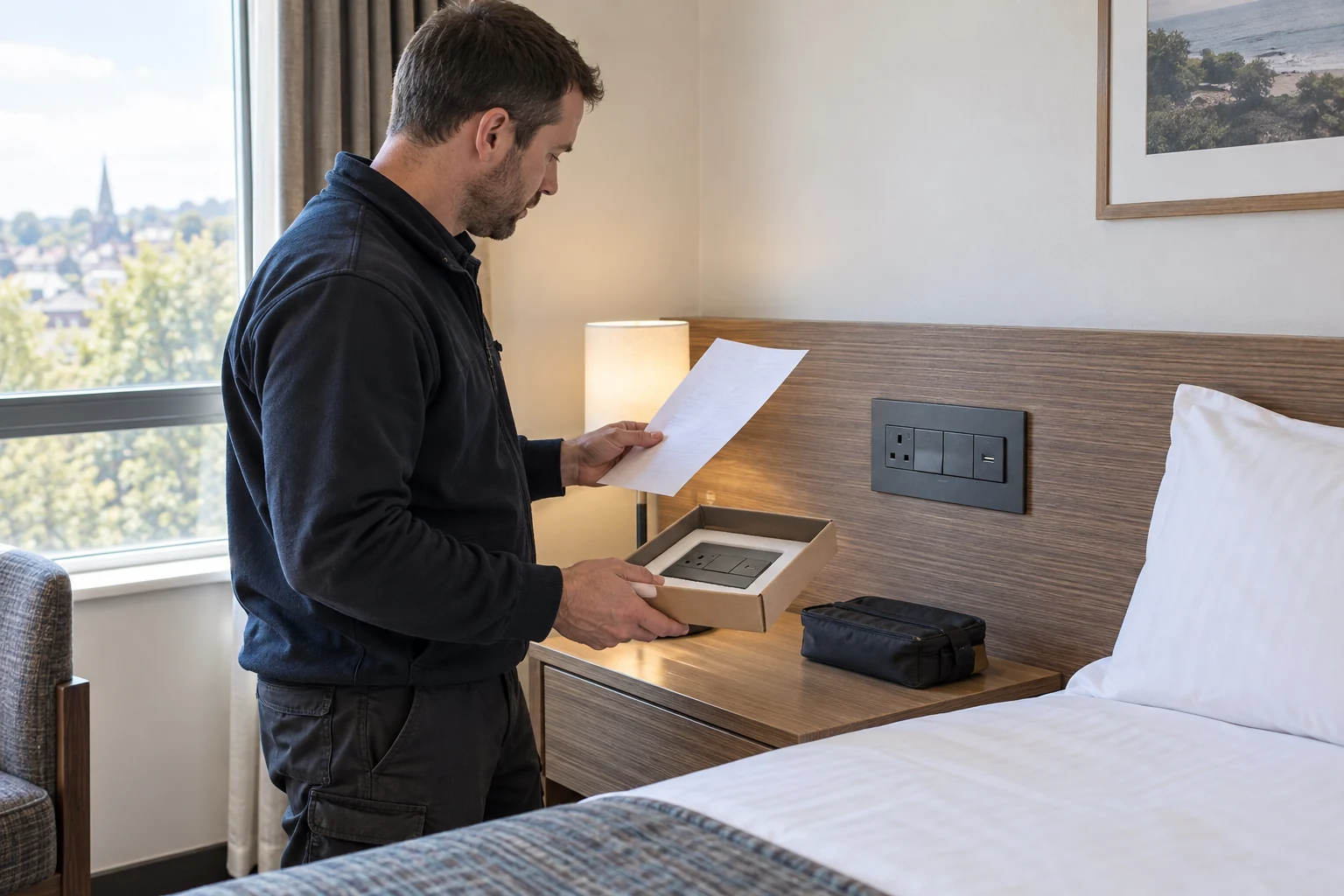
A replacement charging component can look similar while representing a different agreed function. Keep the selected model and its instructions available to the people managing the room. Review a proposed substitution against the guest task and control sequence; a matching finish or plate size should not close that question on its own.
Specify how an operator reports a failed or unavailable charging function without investigating the wiring. The report can identify the room, bedside position, component and observed symptom under the stated setup. Authorized personnel then decide what inspection or work is appropriate. A guest or buyer should not dismantle the component, add an improvised connection or infer a repair from an online discussion.
If a replacement changes the connector, control behavior or visible indication, revisit the affected use case. That does not require repeating every unrelated room review. It requires an answer to the function that changed, using current instructions and the actual furnished arrangement. Keep the accepted replacement distinguishable from an unapproved alternative waiting in a storeroom.
For a detachable room proposal, clarify who supplies the finished hotel fit-out and who coordinates a later component change. The building family alone does not establish service access, a replaceable charger module or compatibility with a new device. Ask for the division of responsibility applicable to the selected order.
Put the night-use requirement in the order
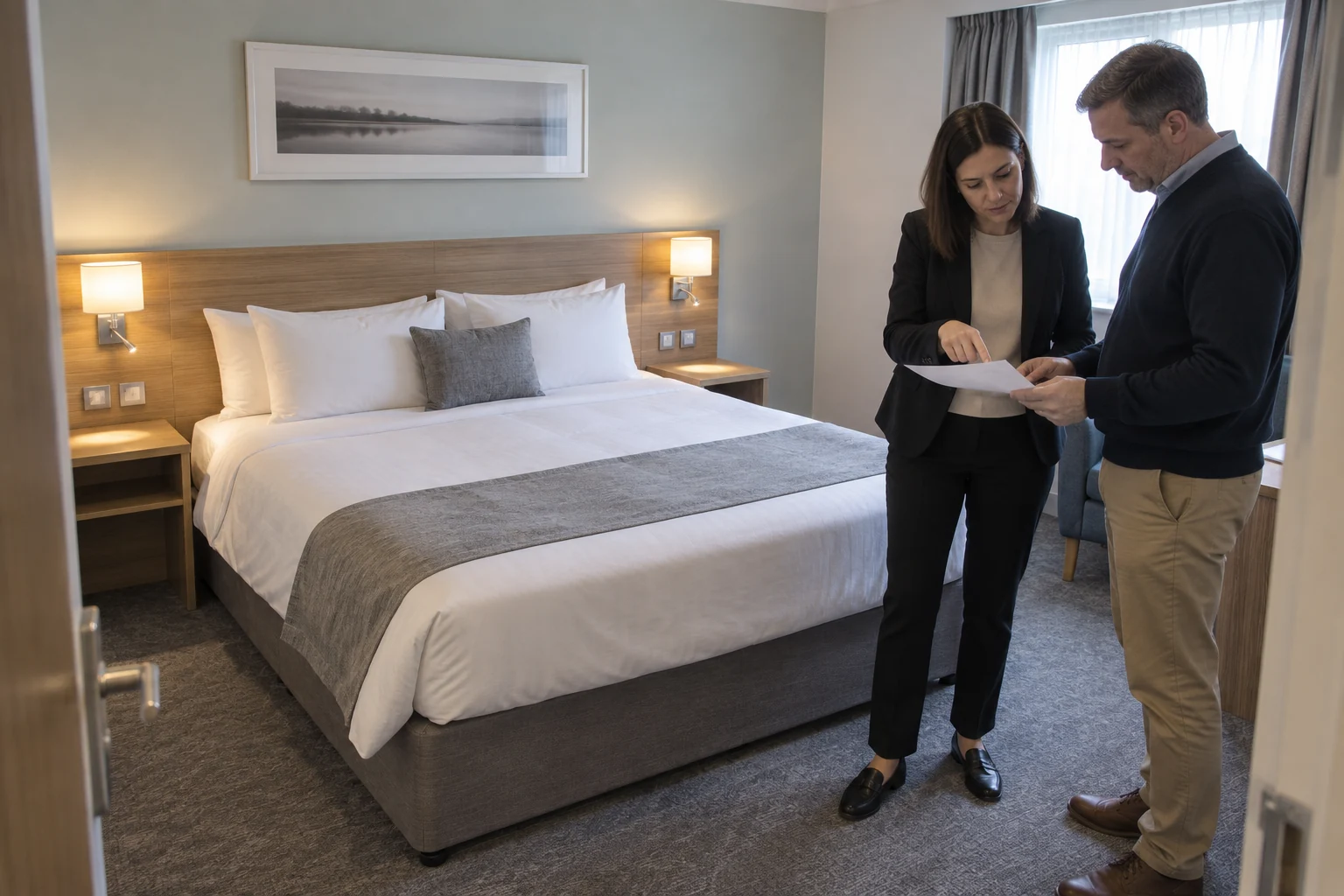
Send a specific night-use question with the room proposal. Identify the intended guest positions, furniture, charging provision and lighting command, then ask the supplier to describe the actual response and the evidence still required. This gives the parties a shared task to resolve before the arrangement is repeated in other rooms.
The order discussion should distinguish component selection from installed-room verification. A named product document helps describe what has been proposed. A room demonstration shows what occurred with a defined setup. The electrical designer's and installer's responsibilities remain separate from the buyer observing a guest task. Do not use a successful charging icon to collapse these different kinds of evidence into a blanket approval.
Agree when the night-use observation can be performed. If the room is not connected to its intended controller or still has temporary furniture, explain what the current review can establish and what remains open. A later change in the bedside arrangement may alter the relevant question even when the wall plate remains untouched. Keeping that connection visible is more useful than an unrestricted statement that the room has charging.
Connect unresolved guest functions to the operator's room-release handoff without repeating the housekeeping workflow. Staff need to know which room and function require attention; the responsible specialist needs the identifiable setup and symptom. Whether a particular issue prevents guest use is the operator's project-specific decision under applicable requirements, not a universal rule created by this article.
Before finalizing the proposal, the buyer should be able to state which bedside provision is included, which commands affect it, which observation has actually been made and which question is still unresolved. If any answer rests on an assumed controller state, an unidentified component or a demonstration accessory outside the order, return that precise issue to the responsible supplier.
Buyer questions
Does a lights-off charging check approve the electrical installation?
No. It establishes only the defined observation under the room setup examined. Electrical design, installation verification and applicable approvals belong to the responsible qualified parties and project requirements. Keep the device, component, controller state and method identifiable. A device reporting that it is charging is not a measured power result or proof of hidden construction.
Should every bedside position have the same charging arrangement?
Agree the provision against the room's intended occupancy and guest tasks. Identical appearance is not the only possible decision, but any difference should be clear to the buyer and operator. Review both sleeping positions with the proposed furniture and room equipment present. This guide does not establish a universal port count or promise compatibility with every guest accessory.
What if a room-control system changes power after the guest leaves?
Ask the supplier to describe the actual configured state, how it is determined and the affected functions and timing. Keep temporary absence, sleeping occupancy and check-out distinguishable where the system includes them. Decide the intended guest provision with the operator, then verify that requirement using the appropriate setup. Do not assume that a generic brochure or button label establishes the installed sequence.
How should a buyer handle an unwanted charging or appliance indicator?
Identify the component and observe it from the intended sleeping position. Ask its manufacturer whether an approved setting or a different specified component can meet the operator's requirement. Do not claim a sleep-health benefit from an illustration or recommend obscuring safety equipment, covering ventilation or changing wiring. If no approved adjustment is documented, keep the selection question open.
Sources and scope
- Reddit hotel bedside-outlet discussion, 4 October 2026. Individual guest account with contrasting replies; original-date-level evidence, not a trend or modular-room case.
- Reddit hotel indicator-light discussion, 21 September 2026. Subjective guest experience; no brightness threshold, health result or permission to obscure equipment.
- U.S. Access Board, ADA Standards. Sections 205, 308–309 and 224/806; applicable U.S. scoping and room features must be established separately.
- U.S. Access Board, Guide to Operable Parts. Guidance on approach, reach and operation; not a worldwide bedside mounting rule.
- Legrand instruction 341424, September 2024. R26USBPD65/TR20USBPD65 only; single/dual-device conditions and stated indicator behavior, not PQSE supply values.
- Lutron Hospitality Solutions, myRoom operating examples. PDF page index 28, printed 55–56; a typical named-system sequence with optional third-party-controlled receptacles.
- Legrand, Dream Hollywood case study. External manufacturer-published arrangement; no charging demonstration, lights-off result or PQSE project claim.
The comparison and observation tables are original editorial buying tools. The numeric examples retain their source-specific subjects and conditions. The article recommends a defined night-use check; neither recent guest discussion establishes that switching off a main light interrupted charging. No PQSE field result, charging rate, universal outlet quantity or sleep-health improvement is asserted.