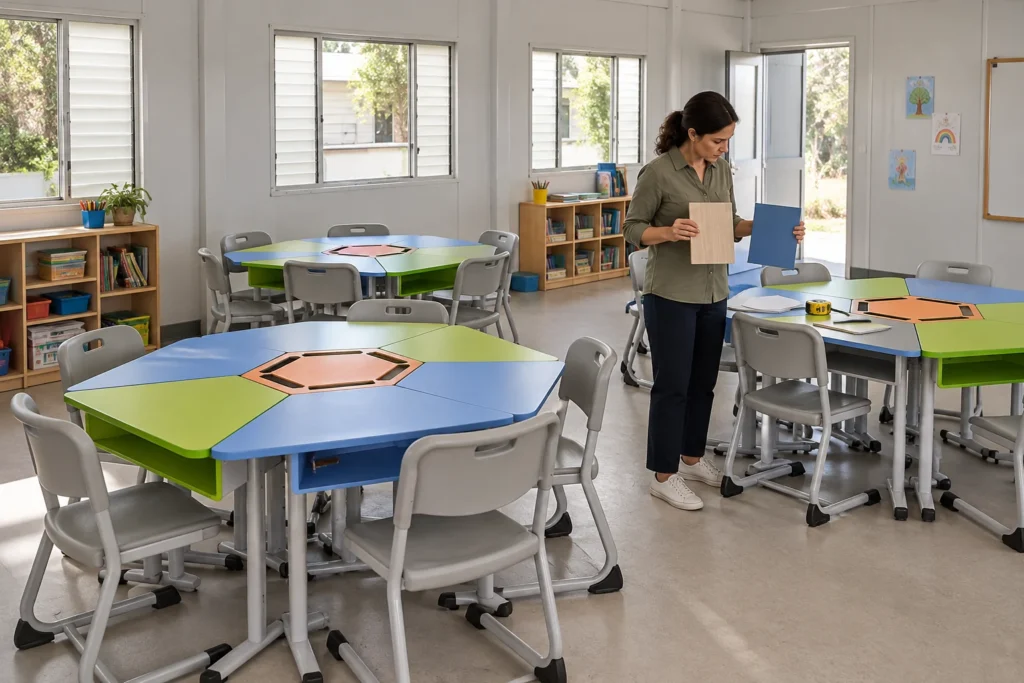
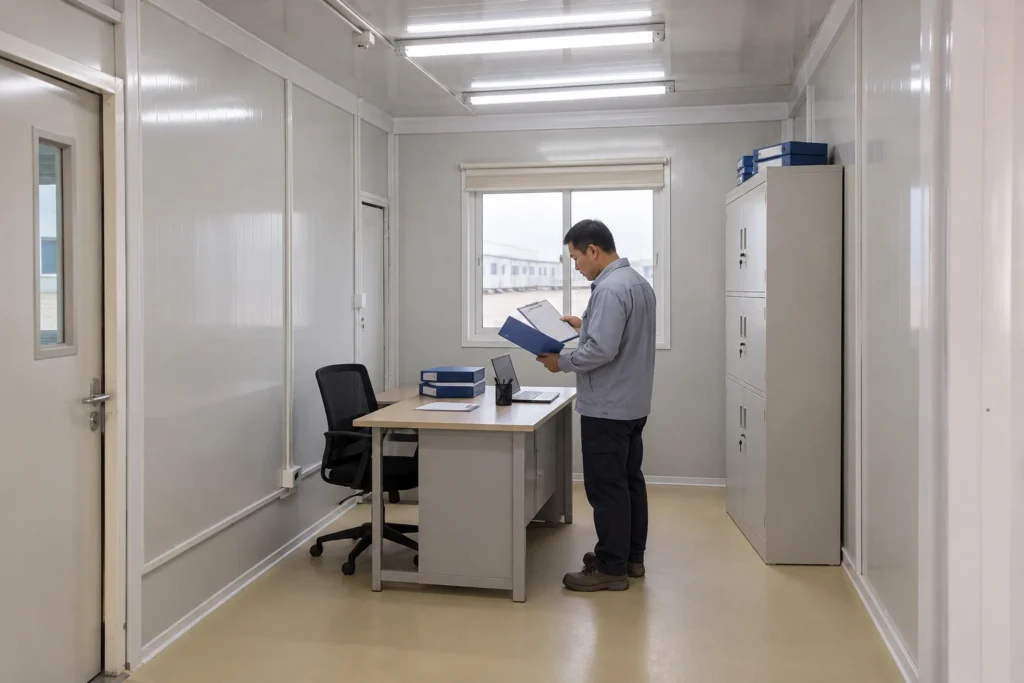
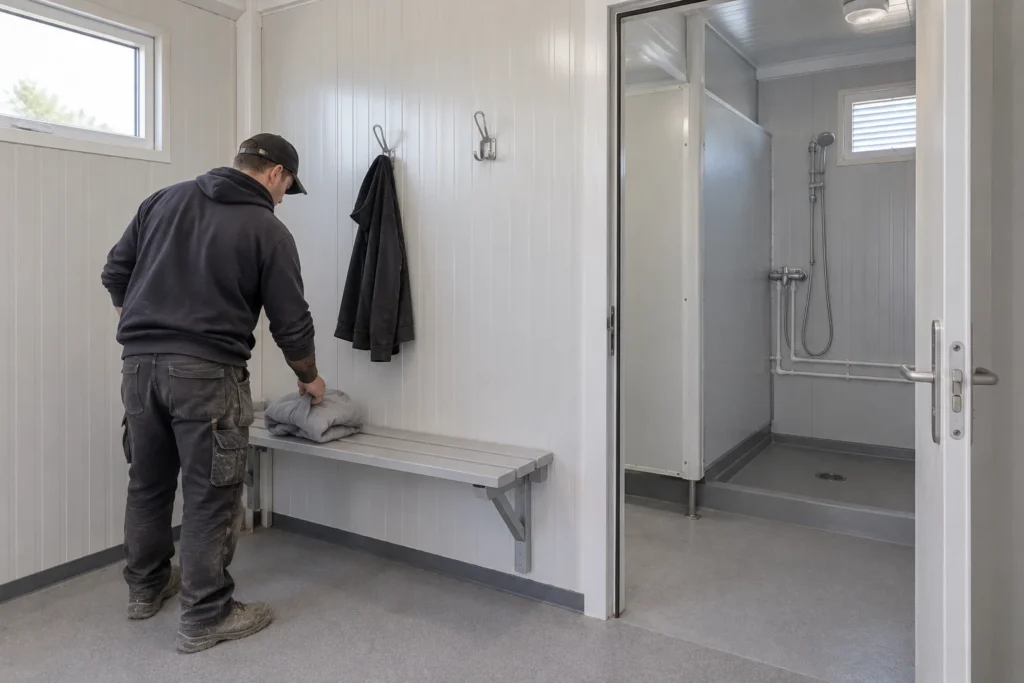
Plan coat and backpack storage as part of the journey into the classroom. Confirm what pupils bring, where they may leave it, how they reach that place and what other people need to do beside it. Choose the furniture after those questions are answered. A place for every bag on a drawing can still fail in daily use if access rules, hanging coats or a door movement were left out.
This is particularly relevant when a modular teaching room has its own outside entrance or uses facilities in another building. The school may already have lockers, but those lockers only replace nearby provision if the pupils can use them at the appropriate time. Equally, a storage bay beside the room does not settle whether children can find their belongings, whether staff can supervise the routine or how wet coats are handled.
For a project buyer, the useful deliverable is a furnished arrangement connected to an agreed school routine. It should identify the supplied storage, its location, relevant installation responsibilities and the questions still awaiting a decision. This article explains how to build that brief without turning a general area guideline into a furniture-capacity claim. It concerns personal belongings in ordinary teaching rooms; specialist rooms and individual support requirements need their own review.
Follow the coat from the school gate to the lesson
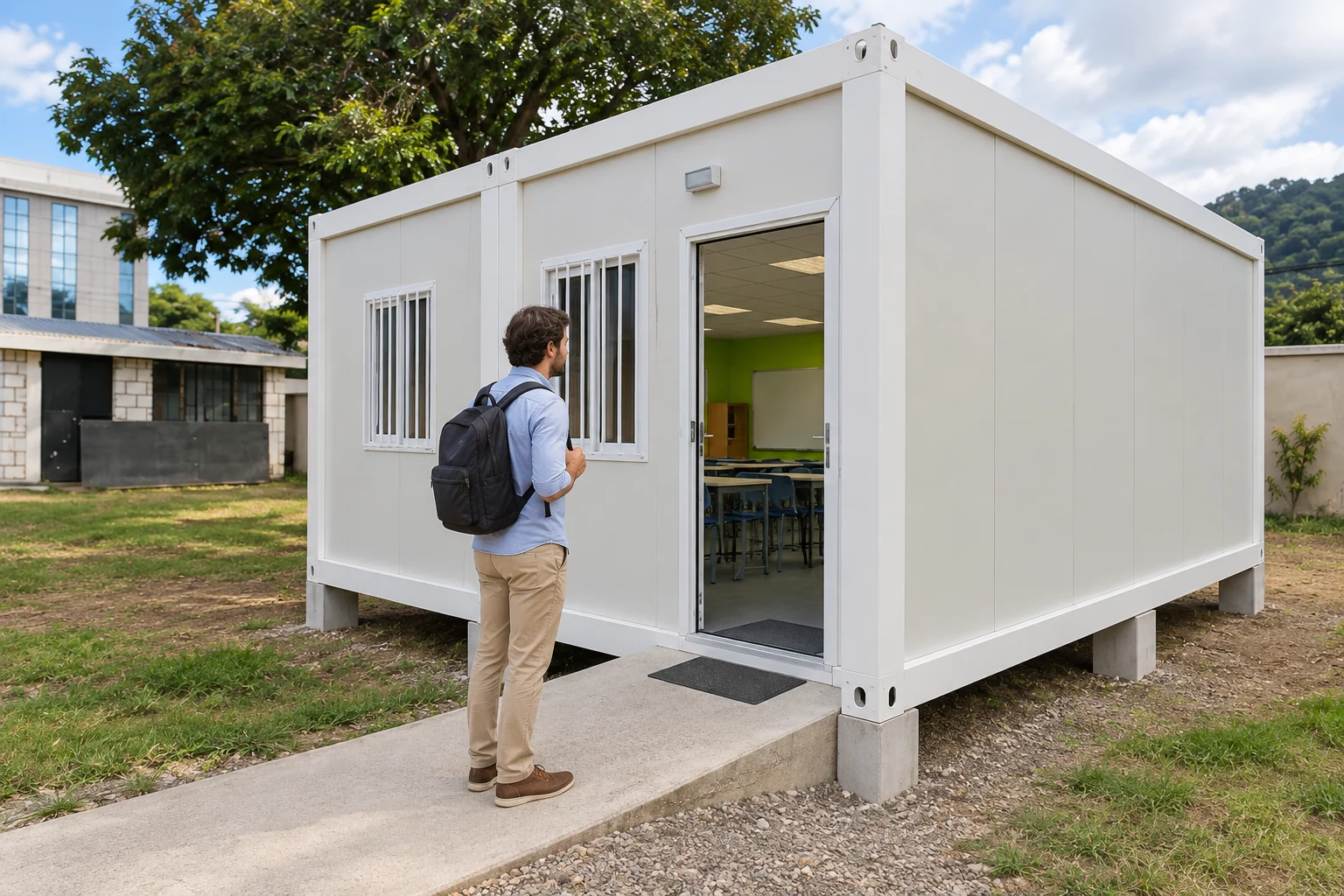
Start outside the room. Walk the actual journey with the school representative who understands arrival, late entry and dismissal. Identify where belongings change from something carried into something stored. That point must fit the school's access arrangements, rather than simply occupy the spare wall nearest the modular classroom door.
An 8 September 2026 discussion in r/Teachers illustrates the question. A self-described teacher reported a belongings policy that complicated locker access when teaching rooms were reached outdoors. It is one unverified account, not evidence of a general policy or its effectiveness. Its useful procurement question is whether the proposed storage fits the journey that users are actually permitted to make.
Put the ordinary sequence in plain language: arrive, leave the permitted items, enter the lesson, retrieve anything needed later, then collect belongings at dismissal. Mark exceptions separately. A late pupil, someone returning after an appointment and a class coming back from outdoor activity may use the same doorway differently. Ask the school which sequence the room must support before agreeing the fit-out.
The brief for a modular classroom solution should connect that routine to the building arrangement. If the proposed storage is elsewhere on campus, identify that location rather than writing that existing facilities are available. An unanswered access question is a decision to obtain from the operator; it is not something the module supplier can infer from a site photograph.
List what arrives with the class
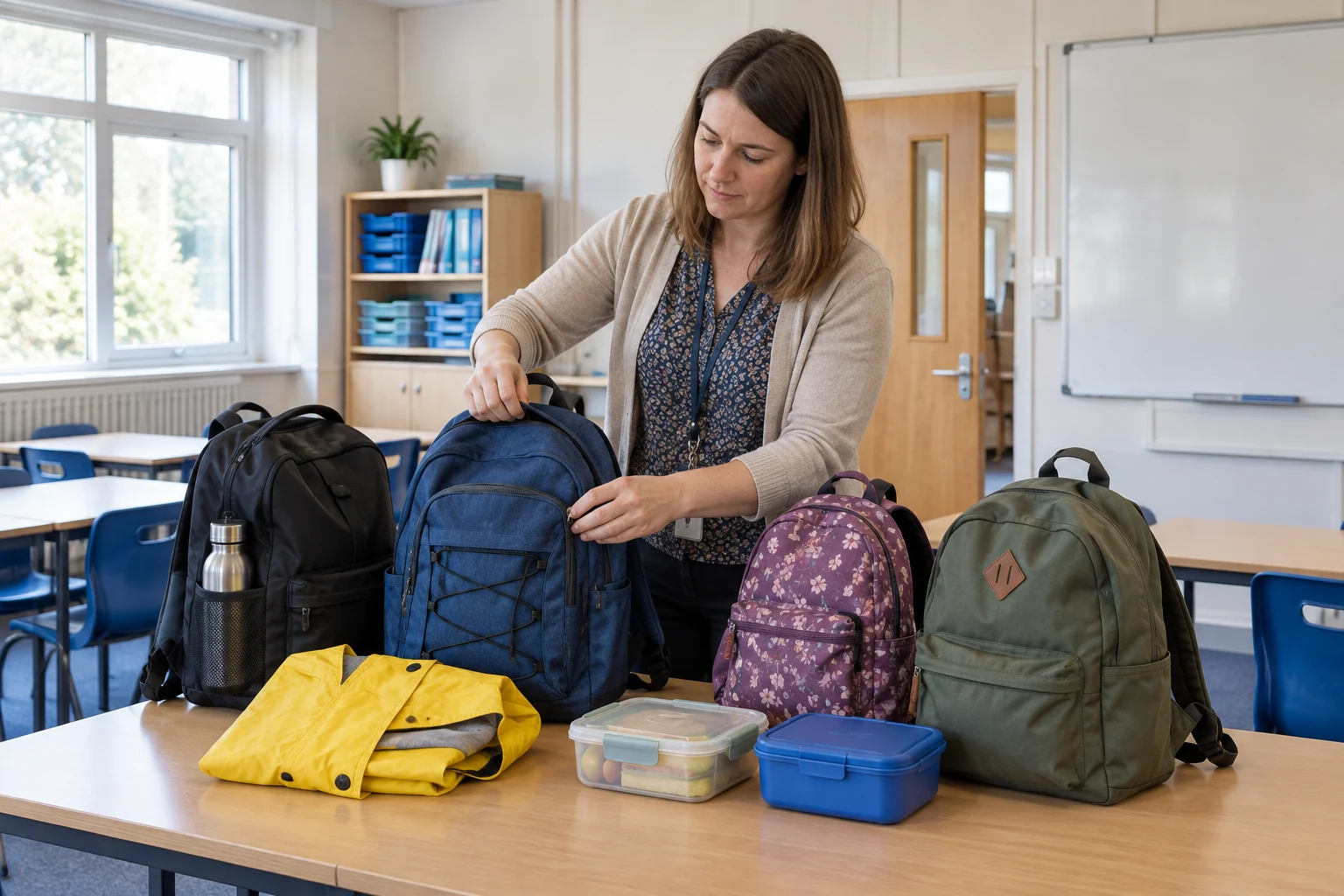
Bring a representative selection of actual belongings into the discussion. An empty backpack, a winter coat and a bag containing books occupy different shapes. Observe how they are carried and stored together. The purpose is to describe the school's needs, not to invent a load category from a photograph.
Ask what is brought on an ordinary day and what changes through the year. Bags, coats, lunch containers and activity equipment may not all belong in the same place. Some items stay in the room; others move between lessons. Describe any belongings that require a separate agreed arrangement, without collecting unnecessary personal information about the children who use them.
Photograph a representative combination with the school’s agreement and record what it represents. Keep the description alongside the picture: an ordinary day, winter arrival or an activity day, for example. A photograph without that context can become an accidental specification. Avoid selecting only neatly folded coats or empty bags because they make a proposed unit appear more generous than it is.
Distinguish the intended number of users from the number of items present at a particular moment. A pupil may bring several belongings, and some may already be retained on site. Neither an empty hook count nor the overall room area establishes that the selected arrangement accommodates those items. Request a fit review using the agreed inputs, rather than translating pupils into an unsupported hook formula.
Record the starting inventory in the procurement brief and name who can approve a change. If the school later introduces larger bags or changes where lunch items go, the original review may no longer describe the routine. That is useful change information, not proof that either the building or the furniture was defective when supplied.
Choose the place before choosing the furniture
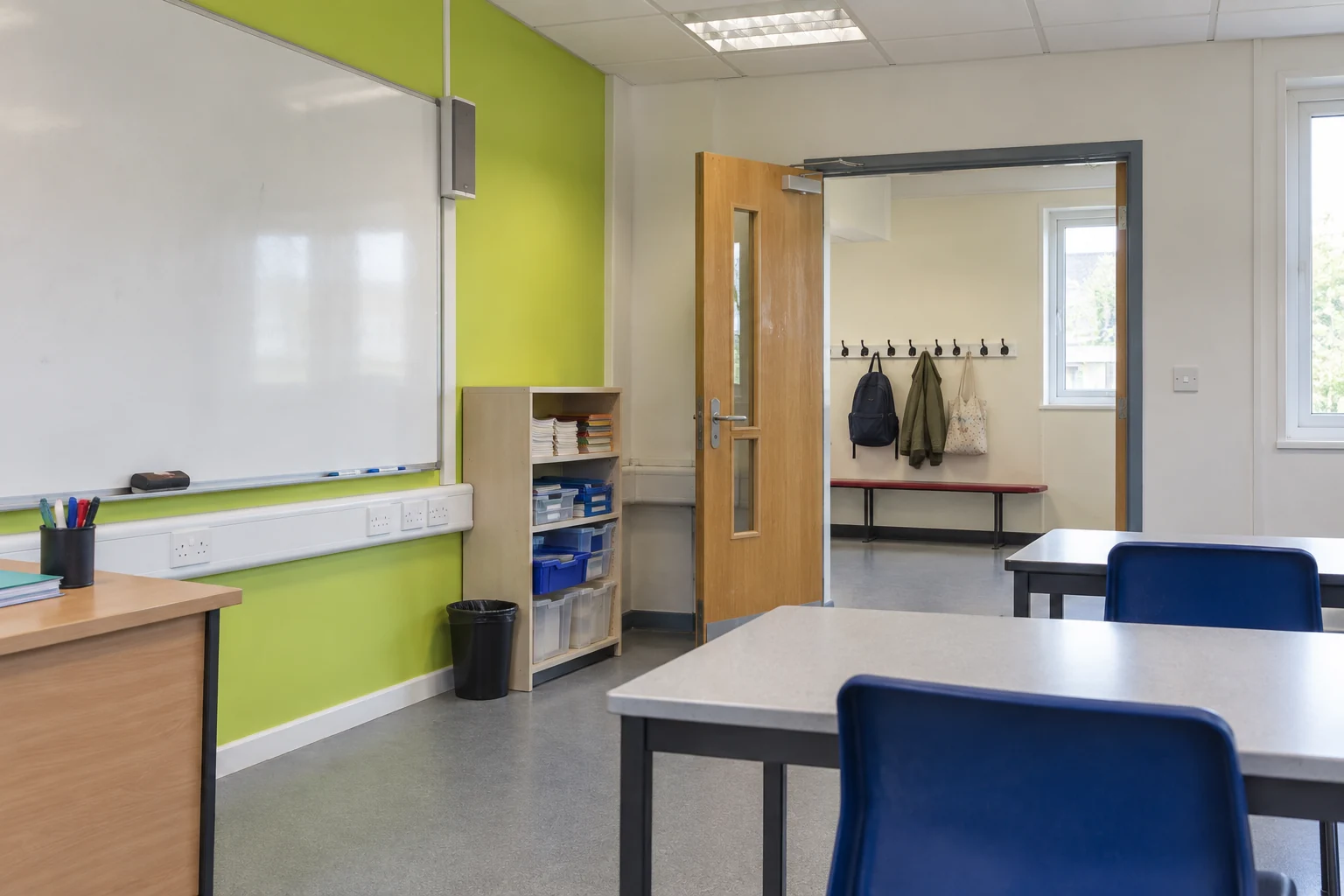
Compare possible locations while the room plan is still adjustable. Consider a classroom bay, an entrance alcove and existing shared storage against the same arrival routine. Each option changes the distance, supervision and movements involved. A convenient furniture catalogue should not decide the location before those relationships have been examined.
A near-entry position can shorten the belongings journey, but it also brings storage activity close to a busy opening. Storage farther inside changes how people cross the teaching space. A central campus location may serve several rooms, while leaving a longer outdoor journey. These are questions to test against the actual school arrangements, rather than universal reasons to prefer one furniture type.
Look from the staff positions used during arrival. Can the relevant part of the routine be understood from there, or does an opaque unit conceal the place where a pupil is waiting? Agree the required supervision with the school. A sightline drawn between two points is useful evidence of geometry, but it does not establish a complete supervision arrangement.
The broader modular classroom planning brief should retain the relationship between the teaching area and its supporting spaces. For this fit-out decision, make the personal-belongings position explicit. A cupboard for teaching resources should not silently become the coat provision, and a temporary pile of bags should not be treated as the final installation.
Compare options using the unresolved project questions below. The descriptions are an editorial worksheet, not tested furniture ratings. Choose an option once its location, use and responsibilities can be shown together; record why an apparently simpler alternative would not support the agreed routine.
| Provision | Potential role | Question before selection |
|---|---|---|
| Open rail and agreed backing | Visible coat provision | Where do loaded coats and bags project? |
| Cubbies or lockers | Individual belongings positions | How are retrieval and door movements handled? |
| Existing campus storage | Shared provision away from the room | Can users reach it when the routine requires? |
| Movable storage | Provision that can be repositioned | What is its agreed position and reset responsibility? |
Draw loaded storage, retrieval and passing separately
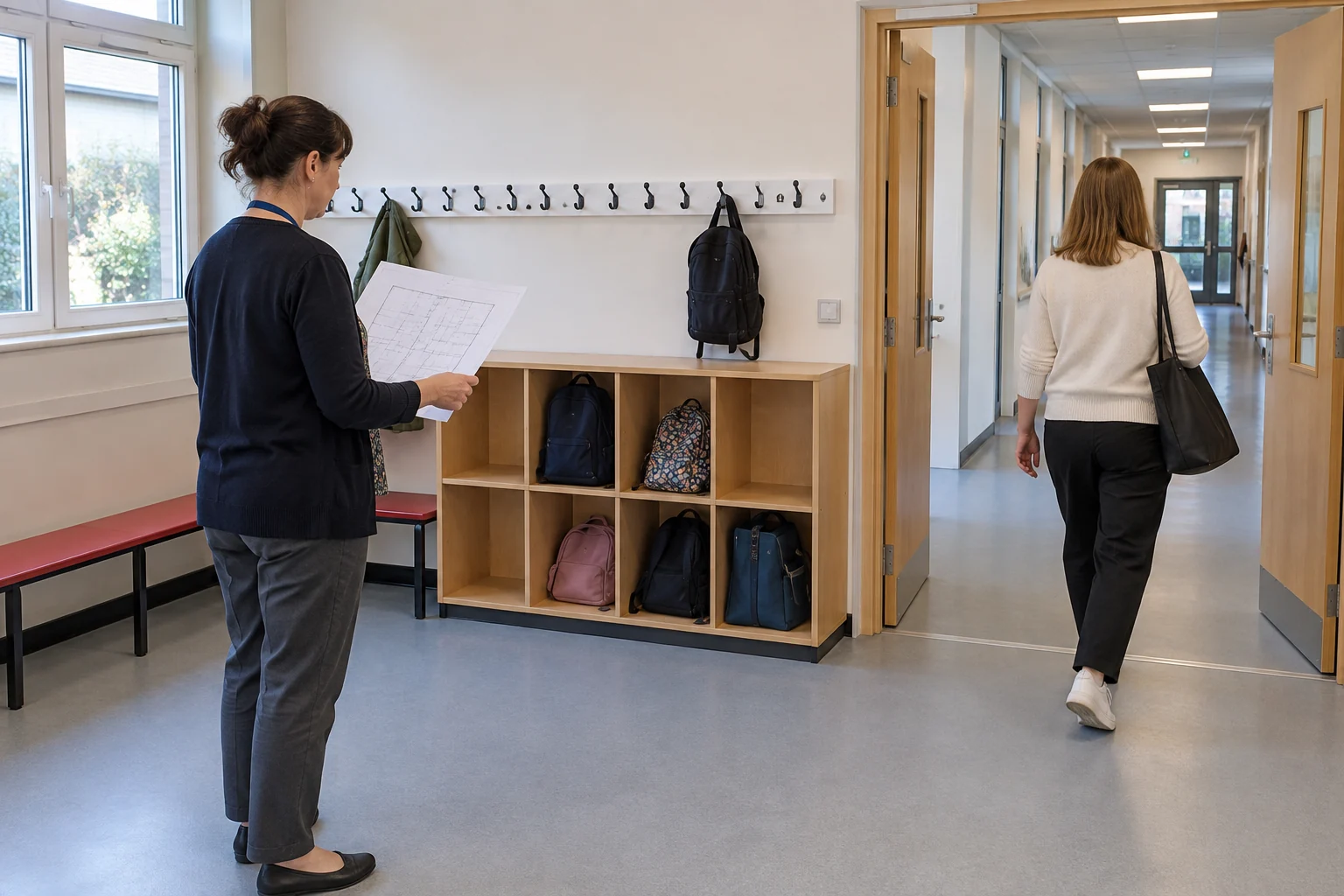
Show the arrangement with belongings in place, rather than drawing only the furniture outline. Add the space used when someone retrieves an item, then keep the continuing route visible. The three views answer different questions. A bag hanging beyond the cabinet front can change the practical arrangement without moving the cabinet.
England’s non-statutory Building Bulletin 103, June 2014, provides a bounded example: primary-school coat and bag storage is described as at least 3 m² per class of net area, excluding circulation past the coats. This is guidance for its stated school context, not a worldwide modular-room minimum or evidence that a particular furniture unit holds a specified set of bags.
Use the actual selected storage dimensions and the agreed belongings sample when reviewing the furnished drawing. Keep the distinction between an item that occupies space and an operation that temporarily uses space. A cupboard door, a bag being lifted and a person turning away are not represented by the same static outline. Refer unresolved geometry to the project’s design reviewer.
The furnished container-house layout discussion helps place this question within the overall arrangement. For the classroom, retain the teaching furniture, entrances and other planned uses on the same drawing. Moving a storage bay out of one route can create a different conflict beside a desk, control or doorway.
Treat the worksheet as a way to show what must be checked. It does not supply an exit width, a capacity calculation or an approval. When the project uses a particular local design basis, identify it separately and ask the responsible reviewer to confirm how the fully furnished arrangement is assessed.
| Area | Show | Check |
|---|---|---|
| Loaded storage | Furniture and protruding belongings | What occupies the space? |
| Retrieval | Person, item and door movement | What happens during use? |
| Passing | Continuing route beside storage | Can the agreed route remain usable? |
Try the storage with its intended users
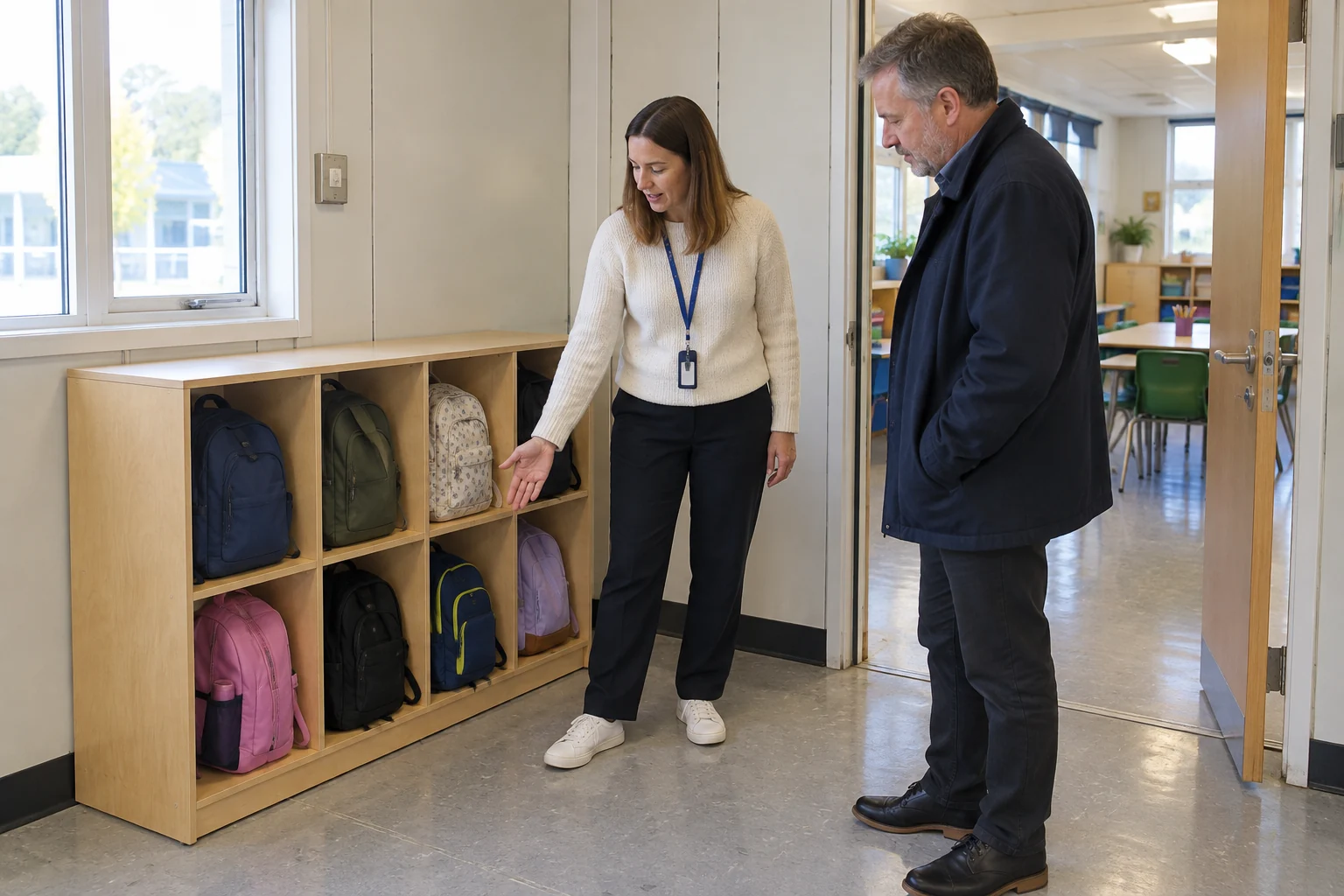
Review how the intended users reach and operate the provision, including any assistance agreed by the school. A low compartment is not automatically suitable for every child, and a reachable hook does not settle the whole movement. Understand the action from arrival through putting away and later retrieving the belonging.
Define what independent use means in this room and what assistance is planned. Younger children and pupils with different support needs may follow different routines. The school should decide which actions the arrangement is expected to accommodate. Do not replace that discussion with one generic hook height or a photograph of an adult reaching the rail.
Use an appropriate review arranged by the school. Observe whether belongings can be identified, reached and returned without the user having to improvise another location. If the review uses adults with representative items, record that limitation. It can reveal an awkward door movement, but it cannot prove that children with different reach or assistance needs will use the provision successfully.
Pay attention to the starting and finishing positions. It is easy to demonstrate placing a coat on a clear rail while omitting the bag already in one hand or the item waiting underneath. A demonstration should reflect the agreed action, including the support available. Preserve the school’s privacy and safeguarding arrangements when collecting any observations.
Where the arrangement does not work, describe the action that failed before choosing a modification. A different storage position, another furniture type or a revised assistance routine may address different causes. Obtain the appropriate approval and update the drawing together with the routine; changing the furniture alone can leave the original question unanswered.
Specify how the fixture meets the module
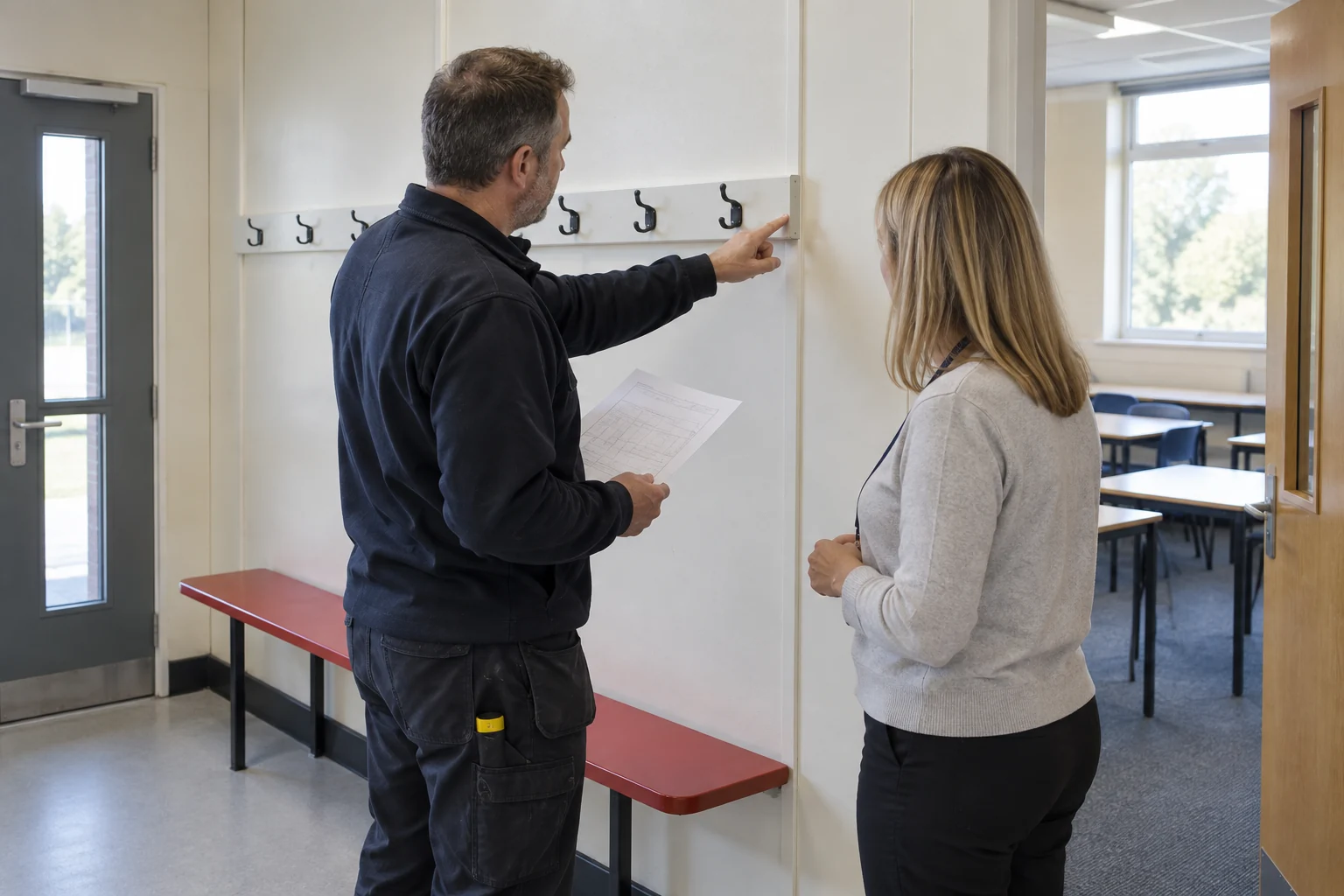
A storage item and its mounting are separate parts of the scope. Ask who provides the selected support detail, who installs it and what record will identify the finished location. The visible panel face alone does not explain the structure behind it or approve a fastener chosen on site.
For a flat-pack container house used as a teaching room, establish the actual interior fit-out before agreeing a wall-mounted rail or cabinet. A familiar domestic fixing does not become suitable because the room is small. Obtain a detail reviewed for the selected item, substrate and building arrangement, including any interfaces the project needs protected.
The HSE’s voluntary ordinary-classroom checklist asks whether permanent fixtures are securely fastened. It does not prescribe a hook load, backing material or screw selection. Those details must come from the relevant project and item information.
Resolve the responsibility boundary in writing. A supplier may provide the module, a furniture contractor the storage and another team the installation; the quotation should say what each party includes. Ask which drawing or mounting information accompanies the handover and how deviations are handled. A photograph of a neat rail is not a substitute for that record.
Consider future change at the same time. If a rail is removed, relocated or replaced, the maintenance information should show who reviews the change and who restores any affected surfaces. Do not quietly carry an old approval to a new location. The new arrangement may encounter different support, nearby services or an enclosure detail that the original location did not involve.
Plan what happens on a wet arrival
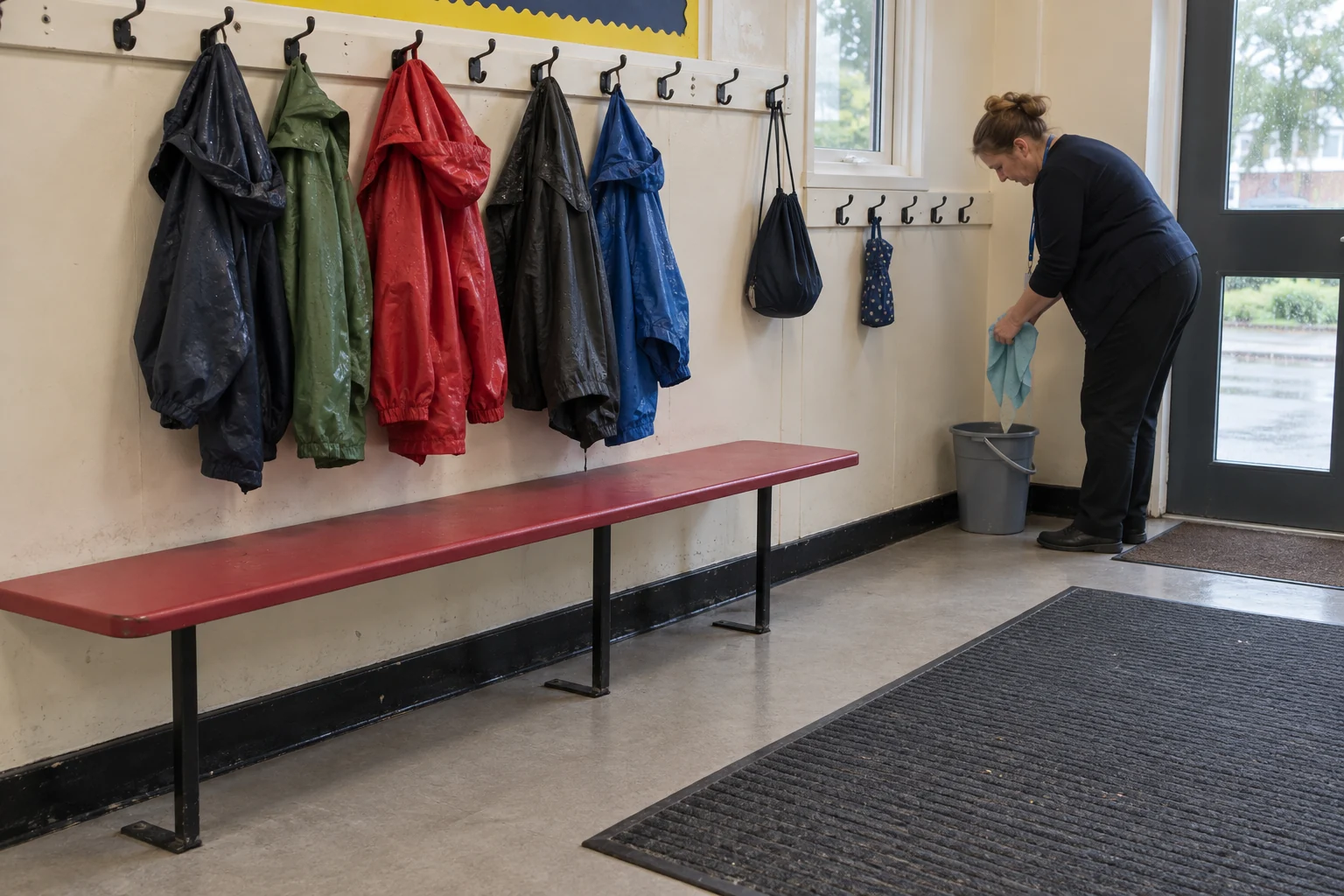
Consider the belongings in the condition in which they arrive. Raincoats, wet bags and muddy footwear may need different handling from dry everyday items. Agree where they go and how staff respond to water or dirt. A room described as having coat storage does not, by itself, describe that routine.
Ask the operator whether wet belongings stay with the ordinary items or use another agreed place. Include how items are collected later and what staff do when that place is temporarily unavailable. Do not promise that a rail, cupboard or module will dry garments at a particular rate without relevant evidence for the selected arrangement and operating conditions.
The HSE checklist also draws attention to clear gangways and dealing with spills. For this belongings routine, record how a cleaning response keeps the affected place identifiable and how the school manages access while the task is carried out.
Review the cleaning action with the storage in normal use. Can the agreed person reach the floor and surfaces, and where do belongings go during the task? Follow the actual furniture and finish care information. Moving all bags into the entrance temporarily can exchange a cleaning problem for an access problem, so include that temporary location in the routine.
The container-house maintenance responsibilities remain relevant to changes around the installed fit-out. Keep building repairs, furniture care and ordinary housekeeping distinguishable. If moisture persists or a surface changes condition, record what was observed and refer it for the appropriate review rather than assuming all water came from a pupil’s coat.
Rehearse the busy moment with the agreed inputs
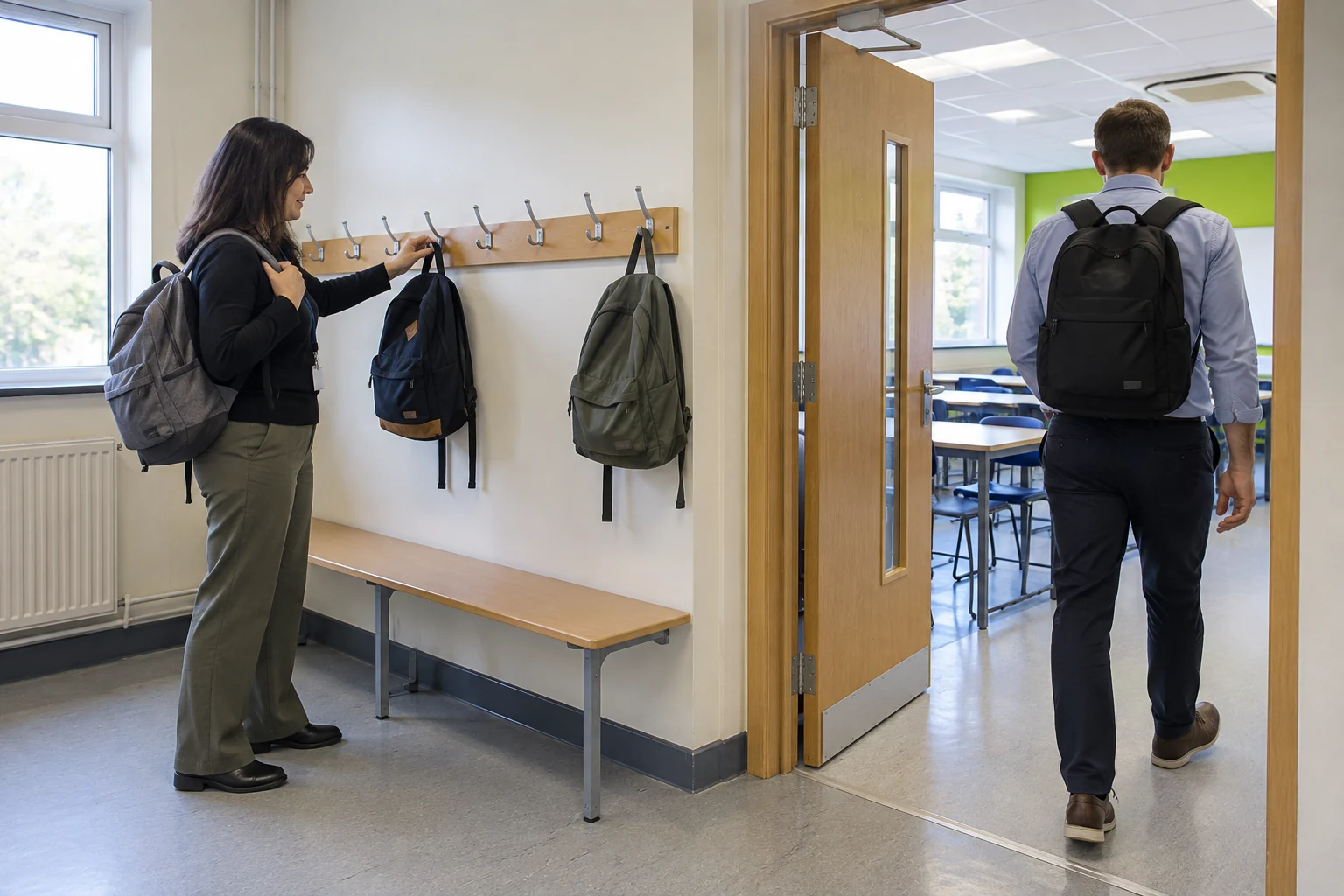
Review the busiest relevant sequence rather than an isolated storage action in an empty room. The school can define which arrivals, retrievals or departures need to overlap. Observe what happens with the agreed belongings and furniture in place. A small rehearsal can reveal a conflict without establishing a processing rate.
Choose the sequence from the school’s operating brief: a class arriving together, pupils collecting belongings before an outdoor activity or a late arrival meeting people leaving. Record which one was reviewed. A demonstration of only the quietest sequence gives little information about the moment the operator is concerned about, but an invented crowd is equally unhelpful.
Observe where people pause, where a bag is set down and whether someone must repeat a movement. Identify the event instead of attaching a broad judgement such as the room feels congested. If a doorway must be held open or a furniture item shifted, retain that observation for the design and operating review rather than treating the workaround as a successful result.
Keep the difference between a review and a measured capacity study explicit. Record the inputs, participants and limitations; do not extrapolate pupils per minute from an informal walk-through. If the school needs a quantified assessment, define that task separately with an appropriate method and reviewer. The purpose here is to discover practical issues before accepting the furnished arrangement.
Use any findings to revise both the plan and the relevant instruction. Moving the rail while leaving the old arrival sequence in place may simply relocate the pause. Repeat the affected part of the review with the new arrangement and retain the outcome. A change is easier to assess when its reason and the sequence being improved remain visible.
Keep the agreed place from drifting during term
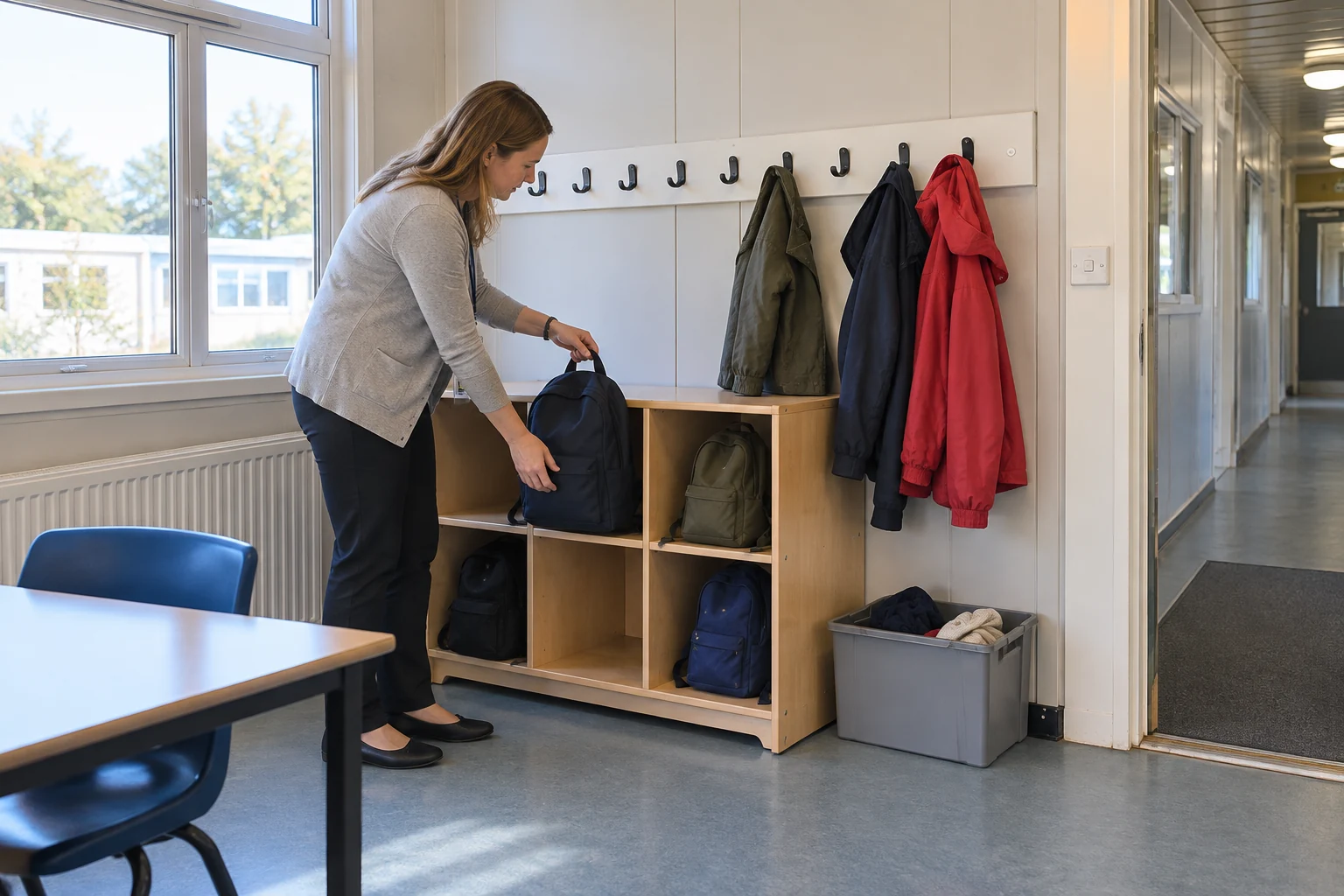
The arrangement can change after handover even when no new furniture is installed. An unclaimed coat, spare teaching materials or bags left overnight can occupy the intended place. Agree how exceptions are identified and resolved. The aim is to keep the reviewed routine recognisable, rather than demand a permanently empty-looking room.
Give unclaimed items and short-term overflow an agreed destination and a responsible person. The school determines the identification and return procedure; avoid collecting unnecessary personal details in a building record. A temporary box may be useful, but its position should not quietly take over the space assigned for the ordinary storage action or an adjacent planned use.
Consider occasional changes separately: sports equipment, seasonal clothing or an activity involving another group. Ask whether the school has a temporary arrangement and how it is reset afterward. A movable unit is only part of that answer. Someone still needs to know its intended position, when it may move and how the normal arrangement is restored.
Keep photographs and simple position references with the operating information where useful. They can help staff notice when an item has drifted into a different place. They are a record of the agreed arrangement, not proof that every later activity is suitable. Avoid labelling routine staff decisions as engineering approval when they have not been reviewed as such.
Review a repeated exception as a possible mismatch in the brief. If belongings regularly end up elsewhere, ask what action the intended provision fails to support. The answer may concern access timing, item size or identification rather than insufficient building area. Record the observation before buying additional furniture, especially where a new unit would alter the furnished route.
Hand over the furnished arrangement
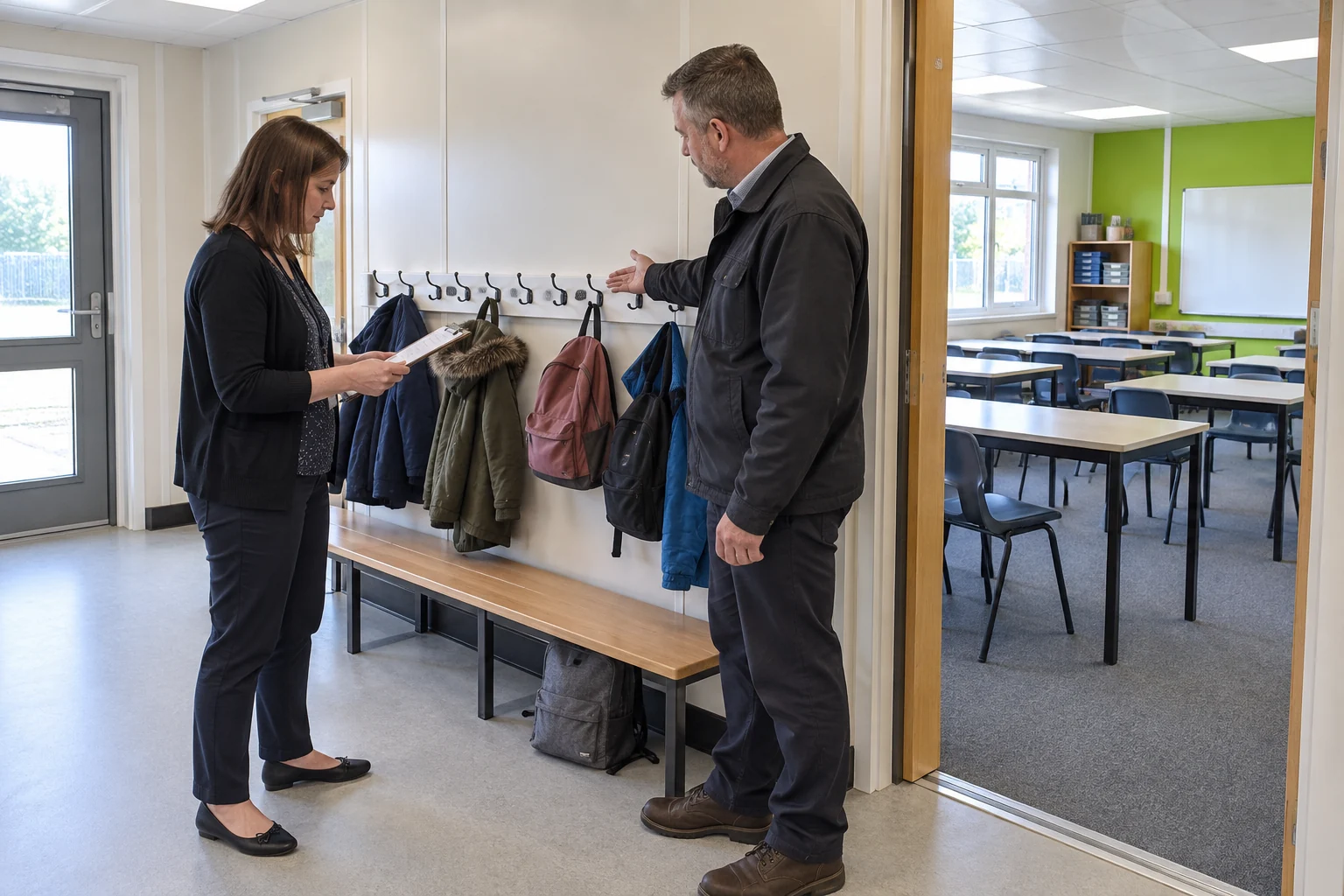
Review the storage in its intended position with the relevant belongings present. Connect each unresolved issue to the item, location and person responsible for its next decision. A delivery list confirms what arrived, but it does not describe how the school will use the furnished entrance when the room opens.
Keep the selected furniture reference, agreed drawing revision and installation information together. Identify which items were supplied by the building contractor and which came from the school or another party. If an item differs from the reviewed proposal, make that difference explicit. A similar appearance does not establish the same dimensions, operation or mounting information.
Use the handover to demonstrate the actions that mattered in the brief. Ask the school representative to identify the normal arrival procedure, the wet-weather arrangement and what happens when an item cannot be stored as expected. Where a question remains open, record its owner and next step; do not convert it into a passed check because the delivery date has arrived.
On an operating school site, coordinate the fit-out with the modular classroom installation and campus opening sequence. That wider task deals with the transition from works to use. The belongings review is narrower: it confirms what was examined in the furnished room and which information the operator receives.
Retain useful evidence without overstating it. A photograph can show where the rail stands and what sample belongings were present. A mounting record can identify the detail used. An observation can describe an awkward retrieval. Each serves a different purpose, and none alone establishes complete acceptance of the building or every possible future classroom activity.
| Demonstration | Retain | Open decision |
|---|---|---|
| Use the agreed belongings sample | Items and action reviewed | What needs a different arrangement? |
| Retrieve beside the furnished route | Relevant position and observation | Which movement requires review? |
| Check the installed fixture record | Item, location and mounting information | Who resolves a mismatch? |
| Review wet-weather cleaning | Temporary belongings place and routine | Who restores normal use? |
| Explain the school procedure | Current instruction and responsible person | Who answers an unresolved question? |
Request a quotation that includes the belongings routine
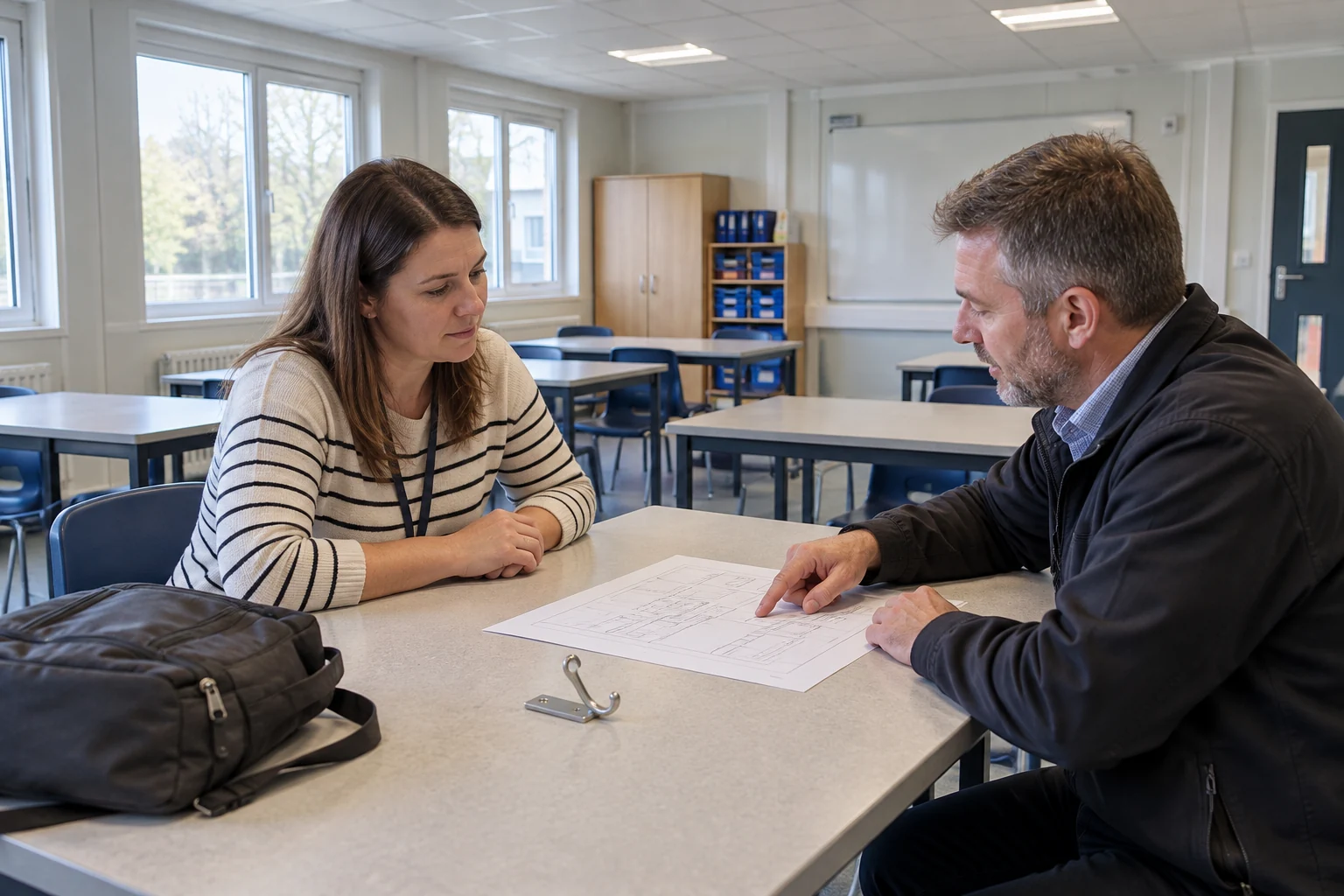
Send the proposed furnished plan alongside the operating information, rather than asking only for a classroom and some hooks. Explain the belongings to be accommodated, the agreed location and the responsibilities still undecided. A useful quotation should let the buyer see which parts of that arrangement are included and which remain separate.
Include the intended teaching use, school access arrangements, representative belongings description, furniture choice or options to compare and required opening sequence. Identify existing campus provision that the proposal depends on. If the selected location needs a design review, say who provides it and when the supplier needs the resulting information. The building order should not hide an unresolved school decision.
Ask for the storage and installation scope to be stated separately where different parties are involved. Confirm the supplied items, relevant support-detail responsibility, location drawings, installation work, finish care information and handover records. List school-supplied furniture or site work clearly. An exclusion can be manageable when it is visible; an assumed inclusion is harder to resolve after delivery.
Use the project approval and local-code discussion to identify who checks the actual proposal against the applicable requirements. A classroom area example from another jurisdiction cannot replace that review. Keep the named guidance, school operating decision and supplier’s order-specific information distinct so that each question reaches the party able to answer it.
Before agreeing the order, review any unresolved question with the relevant school and project representatives. Record the next action rather than inserting a guessed dimension, pupil capacity or mounting detail. For PQSE House, provide the destination, proposed arrangement and intended use with the information available; request confirmation of the actual supply scope instead of treating an illustrative photograph as a standard delivered fit-out.
Buyer questions
Can coat storage share the classroom entrance?
It can be considered within the actual furnished proposal, but the word entrance is not an approval. Show the loaded items, the retrieval action and the other movements that use the place. Ask the relevant school and project reviewers to resolve any conflict. Moving belongings nearer the door may change the journey while also changing activity around that opening.
Are wall hooks automatically included in a modular classroom order?
Do not assume so. Ask the quotation to identify the storage item, its location, the installation responsibility and the associated information. School-supplied furniture or another contractor’s work should be distinguished from the module package. The useful confirmation is an order-specific inclusion or exclusion, rather than an inference from a product photograph.
Can existing lockers replace storage near the modular room?
Existing lockers can be assessed as an option when the school confirms that users can reach them at the necessary times. Trace the ordinary arrival and later retrieval journey, including any outdoor movement and assistance. Check the actual available provision and how it is allocated; an existing locker bank does not by itself demonstrate that the proposed classroom routine is covered.
What should happen before a wall-mounted rail is moved?
Identify the new item and location, obtain the relevant support and installation review, and record who authorises the change. The original mounting information may not apply somewhere else. Update the furnished plan and the operating arrangement together, including any affected surface or nearby interface; a tidy-looking relocation is not sufficient evidence of a reviewed change.
Sources and scope
- HSE, Classroom checklist, first published August 2011. Voluntary ordinary-classroom awareness checklist; no hook-load, fixing or dimensional specification transferred.
- DfE, Building Bulletin 103, June 2014. Non-statutory England mainstream-school guidance; primary net coat storage excludes circulation, not a tested furniture capacity.
- Reddit, r/Teachers, 8 September 2026. One self-reported school circumstance used to discover an access question, not a verified policy or trend.
The comparisons and handover questions are editorial planning aids. No PQSE storage load rating, pupil capacity, approved mounting detail or garment-drying dataset is established here. The named guidance has its own scope; the actual school, selected furniture and applicable project review determine the arrangement. New generated photographs illustrate the discussion and do not document a completed PQSE installation or prove that a depicted route meets a particular requirement.