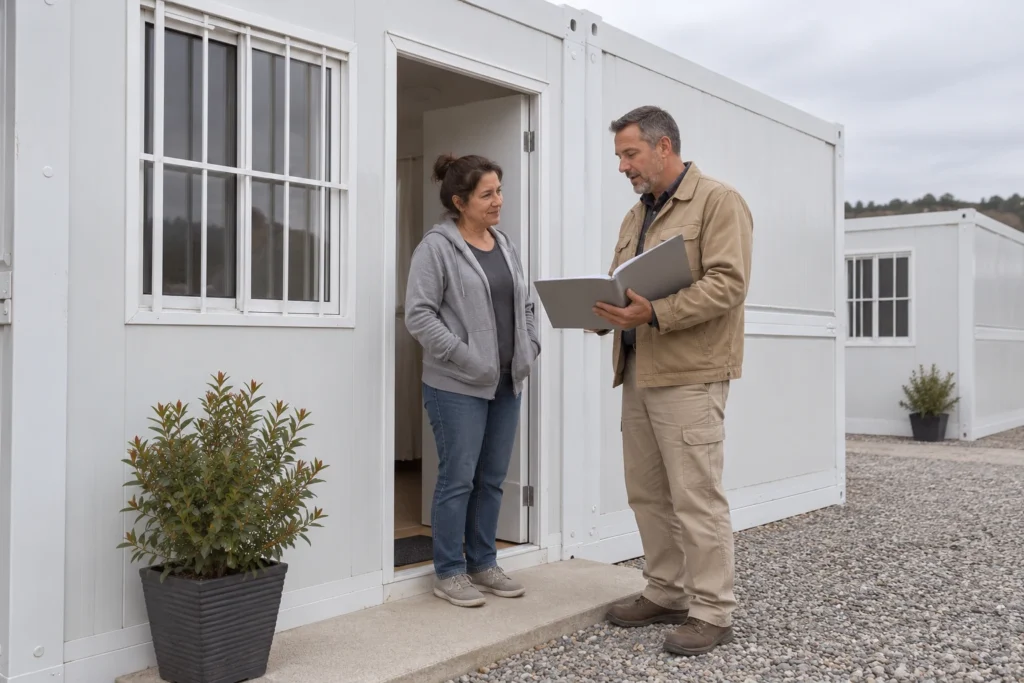
A detachable container house is designed around separately assembled components, but “detachable” does not mean that every part can be reused after any number of moves. The second deployment depends on what happened during the first occupation, how the building is dismantled, whether the frame and enclosure remain serviceable, and what the new site requires. A buyer planning several project phases should evaluate those questions before treating the building as a reusable fleet asset.
This guide gives project owners a practical decision process. It covers the condition record before dismantling, a controlled sequence, packing and transport, inspection at the next site, replacement parts, and the scope of reassembly. It does not authorize a particular lift, repair or structural substitution. Use the approved drawings and manufacturer instructions for the actual configuration, and have the relevant local professionals assess structural, utility, safety and approval questions at each destination.
Decide what “reuse” means for this project
There are several different outcomes behind one word. A unit may be moved intact, disassembled and reassembled in the same arrangement, reconfigured with some new components, or stripped for selected reusable parts. Those routes have different costs and risks. Define the intended route, expected number of moves, storage period, destination climate, intended use and likely new layout before choosing a building system.
The PQSE detachable container house uses bolted frame components and separate panels. That makes component identification and assembly scope central to planning a later move. It does not mean that the original approval, weather seals, fasteners or service connections automatically carry over. A door that worked at one site can bind after a panel or support changes. A bathroom layout that fitted one service route may need a new design at the next location.

If reuse is a procurement objective, write it into the initial brief. Request component IDs, as-built drawings, installation records, a parts schedule, storage guidance and a procedure for condition assessment. Ask what parts the manufacturer expects to replace during a move. Treat a claimed “reusable” building as a system with a maintenance and records obligation, not as a promise that a buyer will never purchase new components.
Make the second-use decision before the first dismantling
At the end of the first project, compare three choices: keep and reassemble the building; reuse selected parts in a revised building; or retire the unit and procure a different solution. The comparison should account for dismantling labor, access equipment, packaging, transport, storage, inspection, replacement parts, foundations, services and local approvals. Do not compare a used kit’s purchase price against a new building’s fully installed cost.
An honest reuse calculation also values delay. If the next site is not ready or key parts require remanufacture, a theoretically reusable kit may not meet the program. Conversely, a controlled dismantling plan can preserve value that a rushed demolition would lose. The Modular Building Institute’s explanation of relocatable buildings supports the general principle that buildings can move and change use; the details of any PQSE project remain governed by its own documents and condition.
Record the occupied building before anything is removed
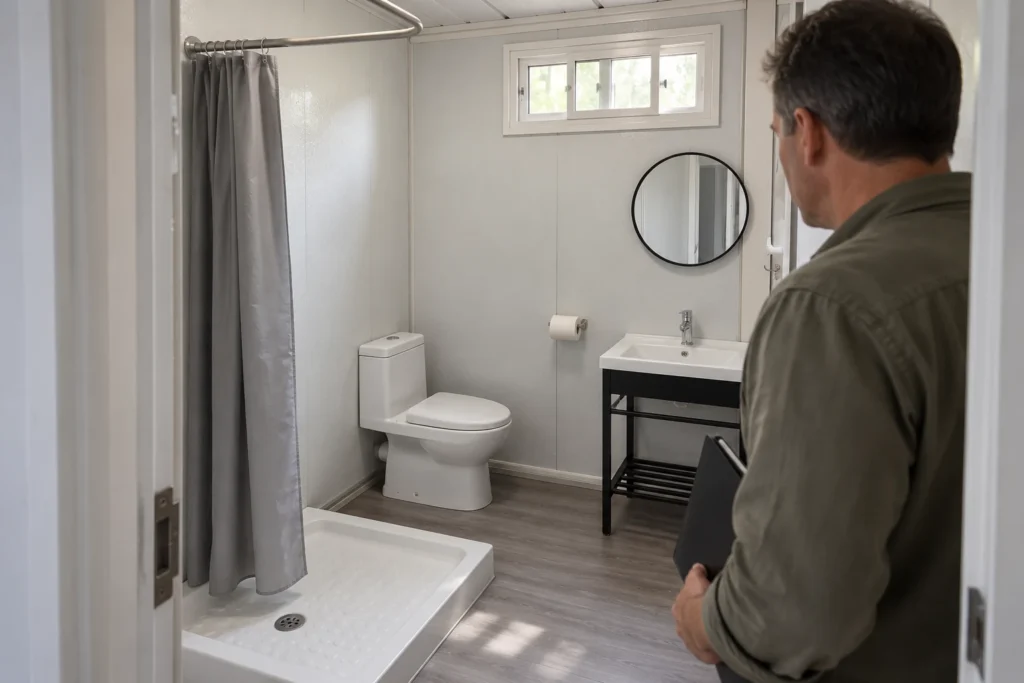
Start with the current drawings, unit identification, installation records, maintenance logs and known defect list. Walk every room and external face. Photograph the frame connection areas, panel joints, roof edges, gutters, openings, service penetrations and any previous repair. Record water stains, recurring leaks, door misalignment, corrosion, coating damage, cracked panels, broken seals and alterations made after installation. A photograph should include the unit and location, not only a close-up that cannot be traced.
Separate damage from ordinary wear. A dirty panel can be cleaned; a distorted load-bearing member requires a different review. A seal can be planned for replacement; a missing connection detail may prevent a safe dismantling method from being defined. Where hidden conditions matter, decide who may open the finish and who assesses the result. Do not make a reuse decision from a distant exterior image.

The container house quality-control guide explains the value of traceable checks across factory and site stages. Apply the same discipline in reverse: the pre-move record becomes the baseline against which parts are judged after removal and before reassembly. Keep a dated defect register with an action owner. If structural condition is uncertain, obtain competent review before treating the kit as reusable.
Record modifications and service boundaries
Later additions can complicate removal. Note every wall penetration, external cable, pipe, fixture, partition, roof attachment and sealant repair. Identify which items belong to the owner, tenant, supplier or local service contractor. Photograph how incoming power, water and drainage connect, then plan lawful isolation by qualified personnel. A building cannot safely be dismantled while its services are merely “switched off” by assumption.
Ask whether the next use requires the same occupancy, fire separation, privacy, access and service capacity. A change from storage to worker accommodation, for example, may affect ventilation, exits, water and local approvals. The container house permits and codes guide helps frame these questions, but only the relevant local authority and qualified designers can decide what the second site must satisfy.
Plan dismantling as controlled construction work
The crew needs a sequence based on the actual frame, joints, temporary stability and lifting points. A generic reverse-order list is not enough. Identify which panels or finishes must come off to access connections, which elements brace the frame at each stage, and what temporary support is required. The installer should hold the current drawing revision and stop if an unexpected joint or unrecorded modification is discovered.
Name the person who controls the work zone, service isolation, lifting plan, access equipment, weather protection and component tagging. The applicable safety rules vary by jurisdiction. In the United States, for example, OSHA’s crane guidance explains responsibilities for ground conditions and equipment inspection; use the rules that govern the actual site and equipment. The important procurement point is that crane and rigging work must be separately planned and resourced, rather than hidden in a “take it apart” allowance.
Protect people and parts at the same time. Store removed panels where they cannot fall or absorb avoidable water. Keep small hardware in unit-specific containers. Do not cut a bolted connection simply because a seized fastener is inconvenient without an approved repair and replacement route. If a member has been welded, drilled or modified on site, flag it before using the original dismantling procedure.
Control sequence changes and stop points
A practical method statement identifies prerequisites, sequence, tools, lifting points, temporary stability, inspections and stop-work triggers. Useful hold points include completed service isolation, exposed structural connections, removal of bracing elements, first lift and the first packed unit. An unexpected movement, crack, leak or connection mismatch should trigger reassessment, not improvised force.
Keep a record of what actually happened. If one corner required a different sequence because of an adjacent structure, the reassembly team needs that note. A photograph of every stage is not necessary, but the critical connection and exception records should remain with the asset. The general container house installation guide describes forward assembly; a relocation plan should add the condition and recovery checks that new construction does not have.
Tag every recoverable part to its unit and position
Once parts are separated, lookalike members become easy to confuse. Use a component register linked to the drawings. Record part type, original unit, location, identification mark, condition, required action and storage package. Keep the existing factory ID where it is reliable; add a durable temporary tag when one is missing. A bag of unlabelled bolts and plates cannot prove that a complete frame remains available.
Separate inventory into four states: ready for reuse after normal cleaning; requires inspection or repair; replace before next use; and discard. Do not let an “unknown” category quietly become “ready.” Be especially careful with fasteners, gaskets, sealant, panel edge trims, drainage pieces and service fittings. Some of these may be consumables even when the steel members remain suitable. Ask the manufacturer or designer which new fasteners and sealing products are required for the specific connection.

The container house kit inclusions guide is a useful comparison when rebuilding a parts schedule. Treat the recovered asset as an inventory that must be reconciled against the kit required for the next installation. If the revised layout has extra doors or joined units, add those separately. Do not count a reused component twice because it appears on two proposed drawings.
Inspect condition after removal, not only before it
Dismantling reveals surfaces that may have been hidden for years. Examine connection plates and holes for distortion, elongation or corrosion; check that frame members remain straight and protective coatings are intact or repairable. Review panel faces and edges for damage, wet insulation, delamination or loss of sealing surfaces. Check doors and windows for square frames, hardware condition and glazing damage. Examine roof and drainage pieces for deformation and repeated leak paths.
Set acceptance criteria before grading. A minor coating scratch may call for a specified repair, while a distorted structural connection may require engineering review or replacement. Avoid a vague “looks okay” sign-off. Document who assessed the component and which instruction or drawing governed the decision. If a part cannot be traced to the right specification, hold it from reuse until identity is established.
The U.S. EPA’s deconstruction guidance treats inventory and selective recovery as part of useful material reuse. That is a helpful process reference, not a certification of building components. For this product, the manufacturer and competent project professionals must decide whether each part is suitable for the proposed next use.
Distinguish repair from redesign
Replacing a seal with the specified product is different from welding a new bracket onto a frame member. A repair returns an item to an approved condition; a redesign changes the connection or performance assumptions. The latter requires a suitable design decision, revised documentation and possibly new approval. Make that boundary explicit when a local workshop proposes a quick fix.
Maintain a replacement schedule with lead times. A reused building can fail the schedule because one proprietary trim, connector or panel profile is unavailable. Check sourcing before booking freight. Keep spare components under the same ID and condition controls as recovered parts, so the second assembly crew receives one coherent package.
Pack for the next assembly, not merely for transport density
Part protection matters because a reusable kit has already consumed one installation cycle. Keep steel members supported and restrained, separate sharp edges from insulated panels, protect door and window glazing, and prevent water from collecting in packages. Use the supplier’s packing and lifting instructions for weights, stacking and tie-down. Do not assume that the arrangement used for the original factory shipment can be recreated with mixed used components and local pallets.
The container house loading and shipping guide covers freight planning. For a relocation, add a recovered-parts manifest showing which unit and location each package serves. Photograph each finished package and record dimensions and handling limits. Make the destination crew’s first count possible without dismantling every bundle. That evidence also helps resolve damage or shortage claims after a long move or storage period.
Storage is its own project phase. Define duration, exposure, drainage, security, inspection frequency and responsibility for deteriorating packaging. A dry component placed on a wet site for months may arrive at the next job in a different condition from the one recorded after dismantling. Reinspect after storage and after transport. A single pre-move pass cannot certify the next installation.
Treat the next site as a new project
The original base, utilities and permit do not travel with the components. Check new ground conditions, support geometry, drainage, wind and other local design actions, access, lifting and intended use. Compare the recovered parts schedule with the new approved drawing set. If the layout changes, confirm the effect on openings, joints, circulation, weathering and services before unloading begins.
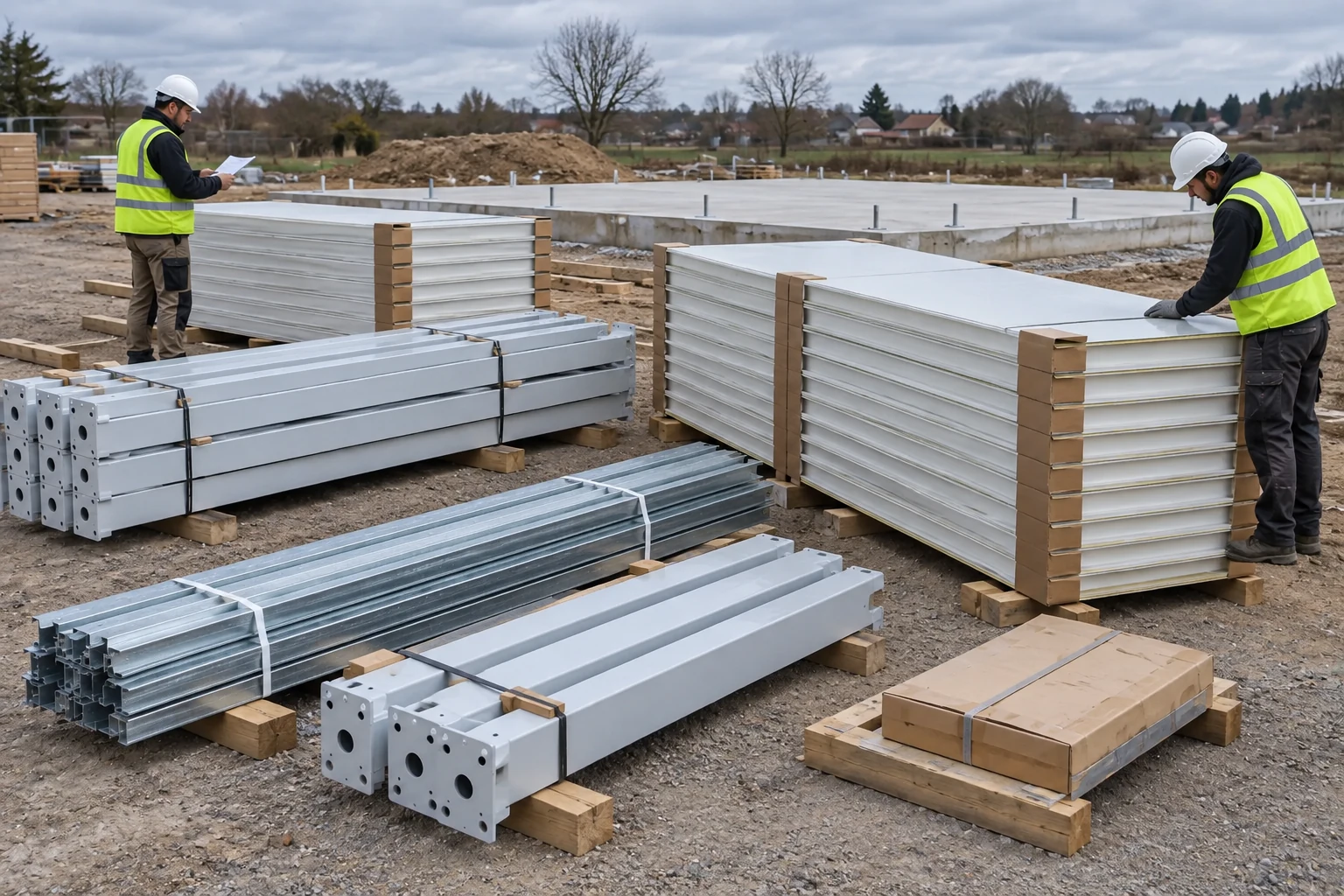
Assign the destination work between the owner, manufacturer and local contractors. The recovered kit may contain frame and panels but not new anchors, seals, fasteners, service connections or permits. Obtain a quotation that identifies inspections, replacement parts, transport, assembly supervision, local labor and testing. If the new use is a worker camp accommodation, for instance, occupancy and service needs must be planned for that camp; a previous office layout is not automatically suitable.

Before reassembly, reconcile the received inventory with the approved new configuration. Hold damaged, unverified or incompatible parts outside the work zone. Follow the manufacturer’s current assembly method and the project-specific engineering. Record critical connections and tests, then issue a new handover pack. The reuse claim is complete only when the second installation is accepted for its new purpose.
Compare the total second-life cost
Calculate dismantling, temporary support, labor, packaging, freight, storage, inspection, replacement components, revised design, foundations, utilities, permits, reassembly and commissioning. Add a schedule allowance for unresolved condition and customs or site access where relevant. Compare that total with a new building delivered to the same acceptance point. A used frame can be economically useful without being the cheapest choice in every location.
Do not convert a broad environmental benefit into a project-specific carbon claim without a method and evidence. Reuse may avoid some new material and waste, but transport, repairs and different service performance also matter. The stronger immediate case is an auditable asset decision: know what is recoverable, what it takes to make it usable again, and when retirement is more sensible.
A practical go, repair or retire decision
Use a three-gate decision. First, can the original building be dismantled safely with the drawings, access and resources available? Second, are the recovered components identifiable and serviceable after inspection and approved repair? Third, can those components form a compliant, accepted building at the next site within the project budget and schedule? If any answer is unknown, assign the evidence needed and hold the decision rather than treating uncertainty as a yes.
The final asset record should contain the pre-move condition survey, isolation and dismantling records, component register, repair approvals, package manifest, storage and transit inspections, new-site drawings, assembly record, test results and outstanding defects. Give the operator access to those records. A detachable system earns its reuse value through controlled handling and documented condition, not through the word on its product page.

For fleet owners, use the same asset identifier across moves. Record the date, configuration, location, main repairs, replaced parts and next inspection. That history allows a future team to recognize repeated trouble at one joint rather than treating each leak as an isolated event. It also helps procurement decide whether to keep standardized spare parts or retire a configuration that has become difficult to support. If several similar buildings are in storage, do not assume their parts are interchangeable simply because they share a nominal size. Verify model revision, connection geometry, panel construction and approvals before mixing inventory. A coherent record can make reuse faster; missing history can turn a promising pile of components into an expensive uncertainty.
If you are planning a move or procuring a demountable building for several sites, share the current configuration, next-site use and expected relocation sequence with PQSE. That makes it possible to discuss component identification, replacement parts and the actual destination scope before a dismantling date is fixed.
Research and applicability notes
This article uses PQSE’s published detachable-system description and checks general relocation concepts against the Modular Building Institute’s relocatable-building overview, U.S. EPA deconstruction and reuse guidance, and OSHA crane and ground-condition guidance. These sources inform the decision process; they do not state that a particular used component is safe or code-compliant. Confirm those judgments for each project and jurisdiction.