Decide what guests should be able to prepare before choosing a kitchenette package. Making coffee, reheating a takeaway and cooking dinner are different promises. A cabinet run and a sink do not settle which of those jobs the room can support.
For an Apple cabin, describe the intended food routine alongside the room layout. Then have the cabinets, fixtures and selected equipment listed in the quotation. The word “kitchenette” alone is not an inclusion list.
Choose the guest task first
Start with a simple scenario: guests return to the cabin in the evening. Are they bringing prepared food, reheating it, or expecting to cook a meal from ingredients? The answer changes what needs a place in the room.
| Intended use | What the brief should establish | What not to assume |
|---|---|---|
| Drinks and cold food | Drink preparation, cold storage if wanted, cups and a place to set food down | A countertop automatically includes appliances or a refrigerator |
| Reheating prepared food | The selected reheating appliance, suitable storage and room to use it | A microwave provides the same cooking choices as a hob and oven |
| Preparing meals | The cooking methods, appliances, preparation surface, washing and storage needed for the meals offered | A “full kitchen” label guarantees a particular appliance or suitable installation |
These are planning scenarios, not legal kitchen categories. Choose the capability that fits the accommodation you intend to offer; adding every appliance is not automatically the better room.
Read the equipment list behind the label
Actual accommodation descriptions show why the details matter. Aloft Silicon Valley's room page describes a kitchenette with a microwave, refrigerator, sink and storage. That list identifies useful amenities; it does not establish every unlisted feature.
AutoCamp's cooking FAQ describes microwaves, utensils and flatware in its Airstream and cabin kitchenettes, then specifically says its cabins also have a stovetop. These are those operators' amenities, rather than a definition of all kitchenettes or a PQSE equipment package.
Use the same level of clarity in your own brief. “Guests can heat a meal and keep drinks cold” is more useful than “small kitchen.” If guests should also fry, simmer or bake, state that separately so the proposed equipment can be discussed.
Give each chosen function a place
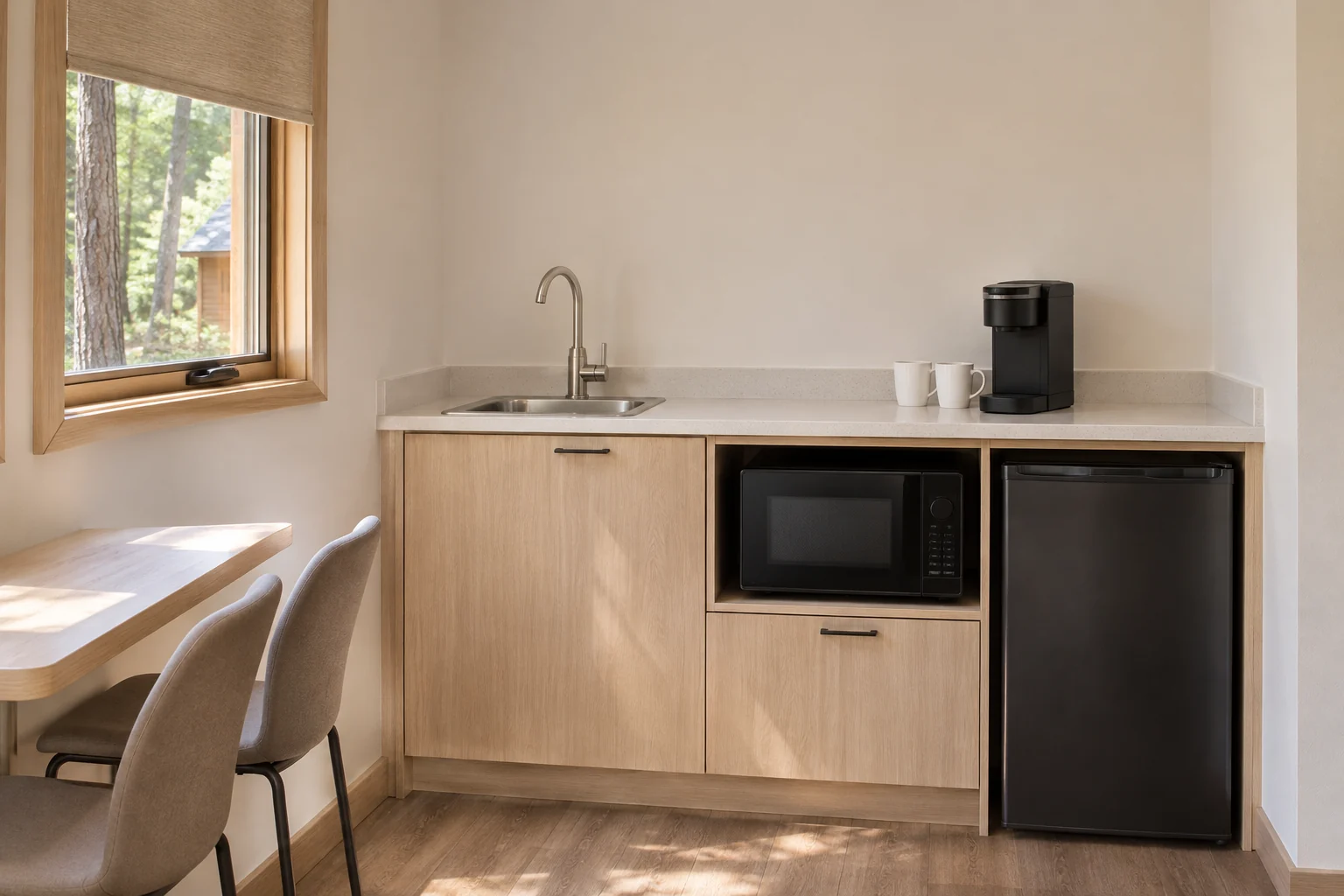
After selecting the capability, bring it into the cabin layout. The plan should identify where food is set down, prepared, heated, stored and washed up. A photograph of finished cabinets can leave those functions unresolved.
For example, a counter occupied by the chosen equipment should not also be counted as an empty preparation surface. Include the storage and washing arrangements that make the intended routine workable. Keep this discussion tied to the actual appliances, rather than assuming a larger cabinet run solves everything.
If a refrigerator is included in the brief, our refrigerator fit and delivery guide uses an expandable-house example to explain the separate fit and service-access questions. If you choose a hob, our cookware compatibility guide addresses pan selection. Those are later decisions; first decide whether cold storage and stovetop cooking belong in the room at all.
Match the supplied package to the guest promise
Separate the cabin shell, interior cabinetry, fixtures and appliances in the offer. Confirm which selected items are supplied, which are optional and which you will source at the destination. A furnished image is not a packing list.
Include the destination when discussing power, water, drainage and ventilation. Our modular building utility-planning guide covers the wider connection brief. The selected equipment needs appropriate project-specific provision; this guide does not design those installations or establish permission to cook in a particular building.
When comparing prefab cabin options, carry the same food-use brief across the offers. Otherwise one cabin may appear cheaper simply because it includes fewer of the functions you expected.
FAQ
Does a kitchenette always have a hob?
Do not infer it from the name. Ask for the exact appliance list. If stovetop cooking is part of your guest offer, make it an explicit requirement rather than an assumption.
Is a microwave enough for a short stay?
It depends on what guests are meant to prepare and where other meals will come from. Stay length alone is not a reliable rule. A short visit can still involve cooking, while a longer visit may rely on meals provided elsewhere.
Can I describe the cabin as self-catering?
Use a description that accurately reflects the actual facilities and applicable local requirements. Spell out the equipment and any food-preparation limits instead of relying on the label to explain the room.
Turn the food routine into a cabin brief
Tell PQSE House the cabin quantity, destination and intended guests. Describe what they should be able to prepare, which equipment you want supplied and which items you plan to buy locally. Add the preferred room layout so the proposal can bring the food area and the rest of the cabin together.