Order cookware by the individual vessel and the selected hob’s requirements. Keep the pan’s named size, its physical contact bottom and its magnetic area separate, then compare the information that actually applies to that appliance. An induction label is useful evidence, but it does not supply every missing dimension or establish a particular pan-and-hob pairing.
The distinction matters before a mixed kitchenware order is placed. A description such as “stainless steel pans, suitable for induction” may leave the actual piece sizes, lids and handle projections unresolved. This guide explains those purchasing questions using published manufacturer examples. It does not establish that a prefab K-house building package includes a kitchen, hob or cookware. Those are separate choices in the agreed project scope.
Begin with the appliance that the room will actually receive
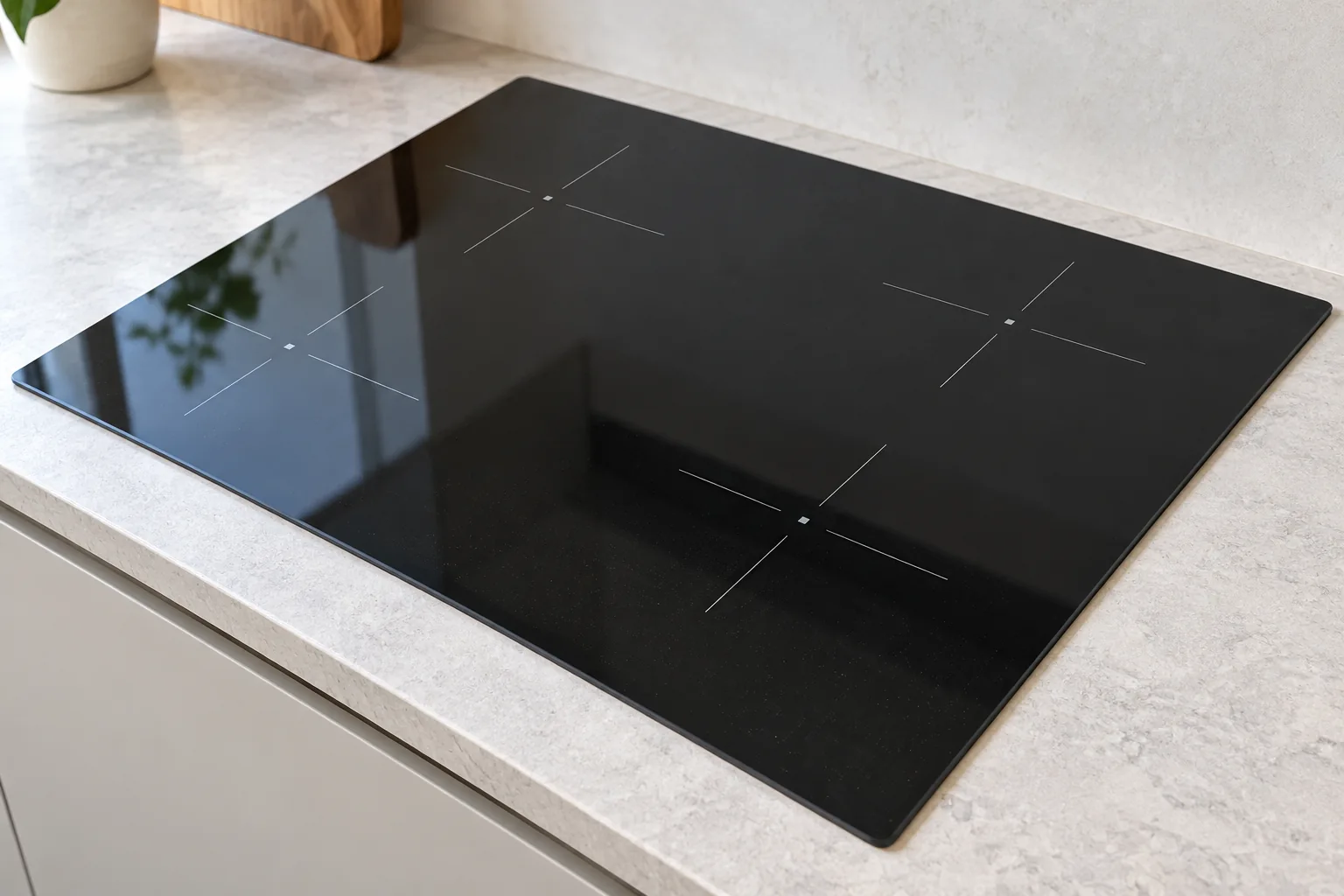
A black glass surface shows an appliance outline and perhaps printed cooking zones. It does not reveal the model’s cookware conditions or the construction underneath. Keep the visible surface and the appliance documents together, while recognising that each answers a different question about the proposed order.
The purchasing comparison starts with a real appliance choice, rather than a photograph of a finished kitchenette. A portable unit and a built-in hob are separate offers even when both have a dark top. Their appearance alone cannot establish the heating technology, the applicable vessel requirements or whether a particular piece has been assessed for them.
If the cooking-room equipment is still being selected, describe the cookware order as conditional. There is little benefit in deciding the entire pan collection around an appliance that the project may replace. Equally, a supplier’s attractive room illustration should not become evidence that the photographed equipment is included in the quoted building.
The K-house room and equipment brief helps establish that broader project context. Within it, the narrower cookware question is what the actual appliance needs from an individual vessel. The answer should survive a change in sales photograph, room finish or supplier catalogue layout.
This article stops at documentary and physical purchasing comparisons. Appliance services belong in the separate utility-interface discussion. No cookware label settles those installation questions, and no room plan can turn incomplete pan information into a confirmed match.
Read the size as a measurement of a particular object

The open mouth, sloping sidewall and long handle belong to the visible upper outline of a frying pan. The underside remains hidden in this view. A diameter attached to the product name therefore needs its own field definition before it can be compared with another dimension.
A circular vessel can have several relevant outlines. The rim describes the opening at the top. The body may widen or narrow below it. The flat region touching a cooking surface is another object, while the handle projects beyond all of those circles. Calling every one of these dimensions “pan size” makes the offer easier to read but harder to compare.
Imagine two proposed frying pans carrying the same nominal size. That shared label is not enough information to say that their contact bottoms are equal. Conversely, different upper openings do not by themselves establish different contact-bottom diameters. These are statements about what the description leaves unknown, rather than assumptions that either pair must differ.
Bosch’s Spanish listing for 12056797 / HEZ9CF280 explicitly identifies a 28 cm mouth and a 22 cm base. Keeping both numbers with their names is more useful than shortening the entry to “28 cm pan.” The page also says that it replaces 17006185; an older item code should remain distinguishable from the currently offered replacement.
The practical enquiry is which physical boundary the quoted number describes. If a drawing and a written description use different words, resolve the relationship before treating their values as comparable. A photograph may help identify the object being discussed, but perspective and the absence of a scale prevent it from supplying a missing specification.
Preserve that meaning when a quotation is reformatted. A column called “diameter” can accidentally erase the distinction established in the original source. A clear offer retains the manufacturer’s field and unit, allowing the buyer to see whether the question concerns the upper opening or the contact bottom.
A visible bottom is not a map of the magnetic area

An underside photograph can make the physical base and its surrounding edge easier to discuss. It cannot identify a hidden material layer or establish the extent of a magnetic area. Use the picture to clarify the visible object, while leaving the unshown construction to appropriate product information.
The four objects in this comparison are the top or rim, the physical contact bottom, the ferromagnetic area relevant to induction, and the selected hob’s recognition conditions. They should not be collapsed into one circle. Each belongs to a different part of the explanation, even when a particular product happens to give some of them similar dimensions.
The historical US Bosch NIT8668SUC / NIT8668UC manual, document 9001096104_H, explains that some cookware bases are only partly ferromagnetic. Its pan-detection paragraph relates recognition to the diameter of that area and the base material. This supports a model-specific distinction between visible bottom geometry and detection; it does not provide a universal minimum diameter for other appliances.
An offer may state the physical bottom diameter clearly while saying nothing about the relevant magnetic area. That missing field is not permission to assume that the full bottom has the same properties. Nor is an embossed ring or a different-coloured finish a measurement of the hidden construction. An attractive underside picture can still leave the decisive technical question open.
The resulting buying decision can be deliberately limited. Retain the bottom dimension as a physical specification and obtain the supplier’s explanation of applicability to the selected appliance. Do not convert uncertainty into a calculated base-to-zone ratio. A ratio made from the wrong two objects would look precise while answering a different question.
Printed zone markings on a hob present another possible confusion. They are visible features on a surface, not an inspection of an internal coil. Comparing a pan photograph with those markings cannot establish the hidden geometry or prove that a proposed combination will be recognised.
Keep the body material and the relevant base construction separate
Material names often dominate a kitchenware quotation because they are familiar and easy to compare. They still need context. A word describing the vessel body does not automatically describe every component or every function of its bottom, particularly when the offer involves induction compatibility.
Tefal’s Middle East product page for the UNLIMITED 20 cm stewpot G2554422 lists an aluminium body, induction among its stated heat sources, and a 17.4 cm contact bottom. That identified example prevents a blanket conclusion that every aluminium-bodied vessel is unsuitable for induction. It does not disclose the diameter of its magnetic area or confirm a pairing with another maker’s hob.
The useful interpretation is narrower than either a positive or negative rule about an entire material family. Read the actual product description as a combination of fields. A general statement about the body and a more specific statement about the intended heat source can coexist without being interchangeable.
IKEA Sweden’s induction-compatibility guidance discusses magnetic materials, special undersides and an induction symbol. These are useful screening concepts. They do not supply a selected hob’s missing conditions or turn an unverified vessel into a tested combination.
For the buyer, the next question is whether the offer identifies an actual item or merely repeats a material category. “Induction-compatible stainless steel” should lead to a particular vessel description. It should not become a substitute for the distinctions between its upper size, bottom geometry and the requirements of the selected appliance.
Ask which part of compatibility the evidence actually answers
A broad compatibility statement can answer a useful question without answering every question. The purchasing task is to keep that supported meaning intact. Treating preliminary evidence as complete proof can conceal the very information that would explain a mismatch between an offered vessel and the chosen hob.
The same historical Bosch manual distinguishes the manufacturer’s usual upper diameter from the base diameter, then discusses model-specific pan detection. Its 2018 US-model context matters. It is an explanatory example, rather than a current instruction for every installation or a reason to transfer one appliance’s conditions to another.
A vessel being recognised and a vessel being suitable for every intended cooking task are different propositions. This guide does not assess cooking results. Its narrower conclusion is that a recognition statement should remain a recognition statement; it must not quietly become a promise about uniform heating, efficiency, service life or performance across a mixed set.
When a supplier gives a general answer, identify the unresolved part without demanding an invented number. The missing information might be the product variant, the field definition or the scope of the compatibility statement. Clarifying which uncertainty remains makes a follow-up enquiry more useful than asking for an unexplained assurance that the pan is “good.”
The table below separates those questions. It is a purchasing interpretation, not a standard or an operating procedure.
| Evidence available | What it can establish | What it leaves open |
|---|---|---|
| Selected hob identity and applicable instructions | Which appliance and documented conditions the order must address | Whether an unidentified offered pan meets those conditions |
| Pan SKU and stated heat-source suitability | Which individual product and intended heat sources the supplier describes | Missing dimensions or a project-specific approved pairing |
| Named size with an explicit rim or bottom field | The particular physical dimension given in the source | The extent or construction of any unreported magnetic area |
| A visible underside or induction marking | The appearance or stated design intention shown | Hidden construction, measured recognition limits or cooking performance |
A set name does not make its pieces geometrically equivalent

A shallow pan, a taller vessel and their lids present visibly different shapes even when they belong to one sales collection. Keep those objects distinct in the proposed order. A common finish or matching handle style does not give every piece the same upper opening, bottom or storage outline.
Bosch Ireland’s 17005722 / HEZ9SE060 six-piece listing gives separate top and bottom diameters for its individual pieces. One listed frying pan has a 24 cm top and an 18 cm bottom. This is a specific set member, not a pot, and not a specification for every pan bearing the same nominal size.
A package can be convenient while still requiring individual decisions. The largest piece is not a representative sample of every smaller piece. Equally, a statement attached to one named vessel should not drift across the whole order merely because the products appear together in a photograph or share a collection name.
The examples below retain the original measurement labels. Their differences explain why the field names matter; they are not a comparison of quality or a recommended shopping list. The figures come from different external products and markets, so there is no defensible efficiency ranking to calculate from them.
For an actual mixed order, work through the pieces that will be supplied. Identify whether a lid is associated with a particular vessel and whether a separately offered replacement preserves the intended relationship. A description of the complete package should make those individual identities easier to understand, rather than replacing them.
| External product and market | Upper or nominal field | Physical bottom field | Limit of this example |
|---|---|---|---|
| Bosch Spain 12056797 / HEZ9CF280 frying pan | 28 cm mouth | 22 cm base | Current listing replaces17006185; not magnetic-area data |
| Bosch Ireland 17005722 / HEZ9SE060 set, one frying pan | 24 cm top | 18 cm bottom | One identified set member; not a pot or a whole-set test |
| Tefal Middle East G2554422 stewpot | 20 cm nominal diameter | 17.4 cm contact bottom | Physical contact field; magnetic-area diameter not stated |
Include the handles in the empty-item outline

A long handle and an opposite helper handle extend the object beyond its round opening. That complete outline matters when the empty vessel is being stored or compared with a proposed cupboard. The visible body diameter alone cannot describe the space occupied by both projections.
Treat the lid as its own object
The storage question begins where the round-size description stops. A pot can have enough space around its body while its handle reaches a drawer front or another object. A lid adds another separate outline. This is a physical arrangement question for the actual empty items, not a conclusion about cabinet loading or the appliance beneath them.
Preserve the distinction in the furnished room layout. A line representing a cupboard does not show how the offered cookware occupies its interior. Ask for the actual empty-item arrangement relevant to that storage position, including any lid or projecting handle that will remain with it.
There is no universal allowance in this guide for the space around a vessel. The necessary comparison depends on the actual items and the actual storage shape. A compact round body with a long handle can present a different problem from a wider two-handle vessel; neither can be reduced to a ranking based only on diameter.
A proposed stacking arrangement also deserves its own description. The outer shape of the combined objects is what the buyer needs to understand. Do not infer that different pieces nest neatly because a photograph shows them grouped on an open worktop, or assume that a marketing claim about storage answers a particular cupboard question.
A handle’s direction in a product photograph can further conceal its projection. Request the item’s complete outline, rather than estimating the missing end from a cropped catalogue view.
Separate neighbouring-pan space from appliance recognition

Two vessels beside each other introduce relationships that a single top diameter cannot show. Their bodies, rims and handles occupy different parts of the surrounding space. A static photograph can explain that distinction, but it does not demonstrate operating clearances, simultaneous heating or recognition of the proposed combination.
A buyer may need to understand both the individual match and the intended arrangement. Those questions should remain separate in a discussion of a shared cooking room. A vessel can have a documented intended heat source while the proposed collection still contains awkward combinations of outlines for that room.
Use the actual intended selection when discussing neighbouring objects. The fact that one small vessel is shown beside another does not establish the arrangement for two larger pieces, or for a long-handled item substituted later. The purchasing question is which combination the offer is actually describing, rather than how many zones are marked on the appliance surface.
The shared-facility accommodation brief can establish who the room is intended to serve. It cannot set a universal cookware quantity or turn a staged surface arrangement into an operating recommendation. Those broader choices need the actual room and service brief.
Keep any visual comparison honest about its limits. An unlit illustrative scene can show that a handle has an outline; it cannot establish a safe clearance, an acceptable load or a completed appliance assessment. Those conclusions require applicable information beyond a photograph. The same limitation applies when the photograph looks particularly tidy or professional.
A replacement offer can change more than the pan label

A separate portable appliance and a two-handle pot remain two different objects in an offer. Showing them together does not establish the heating technology or confirm compatibility. If the appliance changes, revisit the applicable vessel conditions instead of carrying forward a conclusion made for the previous selection.
The same principle applies to a replacement pan. A matching nominal size may preserve the upper opening while leaving another dimension or field unresolved. A similar-looking underside may still be an inadequate basis for identifying the offered product. Retain the reason the original item was selected, so that a proposed alternative can be compared on that point.
Consider what the substitution actually changes. It might alter the vessel identity, the set contents, a handle projection or the selected appliance itself. These are different changes. A useful response addresses the changed relationship without forcing unrelated parts of the order back through a generic approval exercise.
The table below is a way to focus that enquiry. It is deliberately qualitative: no invented quantities, clearances, cooking temperatures or performance scores are needed. If the information remains unavailable, the order can record that limitation rather than creating a guarantee from the word “equivalent.”
| Proposed change | Information needed for the comparison | Separate physical or scope question |
|---|---|---|
| Different pan with the same named size | Actual item and original size-field meanings | Do its handles and any associated lid change the empty-item outline? |
| Different member of a cookware collection | Its own stated suitability and dimensions | Is the intended lid or other piece still part of the offered package? |
| Alternative hob or portable unit | That appliance’s identity and applicable cookware conditions | Does the building order include this equipment, or only the room provision? |
| Changed storage arrangement | Actual empty vessel, lid and handle envelope | Is the proposed grouping shown as it will actually be stored? |
Make the order describe the pieces you have actually chosen
A useful kitchenware order preserves distinctions rather than concealing them under a broader label. Keep the actual appliance, each vessel’s identity and the meaning of its size fields visible. Record unresolved questions as unresolved, especially where a missing magnetic-area or appliance condition cannot be supplied by a photograph.
The written building-package inclusion list remains the place to distinguish the room, appliance and kitchenware supplier scopes. A complete pan enquiry does not silently add equipment to a building contract. Keeping that boundary clear makes the narrower compatibility discussion easier to resolve with the appropriate supplier.
The outcome is an order that says what the buyer means by a particular piece, why that piece was considered for the chosen appliance, and which separate storage relationship has been discussed. It does not promise a universal best set. It gives the next person enough precise information to continue the same comparison without guessing which circle, material word or sales photograph the original decision referred to.
Sources and scope
- Bosch NIT8668SUC / NIT8668UC Use and Care Manual, 9001096104_H. US-model example, copyright 2018, printed/PDF pages 8–9; upper/base distinction and model-specific pan detection. Not current instructions for an unidentified appliance.
- Bosch Spain: 12056797 / HEZ9CF280. Named mouth/base fields and replacement17006185. External catalogue example, not a PQSE specification or pair approval.
- Bosch Ireland: 17005722 / HEZ9SE060. One listed frying-pan member,24 cm top/18 cm bottom. Different products are not compared as performance results.
- Tefal Middle East: UNLIMITED 20 CM G2554422. Body-material, stated heat-source and physical contact-bottom fields. No magnetic-area diameter or tested pairing established.
- IKEA Sweden: induction-compatibility guidance. General material/underside and marking explanation only; no testing procedure reproduced.
- Stilfehler: California Kitchen Cooktop 1 — photographic reference. Original under CC BY-SA 4.0. The corresponding bare-hob illustration is AI-reconstructed with a changed setting, appearance and composition and is offered under that same licence. This applies only to that image, not the article or other images; no endorsement.
- Jim Stonos: Stainless Steel Frying Pan — photographic reference. Original under CC BY-SA 4.0. The corresponding empty-pan-mouth illustration is AI-reconstructed with a changed setting, appearance and composition and is offered under that same licence. Only that image has this share-alike notice; no endorsement.
- Didriks: All-Clad Copper Core pots — photographic reference. Original by Didriks from Cambridge, MA, USA, CC BY 2.0. The mixed-vessel illustration reconstructs the setting, appearance and composition; it does not reproduce an identified catalogue set or imply endorsement.
- Foto: Jonn Leffmann / Wikipedia: frying-pan underside — photographic reference. Original under CC BY 4.0. The underside illustration reconstructs appearance, setting and composition and removes brand marks; it is not the original product photograph or an endorsement.
- Ambrosia10: Stewed apples in saucepan — photographic reference. Source dedicated under CC0. Only the visible long/helper-handle geometry informed a newly reconstructed empty-vessel illustration; source food and cooking activity are not represented as a trial.
- cottonbro studio: photographic reference, Pexels 4253132. Under the Pexels License. The adjacent-vessel illustration reconstructs the scene as empty and unoccupied, with changed composition. No actual cooking, operator action or project claim.
- Anna Tarazevich: photographic reference, Pexels 6035337. Under the Pexels License. The portable-unit/two-handle-pot illustration changes setting, appearance and composition; the source has no lid and does not identify a confirmed compatible pairing.
This is a document-based procurement guide. Published manufacturer data have been checked for their identified products and markets; PQSE House has not conducted a pan-and-hob trial for this article. Photos are independently new AI-reconstructed illustrations guided by the corresponding genuine reference photographs, not records of a PQSE kitchen, commissioned appliance or measured fit. The exterior reference comes from a user-authorised supplier archive; its folder does not establish a PQSE project or K-type model identity. Sources retain their individual rights and the image-specific notices above; there is no blanket CC0 licence. No engineer sign-off, personal cooking experience or independent brand endorsement is claimed.