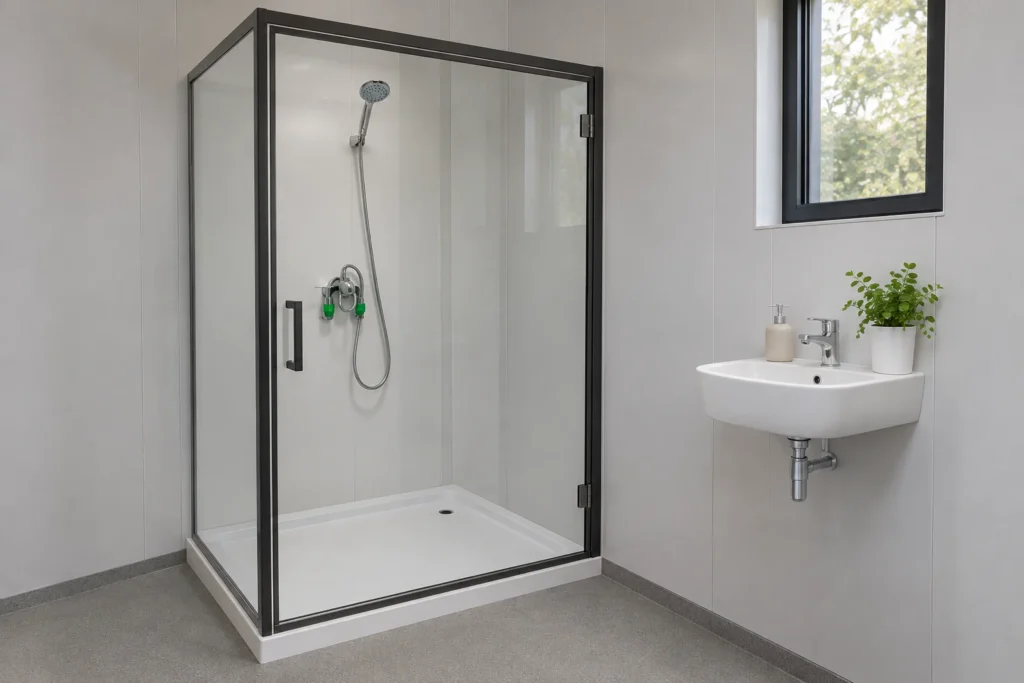
Choose portable-toilet paper and soap refills by matching an exact refill article to the actual dispenser and its documented configuration. Start with the equipment identity, then check the relevant dimensions or manufacturer system and the evidence connecting the two products. A familiar brand, a similar bottle or the word jumbo does not complete that match.
This matters when a buyer orders opening supplies before the washroom arrives, or when an operator receives a cheaper substitute for an existing fitting. The building supplier, consumables seller and service team may each describe a different part of the purchase. For a portable toilet project package, establish which dispenser is actually included before treating a refill quotation as ready to order.
The guide below concerns purchasing evidence, rather than loading instructions or a physical compatibility test. Named manufacturer products illustrate how to read records; they are not established PQSE configurations. The practical outcome is an order that identifies the fitting, the refill and who must resolve any missing evidence before that line is released.
Read the fitting identity before the washroom description

Look at the particular fitting that will receive the refill. A room photograph can show where a dispenser sits without revealing its model or configuration. Keep the room identifier, the equipment identifier and the manufacturer's article reference separate. Together they make a useful starting record; none of them should be inferred from the name of the building alone.
For a proposed installation, ask for the selected dispenser reference as part of the fitting schedule. If the equipment has not been selected, describe the refill order as awaiting selection rather than filling the gap with a commonly available item. That wording matters: it prevents an unconfirmed consumable from quietly becoming the basis on which someone later chooses the fitting.
For an existing room, a photograph of the exterior and any accessible identification label can help connect the physical item to its paperwork. A photograph of a closed cover is not evidence of the internal arrangement. If the label is missing or unclear, send that uncertainty to the equipment provider. Do not let an office description such as white soap unit become a substitute for an identified product.
A combined portable bathroom unit may contain more than one kind of fitting. Organize the record by actual location and function, so a paper item for one room is not assumed to serve every cubicle. The aim is a traceable equipment list, not a longer list of loosely described supplies.
Separate the three dimensions of a paper roll

An unwrapped roll makes the geometry easier to discuss. Its paper width runs along the cylinder, its outer diameter crosses the paper end face, and its core is the central opening. These describe different parts of the same object. A buying conversation becomes clearer when each value is named instead of asking whether the roll is simply the right size.
For one concrete example, Tork's GB record for article 110246 identifies the T1 system and the roll fields below. These are manufacturer data for that article, not a PQSE dispenser specification or a universal fitting rule.
The receiving question is therefore not just whether the package looks smaller than the enclosure. The buyer needs a record that relates the roll to the selected holder's requirements. A photograph may distinguish a cardboard core from the wound paper, but it cannot supply an accurate measurement or reveal what is behind a closed dispenser cover. Keep the physical observations separate from the dimensional evidence.
When comparing a seller's sheet with an equipment document, name the object being measured on each side. A roll dimension, a cabinet dimension and a transport-package dimension may all be presented as width. They are not interchangeable fields. A note that says which object each value describes is more useful than three unexplained numbers copied into a purchasing spreadsheet.
Retain the original unit with every transcribed value. If a working comparison needs a conversion, keep the source value alongside the calculation instead of replacing it. The person reviewing the file can then distinguish a manufacturer field from a buyer's arithmetic. Converting a unit does not create an allowed tolerance or settle whether the equipment document describes the same object.
| Roll field | Published value | Different question |
|---|---|---|
| Width | 9 cm | Axial paper breadth |
| Outer diameter | 26.50 cm | Outside of wound paper |
| Core inner diameter | 7.50 cm | Central opening |
Keep the wrapped pack separate from the single refill

A wrapped pack and a loose roll answer different purchasing questions. The pack helps identify what arrives and how the seller describes the delivery unit. The loose roll shows the item intended for the fitting. Preserve that distinction when an offer, purchase order and delivery label use different names for what appears to be the same supply.
Write the ordering unit explicitly: the particular refill, the seller's unit of sale and the quantity being purchased. Do not use a delivery-carton dimension to complete a missing roll dimension. Equally, do not assume that the quantity printed beside a product is the quantity in every level of packaging. When the quotation is ambiguous, have the seller identify the line it is pricing before comparing totals.
Retain a link between the article reference in the accepted offer and the identification expected on delivery. Product descriptions can be shortened between systems: an invoice might use a brief trade name while the equipment file uses a manufacturer's full designation. Ask for the cross-reference in writing. A buyer should not need to recognize the shape of a wrapped pack to decide which order line it fulfils.
This also makes changes visible. If an item is split into smaller sale units, or the seller proposes another packaged article, the revised offer should identify what changed. The same total number of packages is not enough to show that the original request has been met. Treat price comparison and product matching as separate decisions, then connect them through the exact accepted line.
A model number does not erase a configuration conflict

A familiar model number is useful, but it does not resolve every document question. Keep the applicable configuration and the source record together. When two manufacturer documents appear to disagree, preserve both statements and ask which governs the actual fitting. Choosing the more convenient value would turn an unresolved purchasing question into an unsupported instruction for the operator.
Leave the disputed line open
Bobrick's B-2890 technical sheet marked r4/11/23 specifies a maximum roll outer diameter of 255 mm and a 38 mm core configuration. Its undated international catalogue describes a spindle for one roll of 254 mm outer diameter and a 41 mm core configuration. Other configurations also appear. The 38/41 mm conflict remains unresolved; neither record establishes a universal fitting range.
In an actual purchase, send the conflicting pages with the equipment identification and ask the responsible manufacturer or provider for an applicable response. Preserve the reference used in that response. A statement that an item is standard does not tell the recipient which document was accepted, whether the existing configuration was considered, or what remains to be verified before a substitute can be ordered.
Do not turn this document review into an instruction to alter a fitting. If the provider says that a configuration change is needed, that becomes a separate authorized service question with its own applicable instructions. The practical access needed for such work belongs in the bathroom maintenance-access review. A refill purchasing guide cannot approve the alteration or make the necessary access appear.
Describe the soap article as precisely as the dispenser
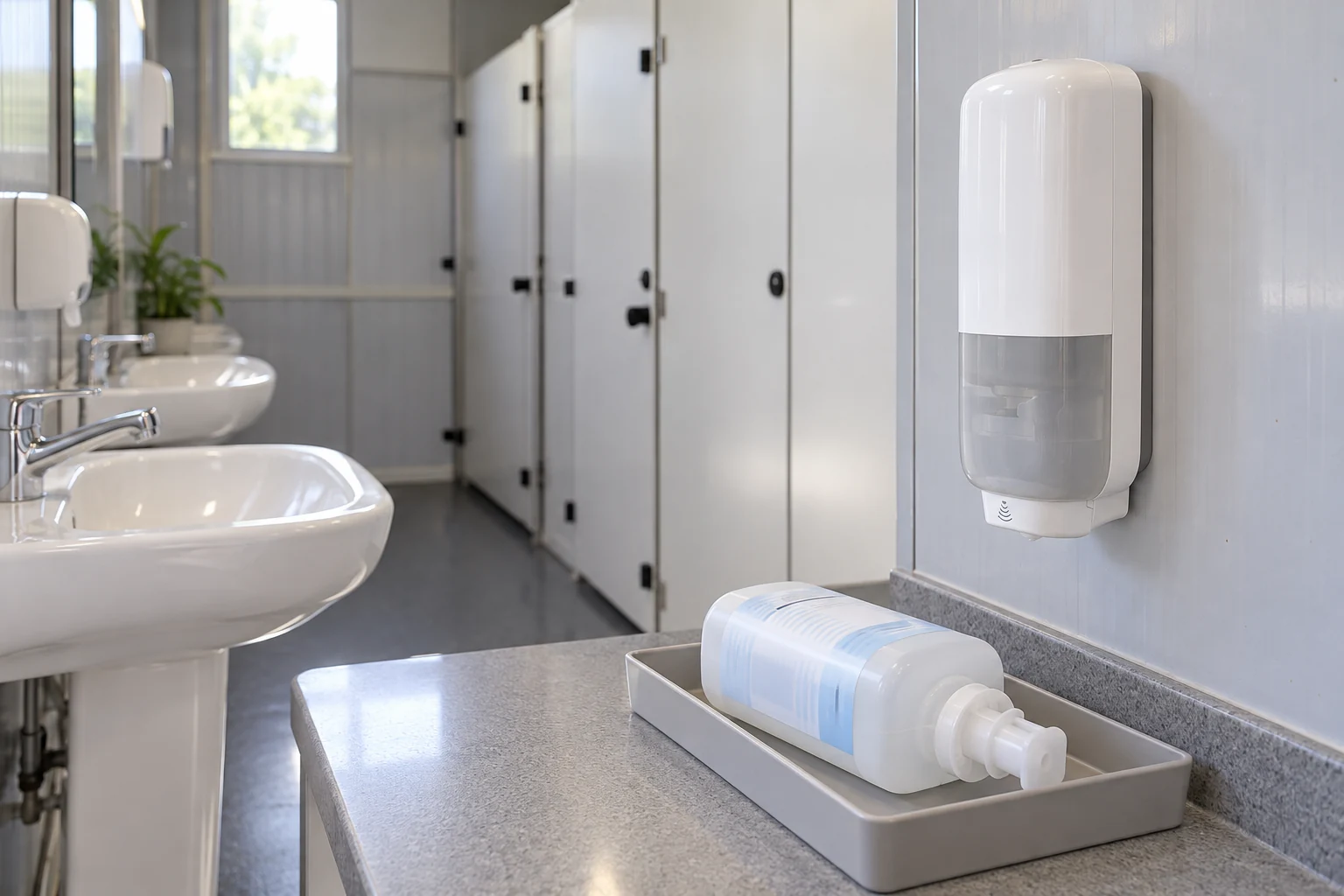
Put the proposed soap refill and the installed dispenser on the same request, but give each its own identity. A bottle's appearance, a seller's generic soap description and the dispenser's operating style are different pieces of information. The purchase should connect an exact refill article to applicable manufacturer evidence, rather than asking the recipient to make that connection from a photograph.
The two GB records below identify different articles: 520501 and 420501. No liquid fill capacity is adopted from the read records. A delivery volume in dm3 is not reported here as bottle capacity.
A useful enquiry retains the distinction between what the seller calls the contents and which article it is offering. If an offer changes either, obtain a revised identity and the corresponding match evidence. Do not describe the replacement as accepted while the recipient is still trying to establish what it is. That is an unresolved line item, even when the quotation is otherwise complete.
Keep a missing field visible instead of borrowing it from a nearby product. This is especially relevant when several product pages share photographs or similar names. The absence of an adopted value in this guide is not a specification for the product; it means that value has not been established within the evidence used here. Obtain the needed selected-article information before making a decision that depends on it.
| Article | Listed type | System | Per case | Liquid capacity adopted |
|---|---|---|---|---|
| 520501 | Foam soap | S4 | 6 | Not established |
| 420501 | Liquid soap | S1 | 6 | Not established |
Read what a named manufacturer match actually establishes

A manufacturer reference connecting identified products is more useful than a seller's broad compatible description. Read the actual model names and the particular refill article to which the statement belongs. Keep a copy or location of that evidence with the order. It should remain understandable after a page layout changes or a colleague takes over the purchase.
The 110246 page lists 246040, 554000 and 554008 as named dispenser matches. This is a manufacturer-specific list, not permission to use another brand's holder.
The 520501 page names 561600, a sensor model, and 564100, an arm-lever model, among its matches. Those entries show why the operating-style label alone should not replace reading the actual listed pairing.
Read the direction of the evidence carefully. A page identifying a refill and named fittings supports that stated relationship within its scope. It does not necessarily answer whether an unlisted substitute is suitable, whether the local equipment has been changed, or whether a similarly numbered product in another market is the same article. These are additional questions, not conclusions to infer from a short list.
For a proposed substitute, ask the seller to point to evidence connecting that substitute to the selected equipment. If the response only repeats the original product's page, the proposed change remains unexplained. A useful reply identifies the new article and the basis for accepting it, with any unresolved limitations stated. The purchasing file should make clear whether the responsible party has answered the substitution question or merely identified the existing supply.
Keep the document identity as well as its link. A saved response should show the products and scope actually considered, not just send a future colleague to a supplier homepage. If the linked page later describes a different selection, that colleague needs enough context to recognize the difference. This preserves the decision's basis without pretending that a past page proves every later purchase.
Treat a substitute as a proposed change to the order
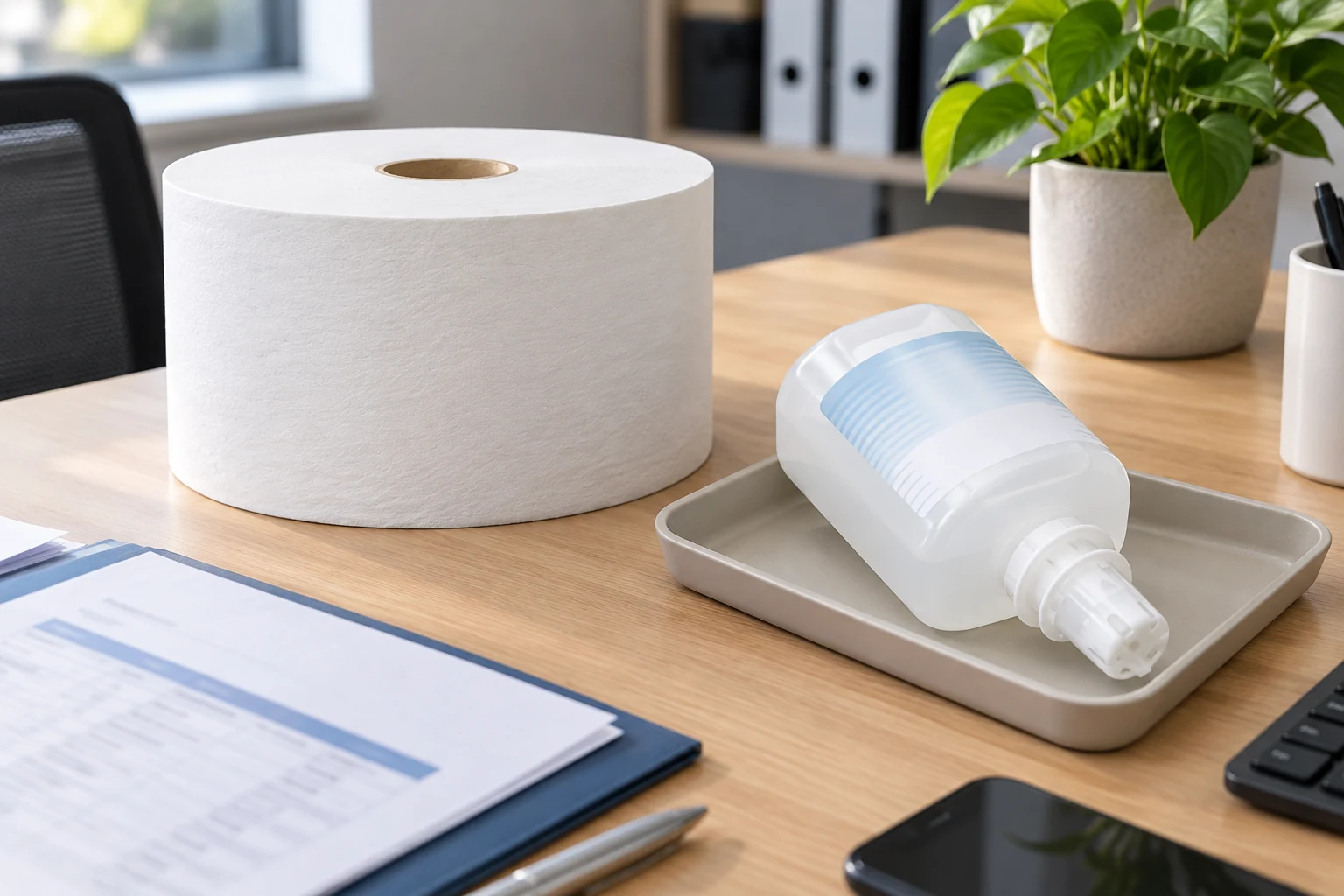
A substitute can be commercially attractive without yet being sufficiently identified. Keep its proposed status visible while the evidence is reviewed. The comparison should state what is changing, which existing equipment it is intended to serve and who will accept the change. A lower price is a reason to examine an offer, not a completed answer about the fitting.
Consider a hypothetical quote that offers an equivalent refill without an article reference. Returning only a request for more detail leaves the seller guessing about the missing evidence. Instead, name the absent identity, attach the relevant equipment record and ask for the proposed pairing basis. The question becomes specific enough to answer: which replacement is being offered for this fitting, and what supports that proposal?
Separate a purchasing decision from an operational evaluation. If a responsible party requires a sample review, agree its scope and who may conduct it before the sample is used. A delivery of samples is not an acceptance result. Record the outcome actually obtained, including limits, rather than changing the order description to approved because someone has received a box.
The point of the table below is to locate the missing decision, not to rank brands. An incomplete response may justify pausing only the affected line while the rest of a quotation proceeds. That is more precise than rejecting an entire building package or releasing all consumables together because the opening date is close. Keep the unresolved product out of the accepted schedule until the stated decision is made.
| Situation | Evidence to obtain | Decision still open |
|---|---|---|
| Fitting identity unknown | Identified equipment record tied to the actual location | Which product the refill must serve |
| Manufacturer documents disagree | Applicable response identifying the governing record and configuration | Which requirement to apply |
| Substitute offered | Exact replacement article and relevant pairing evidence | Whether to accept the proposed change |
| Sample received | Recorded evaluation scope, responsible party and actual outcome | Whether evidence is sufficient to release the line |
Make the refill decision survive the purchase order

An accepted match can be lost when the purchase order drops the identifying detail. Carry the agreed dispenser, refill article, sale unit and evidence reference into the line that is actually being ordered. Identify any excluded supply or unresolved decision alongside it. The person receiving the delivery should not have to reconstruct acceptance from an earlier conversation.
In a worker-camp accommodation project, building procurement and later operating supplies may be handled by different teams. Assign who selects the fittings, who orders the first consumables and who receives the applicable documents. These roles can be held by different organizations. What matters for this purchase is that the point of responsibility does not disappear between their scopes.
Check the schedule of supplied components and local responsibilities rather than assuming that a complete-looking room includes every opening supply. The agreement might cover the dispenser, the refill, both or neither. Record the actual arrangement for the selected order. This guide does not promise that a particular brand or quantity forms part of a standard PQSE package.
If selection remains open, use a clearly pending line with the person and information needed to close it. If a substitute is accepted later, retain its relationship to the original request and update the active line. Otherwise two accurate documents can still direct different purchases: one describes the initial selection, while another quietly records the replacement without saying it supersedes that selection.
Ask whether the quoted consumable is a selected product or merely an allowance awaiting a later choice. An allowance can be useful commercially, but it does not identify a refill. Keep that distinction in the order so the destination team can see whether it must complete selection, place a separate purchase, or receive a supply already specified by another party.
Receive the supplied article before releasing it to routine use

At receipt, compare the delivered identification with the accepted order rather than with a general expectation of what washroom supplies look like. Keep unexpected or unclear products connected to the affected line and the person resolving it. A delivery can be physically complete while the identity question remains open. Those are different statuses and should remain distinguishable in the receiving record.
The receiving record should allow another person to locate the relevant product and see what was accepted. Record the visible identification and any discrepancy without inventing a reason for it. A changed label may need clarification; a similar pack may be a different article. Neither observation alone establishes a fault, a counterfeit product or a compatible replacement. The supplier's explanation still needs to address the actual discrepancy.
Keep old stock identifiable when equipment changes. An unopened package from the previous arrangement should not automatically be relabeled for the new one. Retain the previous association until a responsible person resolves its use or disposition. This is an identity-control recommendation, not an instruction to modify the product, transfer its contents or improvise an interface so that remaining supplies can be consumed.
After the article is accepted, ordinary availability and replenishment become part of the site toilet service plan. Keep that ongoing service decision separate from the initial pairing evidence. A well-filled cupboard does not answer whether the supply belongs with the fitting, and a documented match does not establish when the site needs another delivery.
Leave the operator a usable match record, not a brand nickname

The operator needs to recognize the accepted supply without depending on the original buyer's memory. Hand over the fitting identity, refill reference, applicable evidence and the route for unresolved substitutions. Keep that record near the operating information for the actual facility. It should explain what is known and where a proposed change returns for a decision, without pretending to replace manufacturer instructions.
Reopen the match when the equipment changes
Give the operator a location-specific record naming the dispenser, the accepted refill article and the document used to connect them. Keep the supplier's unresolved qualifications with that record. A brief operating description can help someone locate the fitting, but it does not replace its identity. Avoid handing over a nickname or a photograph that no longer matches the equipment in the room.
When a dispenser is replaced, repaired into a different configuration or moved to another room, review the associated supply record. Do not assume that the building's unchanged address means the old pairing still applies. Identify what changed and refer any technical question to the responsible provider. Retain the old record as history, with a clear boundary between that history and the arrangement currently accepted.
For a new enquiry, send the actual fitting references, proposed refill articles, available manufacturer records, any conflicts and the intended purchasing responsibility. State which information is still missing. That gives the recipient a concrete issue to resolve without asking for a blanket compatibility promise. The order is ready when the evidence supports the selected pairing and the relevant parties understand the remaining conditions, not simply when every box on a generic supplies list has a price.
Buyer questions
Can a roll be accepted because its outer diameter is small enough?
That observation answers only one geometric question. Identify the actual dispenser and applicable configuration, then obtain evidence for the proposed refill. Do not infer the core, paper width or manufacturer acceptance from the roll's outside appearance. A purchasing record can document a proposed match, but it cannot substitute for an evaluation that the responsible provider says is necessary.
Does a similar bottle mean two soap refills are interchangeable?
No match is established by appearance alone. Keep the exact refill identity and the selected dispenser reference together, and ask for evidence covering that pairing. A general description or an unchanged package quantity does not explain a substitution. This guide provides no bottle-capacity estimate, pump modification or universal rule for every product within a soap system.
What should accompany a refill enquiry?
Provide the actual or selected fitting identity and location, the exact proposed refill, the applicable manufacturer records and the particular unresolved question. Distinguish a first purchase from a substitute offer. Identify who makes the acceptance decision and who will receive the resulting record, so the answer can be carried into the purchase order and later operating information.
Sources and scope
- Tork GB 110246. Article specifications and named dispenser list; undated page, read 16 October 2026.
- Bobrick B-2890 technical sheet. Page 2; marked r4/11/23.
- Bobrick international catalogue. Printed page 39; undated; unresolved configuration difference.
- Tork GB 520501. Article identity, system and named matches; undated page, read 16 October 2026.
- Tork GB 420501. Article identity, system and case quantity; undated page, read 16 October 2026.
PQSE House prepared this research-led purchasing guide using the identified manufacturer records and original editorial analysis. The examples are not established PQSE fittings or brand recommendations. No physical pairing test, customer project result, human expert review or project approval is reported. Obtain applicable selected-model information from the responsible provider. Any AI-generated illustrations accompanying this guide explain the purchasing situation; they do not document installed equipment, delivery acceptance or a successful refill test.